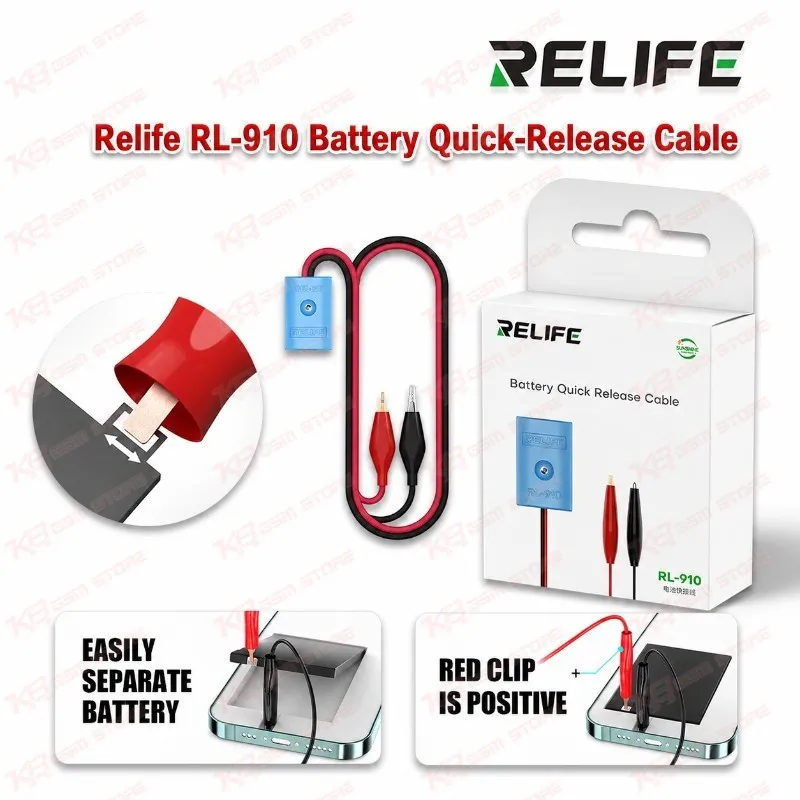
When you are pulling a glued-in battery on a modern iPhone, the last thing you want on your bench is a tool that risks the logic board, and that is exactly the gap the Relife RL-910 Battery Quick-Release Cable closes for technicians working on iPhone 16, 16e, 17, 17 Air, 17 Pro and 17 Pro Max battery jobs. Instead of prying blind or soaking adhesive with solvents that leave residue behind, you clip the red alligator terminal onto the battery's release tab, plug the Type-C end into any USB-C power source, and let the built-in smart chip push a controlled 27V discharge into the adhesive strip. That voltage is not random — the chip regulates it precisely so the cable itself never overheats or short-circuits, which matters when you are working inches away from the battery connector and other sensitive components on the board. The flat-nose clip is shaped to sit flush against the release tab rather than at an awkward angle, and that flat contact area is what pushes the discharge speed up compared to older round-clip cables you may already have on your bench. You get plug-and-play convenience here too, since the Type-C interface pulls power straight from a phone charger, power bank, or laptop port — no coin-cell battery to replace, no separate power brick to carry between jobs. For a repair shop in Pakistan running through multiple battery replacements a day, that convenience adds up fast, because you are not stopping mid-job to hunt for a charged accessory. The cable measures around 205mm, long enough to give you working distance from the board while you handle prying tools with your other hand, and at roughly 11g net weight it barely adds bulk to your kit bag. Compatibility is scoped specifically to the current iPhone lineup using glue-release battery tabs — iPhone 16, 16e, 17, 17 Air, 17 Pro, and 17 Pro Max — so if your workshop is taking in the newer models coming through for battery health complaints or swelling batteries, this cable is built for exactly that workflow. The point of a quick-release cable like the RL-910 is damage prevention as much as speed: pulling a battery without properly softening the adhesive first is one of the more common ways technicians crack a battery cell, bend a mid-frame, or tear a flex cable underneath, and all three of those turn a simple battery job into an expensive comeback. By running a controlled voltage through the adhesive before you start prying, you soften the glue bond evenly across the surface instead of fighting it with brute force in one corner, which keeps the removal residue-free and the surrounding components untouched. This is a tool built for the actual bench workflow — battery diagnosis, adhesive softening, safe separation, and reassembly — rather than a general-purpose accessory, so it earns its place next to your spudgers, suction cups, and heat mats. If your shop already stocks ISP pinout tools, hot air stations, or reballing kits for board-level work, the RL-910 fills the specific gap those tools do not cover: safe mechanical battery removal on glued-in cells. It is a small addition to your kit, but for anyone doing volume battery replacement work on the 16 and 17 series, it directly cuts the risk of board damage and the rework time that comes with it, which is the difference between a clean five-minute battery swap and a comeback job that eats your afternoon.