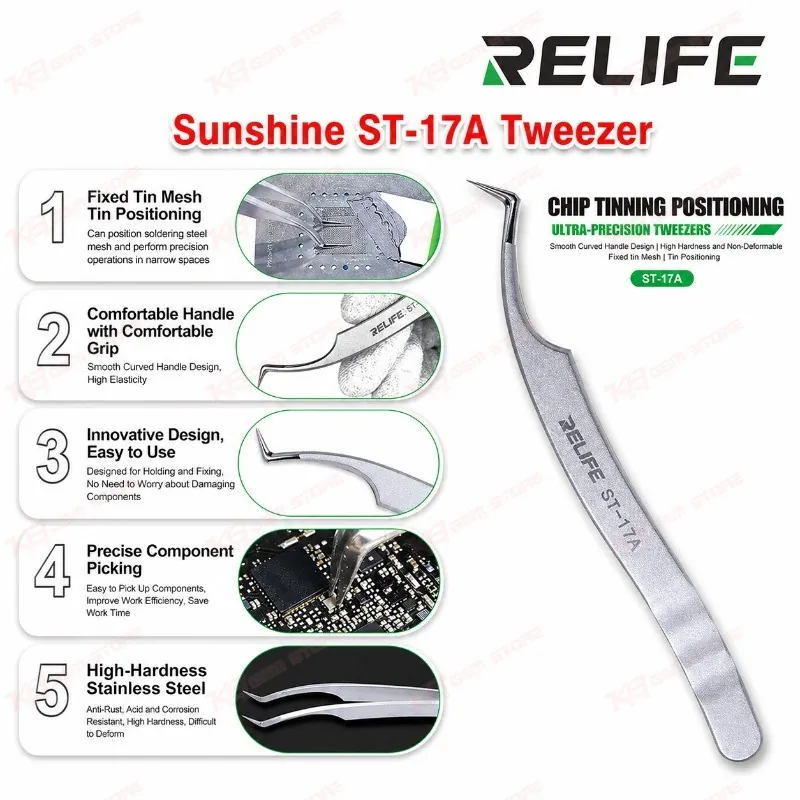
When you're working chip tinning on a phone board, the biggest risk isn't the reflow itself, it's the stencil mesh sliding out of place halfway through the job, and that's exactly the failure point the Relife ST-17A Ultra-Precision Tweezers are built to remove from your workflow. You get a tool designed specifically to hold a tin-plated steel mesh steady in narrow spaces on the board, so the mesh stays aligned with the pads while you apply solder, which matters a lot on tightly packed motherboards where a shifted stencil ruins the tinning pattern and wastes both time and solder paste. The body is forged from high-quality stainless steel that resists rust, acid, and corrosion, which means the tool keeps its shape and grip strength even after repeated contact with cleaning solutions and rosin flux during daily maintenance work, and the tips stay hard and difficult to deform instead of bending out of alignment the way cheaper tweezers do after a few weeks on a busy bench. The handle uses a smooth curved design that reduces hand fatigue during long sessions, so whether you're doing IC change karna on a dead board, picking up tiny SMD components, or holding a chip steady while you check for a hardware fault, your grip stays stable and your hand doesn't cramp up the way it does with flat, sharp-edged tweezers. This kind of precision handling directly supports the broader PCB repair and reballing workflow: technicians reach for the Relife ST-17A when fixing a chip in place before reflow, when removing a damaged IC without disturbing neighboring components, and when positioning fine parts during board cleaning or jumper lagana work, because the fine tip geometry lets you work in the gaps between densely placed components without touching adjacent pads. In a typical Pakistani repair shop, this tweezer sits alongside your hot air station, soldering iron, and microscope as one of the smaller tools that ends up used on nearly every board that comes in for a dead phone, boot loop issue, or charging port fault, since almost every board-level fix at some point needs a steady tool to hold, lift, or position a part while your other hand runs the iron or the hot air gun. Because the tips resist acid and corrosion, you don't have to retire the tool every few months the way you would with a basic tweezer that starts pitting after contact with flux remover, and the anti-rust stainless build keeps the working edge sharp and true through repeated washing and cleaning cycles on the bench. If your workflow already includes an ISP pinout tool, a UFS adapter, or an eMMC programmer for the software side of a repair, the Relife ST-17A fills the hardware-handling gap those tools don't cover, giving you a complete setup that moves from diagnostics through disassembly, chip-level repair, and reassembly without switching between mismatched, low-grade tweezers. Whether you run a single-technician repair counter or a full service center handling volume board work, this tool earns its place in the kit because it does one job, precise tin mesh and component positioning, consistently and without the tip flex or rust issues that shorten the life of cheaper alternatives, and that reliability is what keeps it on the bench of technicians who depend on repeat, board-level repair work as their main source of income.