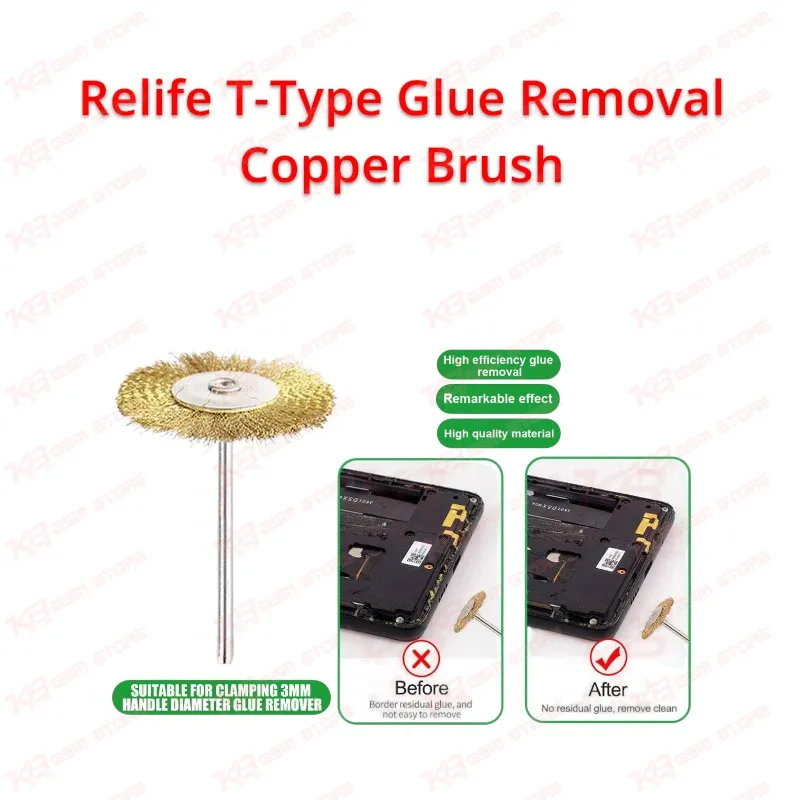
When you're cleaning a motherboard after a chip reflow or scraping dried adhesive off a connector, the brush you reach for matters more than most technicians admit, and the RELIFE T-Type Glue Removal Copper Brush solves a problem you've probably run into with cheaper steel-bristle brushes: micro-scratches on gold pads and solder mask that show up later as intermittent connection faults or corrosion points. Copper bristles sit softer than steel against a PCB, so you get enough abrasive action to break down cured glue, flux residue, and dust buildup around ICs without gouging the copper traces or pad plating underneath, which is exactly why copper brushes have become the safer default choice for board-level cleaning rather than the harder wire brushes technicians used a few years back. The T-shaped handle changes how you actually work — instead of gripping a straight pen-style body and fighting your wrist angle every time you reach a component tucked near a shield or connector, the T-Type layout lets you hold the brush more like a scraping tool, giving you a shorter, more controlled stroke when you're working around a CPU, PMIC, or NAND chip that's still seated on the board. That control matters most during rework: after you lift a chip with hot air, there's almost always a ring of hardened glue or resin left behind on the pads, and dragging a stiff steel brush across that area risks lifting a trace or thinning the copper layer, which is a repair-ending mistake on a board you were trying to save. With this brush, you work the bristles into the residue in short passes, let the copper wire do the mechanical breakdown of the glue without needing heavy downward pressure, and finish with a solvent wipe once the bulk of the adhesive has loosened. It's equally useful on the back side of connectors and battery contacts where dried adhesive or corrosion builds up over time, since the same soft-bristle logic applies — you want abrasion without gouging plated contacts that carry signal or charging current. Technicians handling boot loop boards, charging port failures, or network IC swaps end up using a brush like this constantly, not because it replaces a solvent or an ultrasonic cleaner, but because mechanical cleaning is often the first and fastest step before you apply flux, dry glue remover, or isopropyl alcohol. Keep the RELIFE T-Type Glue Removal Copper Brush on the same shelf as your hot air station and multimeter, because glue and residue removal shows up on nearly every board that comes in for an IC change, a display problem investigation, or a hardware fault diagnosis, and having a dedicated copper brush means you're not reaching for a steel wire brush that was really meant for something rougher, like rust or corrosion on non-electronic metal parts. For a repair shop running high volumes of dead-phone and hang-on-logo cases, that small choice between steel and copper bristles adds up over months of bench work, cutting down on pad damage claims and rework caused by a brush that was too aggressive for the job.