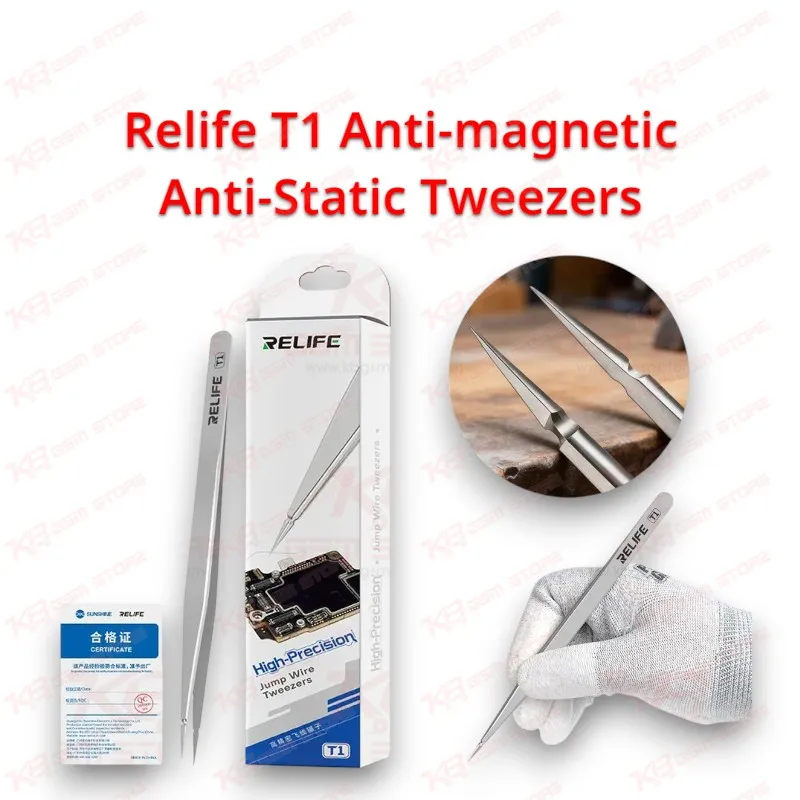
When you open a phone to chase a dead-after-flash fault or a charging issue, the tool you actually touch the most is your tweezer, and the Relife T1 Anti-magnetic Anti-Static Tweezers are built for exactly that kind of repeated, close-up work. The tips come to a fine, needle-like point, so you can lift a lifted IC leg, place a tiny resistor back on its pad, or pull a stubborn flex cable connector without slipping and scratching the board around it. Stainless steel construction gives the tips real stiffness, so they hold their shape after months of jumper lagana and reballing work instead of bending out of alignment the way cheaper tweezers do within weeks. The anti-magnetic property matters more than most technicians realize until they lose it — a magnetized tip pulls at tiny ferrous screws and clips while you're trying to place them precisely, and it can interfere with sensitive components during IC change or board cleaning. Relife engineered the T1 to stay non-magnetic through regular contact with magnetic screwdrivers, holders and mats that sit on the same bench. On top of that, the anti-static coating gives you ESD protection, which is the difference between a component that survives handling and one that dies from a static discharge you never even felt. Boards with exposed CPU, eMMC or PMIC pads are especially vulnerable during software marna and hardware fault diagnosis, so working with a properly anti-static tool isn't optional if you want consistent repair outcomes. The body itself is lightweight but balanced, letting you hold a stable grip through long sessions of screen separation, charging port cleaning or connector pin straightening without your fingers cramping the way they do with heavier or poorly weighted tweezers. A non-slip surface on the handle keeps your grip steady even when your hands are slightly sweaty from working under a hot air station or soldering iron for hours. Corrosion resistance is built into the stainless steel itself, so the tips won't pit or discolor from flux residue, isopropyl alcohol, or the general humidity of a busy repair shop, which means the pointed tip stays sharp and usable far longer than plated or coated alternatives. For technicians who deal with hang on logo issues, network faults, or FRP lock jobs that require opening the device and probing test points, a precise, non-conductive-risk tweezer like the T1 becomes part of the daily toolkit rather than an occasional accessory. It fits naturally alongside your ISP pinout tools, eMMC programmer, hot air station and reballing kit — pick it up for fine IC leg work, then set it down and move straight to your UFS adapter or test box without needing to swap tools for a different tip size. The Relife T1 Anti-magnetic Anti-Static Tweezers are sized for one-hand precision, so whether you're doing pattern unlock hardware work, board-level jumper repair, or basic component placement on entry-level jobs, the tip geometry stays consistent and predictable. Repair shop owners buying in bulk for a service center bench will find the build quality holds up under multiple technicians using the same tool across shifts, and the anti-static property protects the shop's overall component inventory from avoidable ESD losses. If your current tweezer set has gone soft at the tip or started attracting every loose screw on the bench, the T1 is a straightforward, dependable upgrade that fits directly into your existing repair workflow.