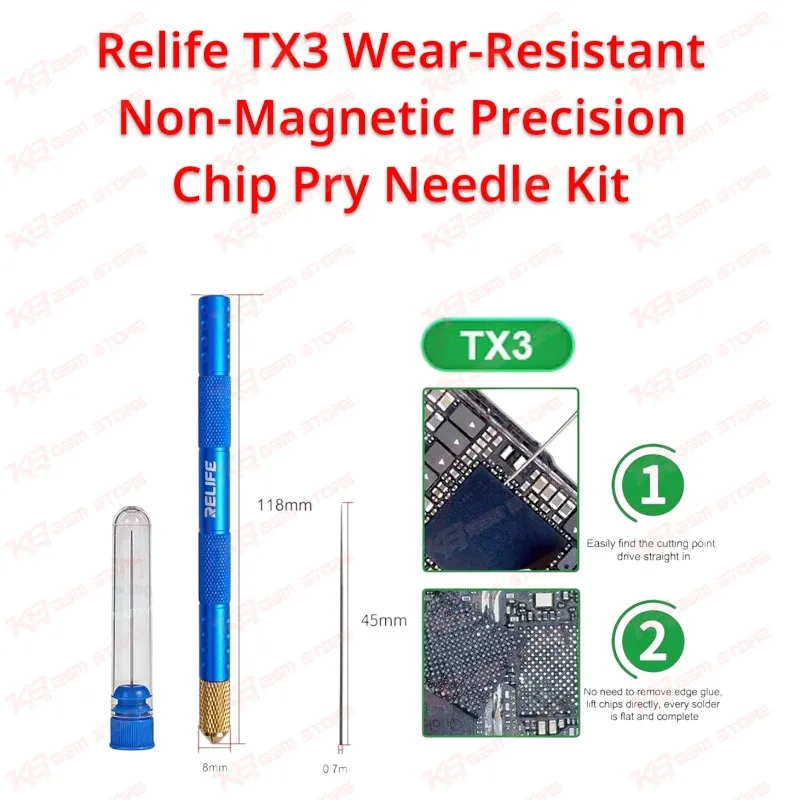
What It Is — The Relife TX3 Wear-Resistant Non-Magnetic Precision Chip Pry Needle Kit is a single-purpose prying tool built for one job: lifting CPUs, ICs, and small soldered components off a circuit board without wrecking the pads underneath, and it earns its place on a technician's bench the first time a board with a stubborn dead-after-flash chip lands in front of you. Build and Feel — The needle tip carries a fine polish that lets it slide under a chip edge instead of catching on it, and because the metal is non-magnetic, you get clean, predictable movement even near sensitive components where a magnetic tip would fight you or risk interference. Toughness matters just as much as finish here — the tip resists rounding off after repeated use on hardened solder joints, so it keeps its edge through weeks of board work rather than dulling after a handful of chip lifts. The handle is machined aluminum, shaped for a grip that stays stable when you're applying steady, controlled pressure instead of a jerky pry that cracks a pad or flicks a chip across the bench. Where It Fits Your Workflow — On a mobile repair bench, this needle sits right between your hot air station and your reballing kit: you heat the joint, then use the Relife TX3 to break the chip free cleanly, whether you're pulling a CPU for reballing, removing a damaged IC before a replacement, or freeing a component that's blocking access during board-level diagnostics. It pairs naturally with microscope work, since the fine tip lets you see exactly where you're applying force, and it complements PCB holders that keep the board steady while you pry. Practical Value on a Pakistani Repair Bench — For technicians handling dead phone boards, boot loop cases, or a board that hangs on logo after a failed flash, this tool answers the hardware side of diagnostics — once software marna and reflashing rule out a firmware fault, board-level work often means pulling a suspect IC to test or replace it, and a clean lift without pad damage is the difference between a quick fix and a board you've turned into scrap. The non-magnetic tip also matters when you're working near sensitive test points or during ISP-mode diagnostics, where stray magnetic interference is the last thing you want on a board you're already troubleshooting. Splatter Control and Safety — Because the needle is shaped to guide a chip up and off rather than gouge underneath it, it helps prevent solder splatter during the lift, which keeps neighboring components clean and cuts down on the cleanup and rework that follows a messy pry job. Storage and Longevity — The kit includes a protective tube that shields the tip when it's not in use, which matters on a busy bench where tools get tossed in a drawer between jobs; keeping the tip covered protects both the tool and whatever else shares that drawer space. Who It's For — This is a bench tool for GSM technicians, hardware repair engineers, and service center staff doing daily CPU and IC work, not a casual accessory — if your repair queue includes board-level faults, reballing prep, or chip-level diagnostics on smartphones and small electronics, the Relife TX3 earns a fixed spot in your tool roll next to your tweezers and spatulas.