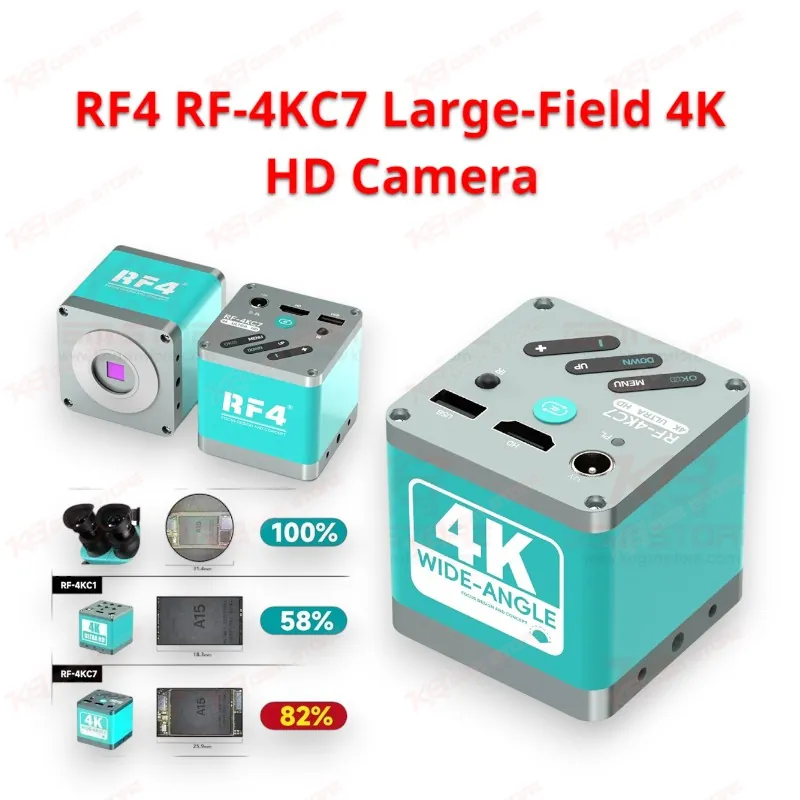
The RF4 RF-4KC7 large-field 4K HD camera solves a problem every chip-level technician runs into on the bench: standard microscope cameras crop the view too tight, forcing you to shift the board constantly while you trace a track or reflow a BGA. RF4 built the RF-4KC7 around an 8-megapixel 1/1.8" Sony color sensor that captures a genuinely wider field at full 3840×2160 4K resolution, so you see more of the board in one frame without losing the fine detail you need to spot a lifted pad, a cold joint, or a hairline crack running under an IC. The camera runs on DC 12V and connects through a C/CS-mount interface, which means it slots directly onto trinocular stereo microscopes already common in Pakistani repair workshops, and it outputs through a standard HDMI port to a monitor or through USB2.0 in UVC mode straight to a laptop, so you can work off a full-size screen instead of squinting through an eyepiece for hours. Key-button operation keeps things simple mid-repair: press to grab a 3840×2160 JPG still of a board layout for your records, or switch to 1920×1080 AVI recording when you want to document a full reballing or jumper-wire job for a customer or for training. Footage and photos save directly to a USB flash drive up to 32GB, and the onboard file management lets you play back stills and video right from the drive without pulling it out to check a computer. The 1-8 group reticle overlay is a genuine workflow feature rather than a gimmick — when you're measuring pad spacing before hand-soldering a fine-pitch IC or checking trace width on a damaged board, having a built-in scale on screen saves you from switching tools mid-job. At 63×63×63mm and roughly half a kilo, the RF-4KC7 mounts without throwing off the balance of most stereo microscope stands, and the package includes the USB cable, HDMI cable, remote control and power cable you need to get it running the same day it arrives. This is the kind of tool that earns its place on a repair bench doing PCB inspection, IC removal and placement, board-level diagnosis on a dead phone, chip reballing, fine soldering and rework, and general quality-control checks before a repaired board goes back to the customer. Because it's a UVC-compliant camera rather than a device-specific tool, the RF4 RF-4KC7 isn't tied to one phone brand or chipset — it works with whatever board is under your microscope, whether that's a Qualcomm-based board, a MediaTek unit, or an Apple logic board, which makes it a practical buy for a service center handling mixed brands rather than a single-device workshop. Technicians moving from a basic 1080P microscope camera to the RF-4KC7 typically notice the difference immediately in board-level work: less time hunting for a dry joint under a narrow field of view, and a clearer still image when you need to zoom into a schematic-matched point on the board. If you're already running ISP or eMMC tools, a soldering station and a hot air rework station on your bench, the RF-4KC7 fills the visual-inspection gap in that workflow — it's the step between diagnosing a fault with a test box or multimeter and actually reworking the board with a soldering iron or hot air gun. For a repair shop scaling up from phone-level jobs to real PCB and IC-level work, this camera is one of the lower-cost upgrades that pays off on nearly every board that comes through the door.