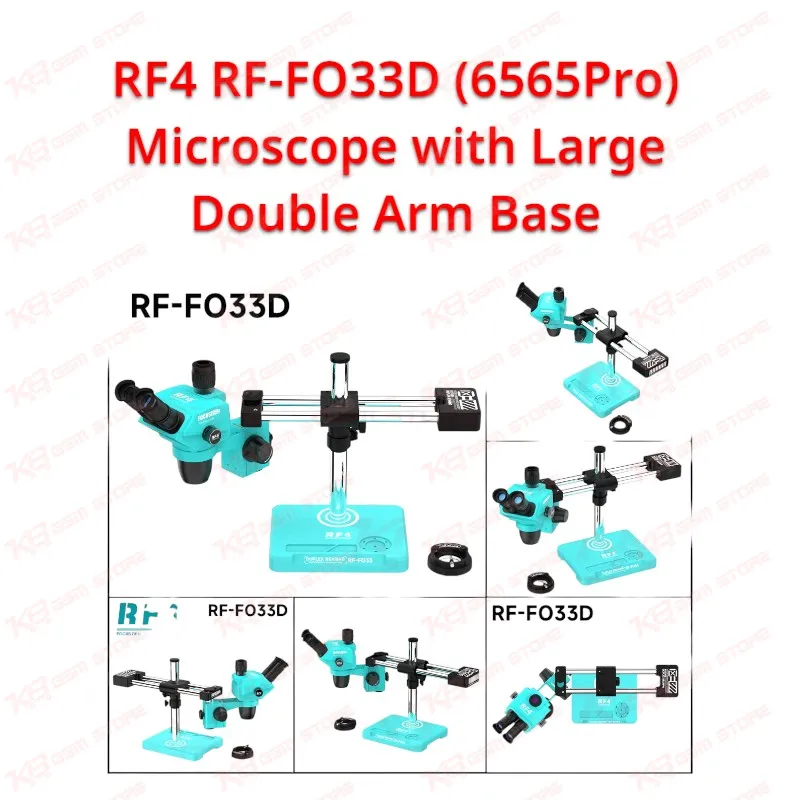
When a dead phone lands on your bench and the fault hides under a shield can, a naked eye and a hand magnifier will not find it, and the RF4 RF-FO33D (6565Pro) Microscope with Large Double Arm Base gives you the optical depth that proper board-level repair demands. This trinocular stereo microscope zooms continuously from 6.5X to 65X, so you start wide to scan the whole motherboard for burnt tracks, corrosion, and liquid damage, then push in to read tiny resistors, capacitors, and pad edges before you touch the board. The 45-degree inclined head swivels 360 degrees, so you turn it to a comfortable angle during a long IC change karna session, or rotate it toward a colleague or trainee sitting beside you. WF10X/22mm wide-field eyepieces pair with a 0.65X to 6.5X objective, and the wide field keeps the image steady while your tweezers, solder wire, and hot air nozzle move in and out of view. The third port takes a 0.5X camera connector, and the synchronous zoom design keeps the eyepiece view and the external monitor at the same magnification, so what you see through the lens matches what your customer or student sees on screen. That helps in a Pakistani repair shop where you show the fault to the customer before you quote the price, and in a training institute where an instructor demonstrates reballing to a whole class. The included CTV lens has a black aluminum alloy body and a chrome-plated copper bayonet. You focus it by hand while you watch the LCD, which gives you direct control over sharpness on the monitor. The stand decides how much you trust a microscope at 65X, because every tremor grows with the zoom, and this model answers that with a newly designed large double arm base. The swing arm and base work together to keep the head from shaking while you solder, and a 250 x 180mm base with a 365mm pillar of 32mm diameter gives the whole rig a solid footing on your bench. The support arm carries a 32mm column aperture, a 76mm lens aperture, a 155mm center distance, and a 50mm lifting range, so you raise the head over tall shields and lower it to a bare board without fighting the stand. A mechanical gear zoom lock knob makes each zoom gear a precise multiple, so you return to the same magnification quickly and skip the constant hunting for the right zoom. Lighting matters as much as magnification when you chase a hairline crack on a track, and the 144 LED ring light sits around the lens with a 60mm inside diameter and white light. You adjust the brightness to match the board, dim for shiny shield cans and bright for dark PCBs. The light runs from a 100 to 240V AC input at 50/60Hz and outputs 12V DC at a maximum of 700mA. A dust-proof lens cover protects the optics when you leave the bench, because dust and flux fumes ruin a clear image faster than most technicians expect. This microscope fits directly into your daily repair workflow. You inspect a board after a liquid damage clean, check charging IC and charging port pads on a charging issue, and examine FPC connector pins on a display problem. You trace RF section components on a network issue, verify the state of PMIC and CPU area joints on a boot loop issue or a hang on logo fault, and confirm every joint after reflow. When a phone stays dead after flash, you examine eMMC or UFS test points, then solder thin ISP wires on tiny pads with confidence. You also see broken tracks clearly enough to place a jumper (jumper lagana) with the right wire thickness, and you check BGA alignment and reballing results at 65X before you close the phone. The scope supports IC repair, CPU repair, PCB repair, eMMC and UFS repair operations, diagnostics, soldering, rework, and final testing, so one microscope covers every stage of a hardware fault. It pairs naturally with the tools already on your bench. Put a hot air station and a soldering station under the lens for rework, hold the board in a PCB holder for stable positioning, and use a multileter to confirm what you see. A reballing kit, an ISP pinout tool, an eMMC programmer, a UFS adapter, and a test box all work better when you see the pads and pins clearly. If you currently use a simple magnifier or a basic binocular scope, this trinocular model with a monitor output is a logical upgrade path, because you keep your eyes on the eyepiece and still record, teach, or show the repair to customers. Repair shop owners, service center managers, GSM hardware engineers, and technical training institutes will find the value in the stable base, the precise zoom gears, and the shared eyepiece and monitor view. The package includes the microscope, the large double arm, the 144 LED light, the dust-proof lens, the CTV lens, the column, and the base, so you add your own camera and monitor to complete the setup and start working on your first dead phone.