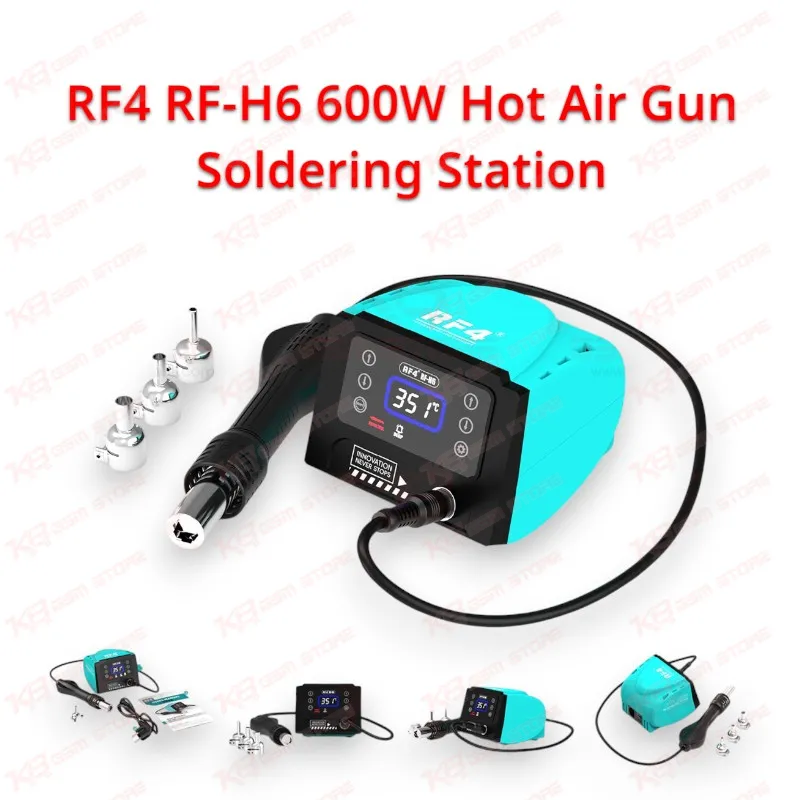
Every mobile repair bench eventually needs a hot air station that can keep up with real workshop demand, and the RF4 RF-H6 600W Hot Air Gun Soldering Station is built around that exact requirement, giving you a heating core, fan, and control system matched closely enough that you stop babysitting temperature and start working on the board in front of you. The 600W brazed ceramic heating element is the core of the design: it heats up quickly after power-on so you are not standing around waiting for a warm-up cycle before your first IC removal, and it cools down fast once you set the gun back in its stand, which matters when you are running dozens of jobs a day and switching between chip-level and board-level tasks. Behind that heating core sits a brushless turbine fan, chosen specifically because brushless motors hold up under continuous daily cycling far better than brushed alternatives, and the fan delivers enough air volume to move heat evenly across a pad without scattering nearby passives, which is exactly the kind of control you need when you are lifting a small IC next to components you cannot afford to disturb. The RF4 RF-H6 runs on a dual-voltage input of 110V at 60Hz or 220V at 50Hz, with fuse protection rated at 8A/250Vac on the 110V side and 4A/250Vac on the 220V side, so the station is built to survive the kind of voltage fluctuation common in a shared workshop power circuit rather than tripping out mid-job. Temperature range runs from 150°C to 500°C (302°F to 932°F), which covers the full spectrum of mobile repair heat work: lower settings for delicate flex cable soldering and connector rework, mid-range settings for standard SMD component desoldering, and the top end for stubborn IC removal or reballing prep where you need sustained heat to break the solder bond cleanly. The digital display keeps that temperature reading in front of you throughout the job instead of forcing you to guess based on how the gun feels, which cuts down on both overheating damage to boards and undertemp jobs where a chip lifts unevenly and drags pads with it. Nozzle replacement is built for speed rather than requiring tools or a shutdown cycle, so when you move from a tight-pitch IC job to a wider board area you are not losing five minutes swapping hardware between customers. The high-power copper transformer inside the unit is what actually lets the RF4 RF-H6 deliver consistent output at 600W without the voltage sag that cheaper stations show when the heating core first kicks in, and that stability is what technicians notice most once they have run the station through a full day of mixed jobs. In terms of where this fits in your actual repair workflow, the RF4 RF-H6 sits at the hot air stage of PCB and SMD repair: after diagnostics has isolated a dead phone, boot loop issue, or charging problem down to a specific IC or component, this station is the tool you reach for to lift, reflow, or replace that part, whether the underlying fault is a hardware fault on the power IC, a display problem traced back to a connector, or a network issue tied to a baseband component that needs reballing. It works equally well on Qualcomm and MediaTek-based boards, Samsung Exynos boards, and Apple logic boards, since hot air rework is chipset-agnostic by nature — the tool responds to solder and pad size, not brand — which makes the RF-H6 a genuinely universal station rather than one locked to a specific phone lineup. For a repair shop running through Android and iOS jobs side by side, that flexibility means one station covers charging port resoldering, camera module removal, small IC desoldering, display flex rework, and general board cleaning after a liquid damage job, instead of needing separate tools for separate device families. Safety features built into the RF4 RF-H6 protect against overheating during longer sessions, which extends the working life of both the heating core and the technician's nerves during back-to-back jobs. For technicians upgrading from a basic fixed-temperature gun, the digital control and dual-voltage input on the RF-H6 represent a real step up in repeatability — you can dial in the exact temperature a specific job needs and return to that same setting tomorrow, rather than eyeballing heat output every time. Paired with a good set of PCB holders, a stereo microscope for pad-level inspection, and a reballing kit for chip reattachment, the RF4 RF-H6 becomes the center of a full BGA and SMD rework bench rather than a standalone tool, and that is exactly the role it is designed to fill in a professional mobile repair workshop.