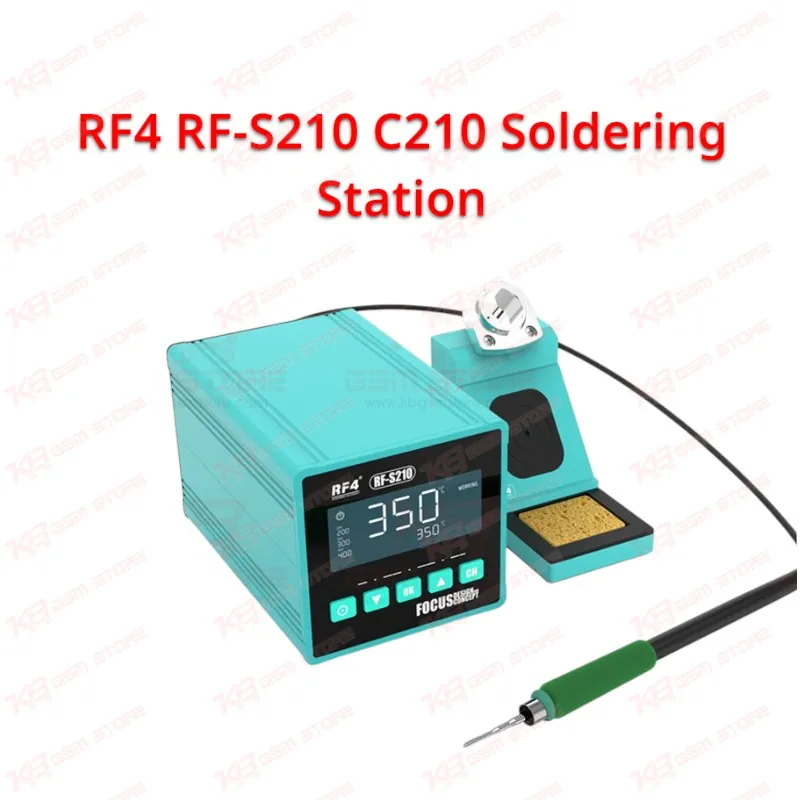
The RF4 RF-S210 C210 Soldering Station takes the everyday soldering task on a repair bench and gives it the kind of temperature discipline that fine-pitch mobile phone work actually needs, and RF4 built this around its own "TCP" temperature control system so the iron holds a set point instead of drifting the moment you touch a joint, which matters when you're reflowing a charging port pad or reattaching a jumper wire next to components that can't take excess heat. You set the working temperature anywhere between 100°C and 500°C, so the same station covers light rework on delicate flex cables and heavier joints on thicker PCB traces without swapping tools, and the unit switches between Celsius and Fahrenheit so you can work in whichever scale you're used to reading. Three-level memory storage lets you save three separate temperature presets and jump between them with a single touch, so if your bench routine moves between low-heat IC leg touch-ups, mid-range connector resoldering, and higher-heat board-level joints, you don't spend time dialing the temperature back in every time you change tasks. The 72W rated output gives the RF-S210 fast heat-up from cold start and quick temperature recovery after each joint, which keeps your soldering rhythm steady during back-to-back repairs instead of forcing you to pause and wait for the tip to catch back up to your set point. Pedal start temperature compensation is built in specifically for the moments when you land on a larger solder joint or a section of board with more copper mass pulling heat away from the tip, and rather than watching your set temperature sag mid-joint, the station compensates so you keep consistent heat transfer through the whole solder cycle. The station ships with the C210 handle and matching C210-K heating core, a pairing RF4 uses across its S-series stations because the C210 heating core reaches temperature fast and holds it tightly, and because C210 tips are common across the mobile repair trade in Pakistan, sourcing replacement tips or a spare handle later is straightforward rather than a hunt for a proprietary part. Anti-static design runs through the build, which protects the ICs, connectors, and surface-mount components you're working around on a live motherboard from static discharge damage, a real risk on any bench handling boards without a fully grounded workstation. On a Pakistani repair shop's workbench, this station fits naturally into the daily grind: jumper lagana on a board with a broken trace, resoldering a loose charging port after a dead-after-flash unit gets a hardware fix, reattaching small SMD components after a board clean-up, or reflowing IC legs during a board-level diagnostic when a hang-on-logo issue turns out to be a cold joint rather than a software fault. It's built for the point in the repair workflow where diagnosis is already done and physical rework begins — after ISP or eMMC troubleshooting rules out a software cause, or after box software confirms a hardware fault, this is the tool that does the actual soldering and desoldering on the board. Technicians running Qualcomm and MediaTek boards side by side, or moving between Samsung, Oppo, Vivo, Infinix, and Tecno repair jobs in the same day, get one consistent soldering platform instead of juggling multiple irons at different fixed temperatures. The compact desktop footprint keeps bench space free for your microscope, hot air station, and test box, and it pairs naturally into a workflow that also includes ISP pinout tools for dead-phone recovery, an eMMC or UFS programmer for storage-level repair, and a hot air rework station for BGA reflow — the RF-S210 covers the fine soldering step that sits alongside all of those. For a shop scaling from occasional soldering fixes to daily board-level repair work, the RF4 RF-S210 C210 Soldering Station gives you the temperature accuracy and recovery speed to keep throughput up without sacrificing the precision fine-pitch mobile repair demands.