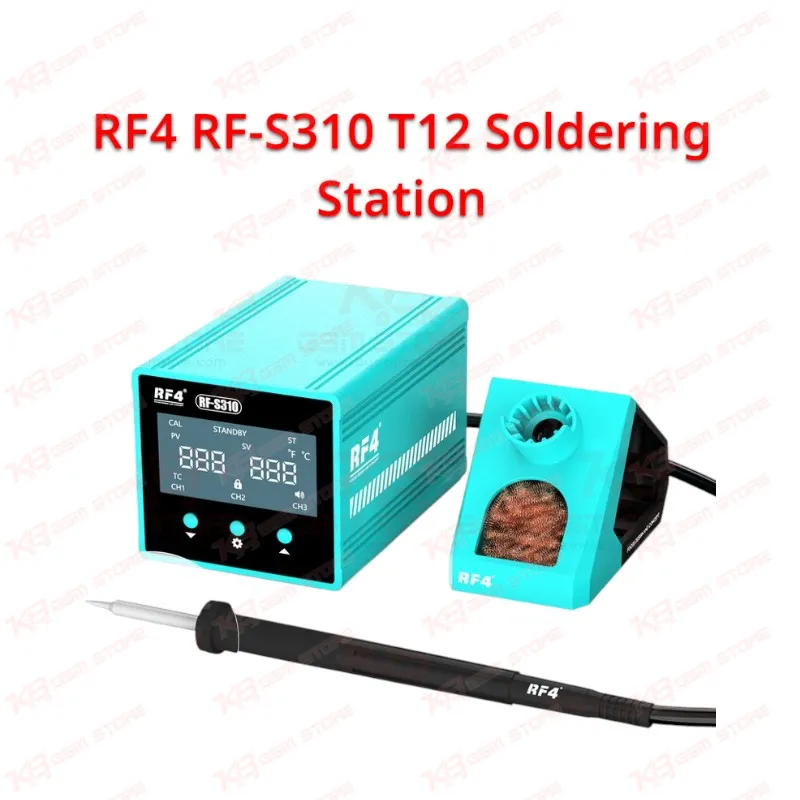
The RF4 RF-S310 T12 Soldering Station is built for technicians who need consistent, board-safe heat every time they pick up the iron, and it does this through a proprietary "TCP" temperature control circuit that RF4 developed specifically to close the gap between what the display shows and what the tip is actually delivering. Rated at 75W and paired with a 210-style handle running T12 series bits, the station reaches working temperature quickly and, more importantly, recovers that temperature fast after each solder joint, which matters most on ground planes, shield connectors, and multi-layer PCBs that pull heat away the instant the tip touches down. On a typical Pakistani repair bench where the workload swings between charging port jumpers, camera connector reflow, dead-after-flash board diagnostics, and general hardware fault repair, that recovery speed is the difference between a clean joint and a lifted pad. The three-level memory channel system is where the RF-S310 earns its keep during a busy shift: instead of resetting temperature by hand for every task, you store your go-to settings — one for delicate SMD work, one for general component soldering, one for heavier joints — and switch between them with a light touch on the metal contact sensor built into the handle, so your hands stay on the board instead of on a menu dial. When a job does need more heat than the stored channel gives, the pedal-start temperature compensation feature steps in: press the foot pedal and the station pushes extra heat to the tip on demand, solving the common problem of insufficient temperature on large solder joints, thick copper pours, or connectors with heavy shielding, without permanently raising your baseline setting and risking heat damage elsewhere on the board. Anti-static design runs through the whole unit, which matters on a bench where ESD-sensitive ICs, charging controllers, and PMICs sit exposed during repair, and it means the RF-S310 slots into the same safe workflow as your existing ESD mats and wrist straps without extra precautions. Because the station uses the widely available T12 bit family rather than a proprietary tip shape, you get access to a broad range of chisel, conical, knife, and bevel tips for different soldering angles, so the same station handles fine-pitch SMD rework one minute and a chunky dock connector the next. This flexibility is why the RF-S310 fits naturally into board-level repair workflows that sit between basic hand soldering and full BGA rework: it's the tool you reach for after diagnostics point to a specific joint, connector, or component, rather than a whole-chip reflow job that would call for a hot air station instead. In a typical repair shop, the RF-S310 handles jumper wire soldering after an IC change, dock and charging port pin repair, board-level component replacement, wire tinning, connector resoldering after a display or battery swap, and general PCB cleanup work where precise, stable heat protects nearby components from thermal stress. The metal-contact handle and fast-switching memory also reduce the wear-and-tear guesswork that comes with older analog irons, where technicians eyeball dial positions and end up either underheating joints — leading to cold solder and intermittent faults — or overheating them and damaging pads. For a service center running multiple technicians on shared benches, having repeatable, numbered temperature channels means less retraining and fewer joint failures traced back to inconsistent heat settings. The RF-S310 sits at the entry point of RF4's soldering station lineup alongside the RF-S110, RF-S210, RF-S410, and RF-S510, sharing the same TCP control philosophy but tuned around the T12 tip ecosystem specifically, which makes it a natural fit for technicians already invested in T12 bits or upgrading from a basic non-digital iron. Paired with an ISP pinout tool, a UFS adapter, or an eMMC programmer on the same bench, the RF-S310 covers the manual soldering side of a repair job that those tools can't touch — reworking the physical connection before or after a chip-level fix — making it a practical middle step between basic hand tools and a full hot air rework station.