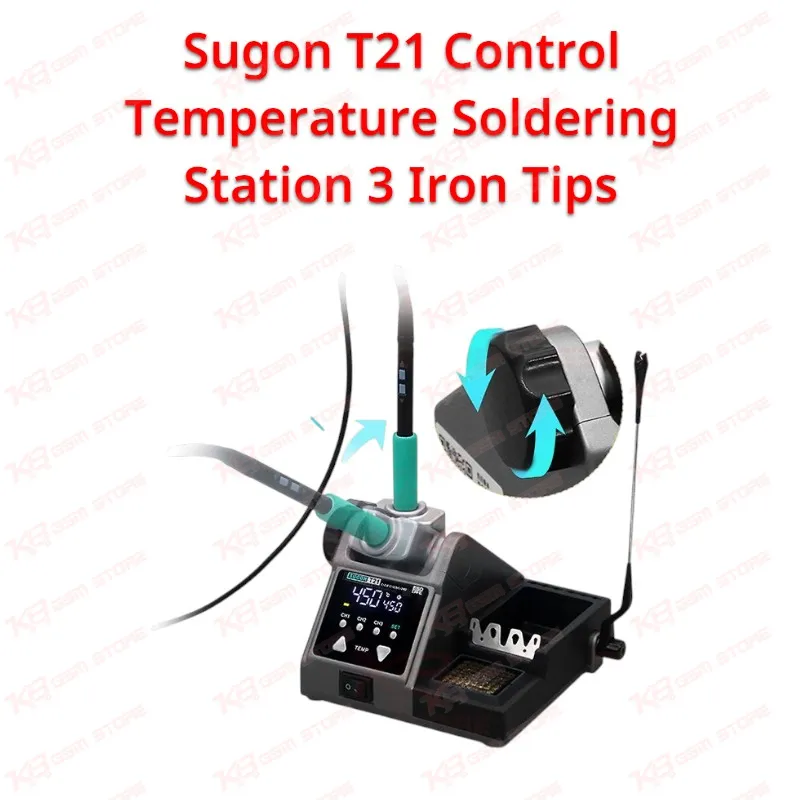
The Sugon T21 solves a problem every repair technician knows well: cheap soldering irons that drift in temperature the moment you need consistency most, right in the middle of a delicate chip removal or BGA reflow job. Instead of relying on old-style AC voltage regulation, the T21 uses a program chip to control heat output directly, which means the tip responds to your workflow in real time rather than lagging behind it. You get a working range of 100°C to 450°C (212°F to 842°F), and the unit pulls this off on just 120W maximum, drawing from a universal AC 220V or AC 110V supply at 50–60Hz, so it runs on standard Pakistani mains power without needing a separate voltage converter. Heat-up speed is where this station earns its keep on a busy bench: the tip reaches around 300°C in about 2 seconds, cutting the dead time technicians usually lose waiting for an iron to catch up after cooling. That matters when you're doing IC change karna on a dead phone board or working through a stack of boards with hang on logo and charging issue complaints stacked up in the queue. The display shows temperature, power draw, and heating percentage together, so you can watch the station respond in real time instead of guessing whether it has actually reached your set point. Three-channel temperature memory (CH1, CH2, CH3) lets you store your most-used settings and recall them instantly, which is a genuine time saver when you're switching between low-temp work on sensitive components and higher heat for larger solder joints. Automatic sleep function kicks in the moment you rest the handle on the bracket, dropping it into standby and reheating immediately when you lift it again, protecting both your tips and your power bill during long shifts. The handle bracket adjusts up and down by 45 degrees, so you can angle the rest to match your hand position and bench layout instead of working around a fixed stand. Mechanical short-circuit protection stops the unit automatically if a fault occurs, which adds a layer of safety when you're working on boards with damaged tracks or an unpredictable hardware fault. Temperature compensation, including PID-based compensation for larger solder joints, keeps the tip at your set temperature even as it loses heat into a bigger connection point, so your solder flow stays consistent instead of cooling out mid-joint. The T21 is compatible with the C210, C245, C115, and C470 tip series, giving you flexibility to switch handle types as your repair work demands; note that C245 and C210 handles include on-handle temperature control, while the C115 handle does not carry that remote adjustment feature, so factor that into which handle set fits your workflow. In the box you get the soldering station body, a compatible handle, three original Sugon iron tips, a power cable, and the printed user manual, so you can plug in and start soldering without sourcing extra parts separately. On the bench, this station handles the tasks that define daily GSM repair work: reflowing and removing PMICs, CPU ICs, and other surface-mount components during a dead after flash situation, tinning pads before reballing, desoldering charging ports and connectors damaged from years of daily use, and general board-level rework where consistent heat matters more than raw wattage. For shops running high volumes of motherboard repair, network issue diagnostics, and display problem troubleshooting, having a station that reheats fast and holds temperature accurately reduces the number of failed joints and rework cycles per board, which adds up across a full day of repairs. The copper wire brush style tip cleaning method recommended for this station keeps tips oxide-free between joints, extending tip life and keeping heat transfer efficient, which matters since a dirty tip is one of the most common reasons technicians blame a station for inconsistent heat when the real issue is tip maintenance. Compact dimensions and a straightforward control layout with dedicated set and save keys mean less time reading a manual and more time working, and the mechanical short-circuit safeguard combined with sleep mode gives you a station you can leave powered on through a full shift without worrying about tip degradation or safety risk. Whether you're running a solo repair bench or outfitting a multi-technician service center, the Sugon T21 fits into an ISP, eMMC, or UFS repair workflow as the soldering and rework component that handles the physical chip-level work before or after software-side diagnostics like box chalana or software marna, making it a practical core tool rather than a specialty add-on. It's a station built around the reality of a repair shop floor: unpredictable board conditions, back-to-back jobs, and the need for a tool that stays accurate job after job without constant recalibration.