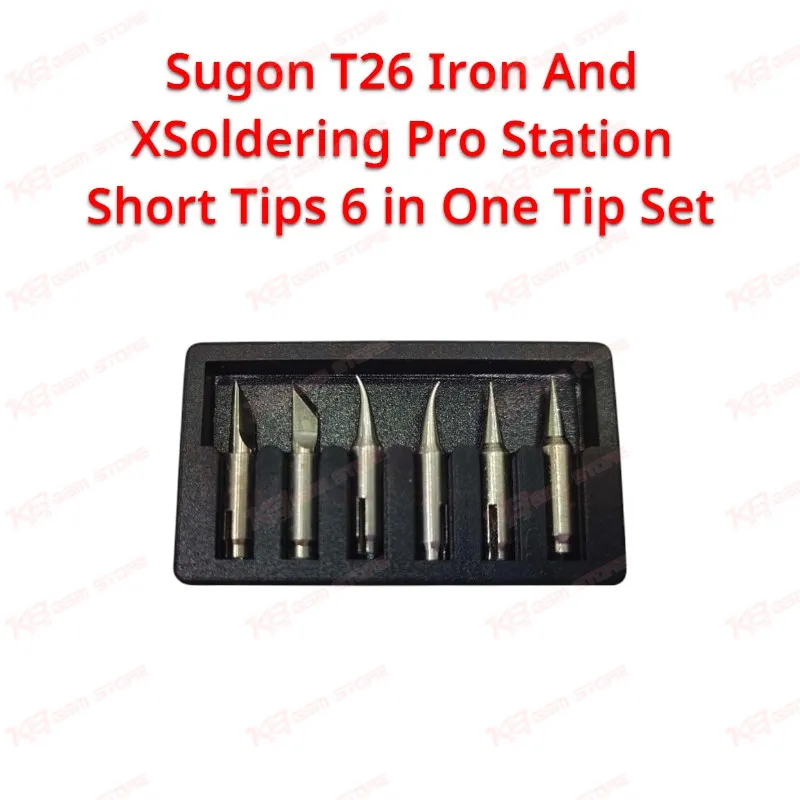
Every board-level repair job starts with heat control, and the Sugon T26 soldering station is built around that single idea: give the technician stable, fast, repeatable heat without wasting bench time. The station uses a single-chip microcomputer control system that drives the C210 handle to your set temperature in around 2 seconds, which matters when you are working through a stack of dead phones with different soldering demands — a quick jumper repair does not need the same heat as reflowing a connector, and the T26 lets you move between those jobs without standing around waiting for the tip to catch up. Input runs on AC 110V or AC 220V at 50/60Hz, so the station adapts to standard Pakistani mains power without needing a separate converter, and the output temperature range spans 200°C to 500°C (392°F to 932°F), covering everything from delicate SMD component work to heavier ground-plane soldering. Temperature stability sits at around ±2°C without airflow and no load, which keeps your tip temperature consistent instead of drifting mid-job, a detail that matters when you are doing repeated IC change karna on boards where overheating a pad means a scrapped motherboard. The included 6 in 1 short tip set is built for the C210 series, matching the same tip family used across JBC-compatible T26 handles, so you get a practical spread of tip shapes and sizes for different repair scenarios instead of relying on one general-purpose tip for every job. Short tips specifically give you better control and closer visibility in tight board areas, which is where most connector-level and small-component soldering happens on modern smartphone motherboards. Three programmable memory channels, CH1, CH2 and CH3, let you save your own working temperatures and switch between them with a press, so a technician handling both display flex soldering and heavier shield can removal does not need to manually dial in a new temperature every time — you set it once, save it, and recall it instantly during your workflow. The station also carries a practical bench feature common on higher-end soldering stations: tapping the handle holder briefly raises the temperature for a short window, giving you extra heat for a larger solder joint without permanently changing your saved setting, then it settles back to your normal working temperature on its own. Auto-sleep activates the moment you place the handle back on its holder, which reduces oxidation on the tip and extends the life of the heating element, a small habit-forming feature that saves technicians real money over months of daily use since tip replacement and heating element wear are recurring workshop costs. On a repair bench, this station fits directly into board-level and IC repair workflow: you use it for jumper lagana on cracked traces, reflow work around IC pads after a component replacement, connector and charging port resoldering, EMI shield removal and reattachment, and general SMD rework where a hot air station alone is not precise enough. It also complements ISP and eMMC repair workflows — when a board comes in with a dead-after-flash condition or a hardware fault suspected after a failed software marna attempt, the soldering station becomes the tool you reach for to physically inspect and rework the affected area before retesting. For technicians running a mixed software-and-hardware repair shop, having a fast-heating, stable station like the T26 next to your box and programmer setup means you are not bottlenecked waiting for a slow iron to catch up between diagnostic steps. The C210-compatible handle also means your tip investment is not locked to a single station model, giving you flexibility to source replacement or specialty tips locally as your repair volume grows. Build quality on the T26 line targets the mid-to-professional segment: it sits above basic adjustable irons in heating speed and temperature control while remaining affordable enough for independent repair shops and training institutes to adopt without the cost of a full JBC-branded station. For a service center handling daily board repairs — display issues, charging problems, network faults, and hang on logo boards that need component-level diagnosis — a dependable soldering station is not optional equipment, it is the backbone of the hardware side of the workshop. The Sugon T26 with its 6 in 1 short tip set is built to hold up to that daily use, giving your bench the heat response and tip variety needed to move through repair tickets without the station itself becoming the delay.