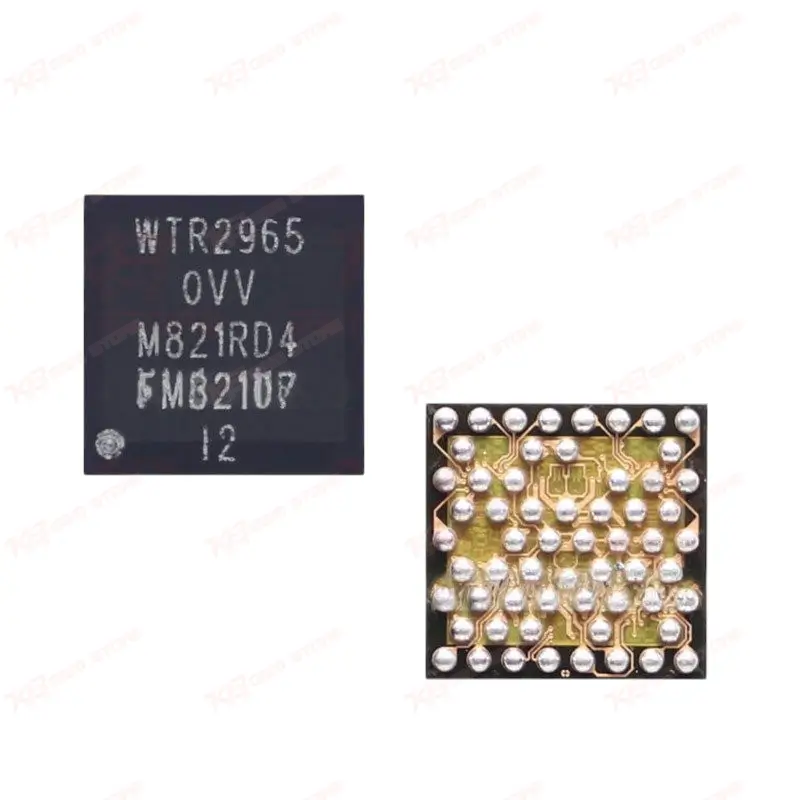
A "no service" or "no network" complaint is one of the most common signal-related faults a technician sees on the bench, and in a large share of these cases the fault traces back to the network/RF transceiver IC rather than the antenna flex or SIM tray. The WTR2965 Universal Network IC is the replacement part technicians reach for once diagnostics confirm the transceiver itself, not the RF front-end or antenna connector, is the failure point. Before ordering or fitting this IC, proper fault isolation matters. A phone showing no signal, intermittent network drops, or "searching" states that never lock to a tower needs a current-draw test on the network rail first. If the board pulls abnormal current on the RF/network line, or the transceiver shows physical corrosion, cracked solder balls under thermal imaging, or a failed continuity check against a known-good board, that points to the IC rather than a software fault. Skipping this step and swapping the IC on a phone with a firmware-level network issue wastes both the part and the appointment slot, so a proper repair workflow always separates hardware-confirmed cases from ones that just need a software flash. This chip sits in the mobile repair workflow between diagnostics and reflow. Once you've confirmed the fault at the IC, the actual replacement is a standard hot air rework job: remove the old chip cleanly without lifting the pad, clean the footprint with flux and isopropyl alcohol, align the new IC precisely under a microscope, and reflow at the correct temperature profile for the package. Because this is a fine-pitch, moisture-sensitive component, it should come straight out of sealed packaging and go onto the board without extended exposure to open air, otherwise trapped moisture can cause popcorning during reflow and take out an otherwise good chip. In the Pakistani repair market this part gets requested constantly for Xiaomi and Redmi units coming in with "no service" after a drop or liquid exposure, for Samsung A-series and J-series boards with intermittent network drop, and for Vivo, Oppo, and Infinix models showing the same signal-loss pattern. Shops in Lahore, Karachi, and Islamabad handling walk-in network complaints keep this IC in stock precisely because signal faults are a daily ticket item, not an occasional one. One important note for anyone stocking this part at scale: this designation is used across the aftermarket parts trade as a generic "universal" network IC reference, and exact pinout, footprint, and device-specific compatibility should always be confirmed against the specific board you're working on rather than assumed from a device name printed on a listing. Technicians experienced with signal-IC swaps typically verify by comparing IC markings and board test points directly, since the same physical package designation can appear across multiple phone generations with different surrounding circuitry. This IC is intended for use by trained mobile repair technicians with hot air rework experience. It is not a user-replaceable part and requires proper ESD precautions, a calibrated hot air station, and microscope-level precision to fit correctly without damaging adjacent components.