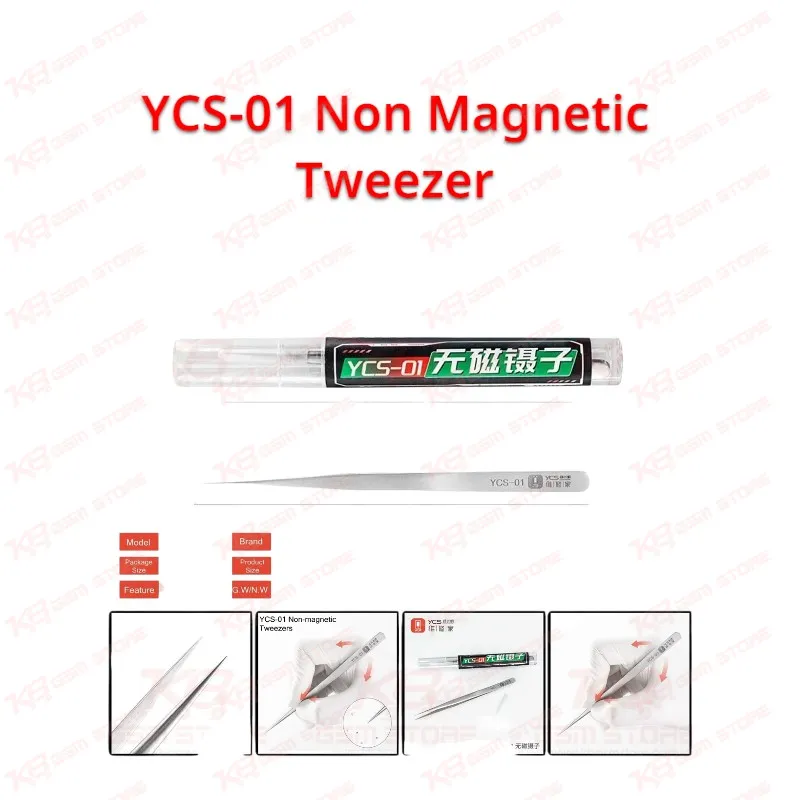
Every technician who has chased a tiny SMD capacitor across the bench knows how much one weak tool costs you. The YCS-01 Non Magnetic Tweezer from YCS solves that daily headache with an ultra-fine tip and a non-magnetic stainless steel body that never drags small metal parts toward the tip. When you work on a dead phone under the microscope, you need a tweezer that picks the part, holds it steady and releases it exactly on the pad. This tool does that job cleanly, shift after shift, without the fuss of a worn-out generic pair.
Ordinary steel tweezers pick up magnetism over time, especially when you keep them near magnetic screwdriver bits, speaker magnets or a parts tray full of screws. A magnetized tip grabs loose screws, lifts tiny shield clips and makes small components jump at the wrong moment. The YCS-01 uses non-magnetic, high-tenacity stainless steel, so the tip stays neutral around the earpiece speaker, loudspeaker module and vibration motor of a phone. You place screws back in their holes without them flipping onto the tip, and you avoid losing a part inside the housing during reassembly.
On board-level jobs, the YCS-01 Non Magnetic Tweezer earns its place. During an IC change, you lift a charging IC or PMIC off the board after hot air reflow, position the new chip on fresh flux and nudge it into alignment before the solder settles. For a jumper job, the fine tip holds jumper wire flat against a test point while your soldering iron tacks it down. That control matters most on a network issue or charging fault, where one bridged pad sends you back to the start. Steel conducts heat, so rest the tip lightly on hot parts and let the board cool before heavy handling.
Outside the soldering stage, this tweezer handles the small physical tasks that fill your repair bench all day. You open flex connectors, lift display and battery FPC cables, peel adhesive strips, pick debris out of charging ports and sort screws from a stripped frame. A water-damaged phone often hides corrosion under shield cans and between connector pins, and the fine tip helps you clean those spots after an alcohol wash. On a phone stuck in a boot loop issue or hang on logo after a liquid spill, that careful cleaning often decides whether the board survives.
The YCS-01 measures 135.0 x 6.8 mm and weighs just 12.9 g, so it balances lightly between your fingers and does not tire your hand during long microscope sessions. The slim profile reaches between tall components on crowded motherboards, and the high-tenacity steel springs back to its open position after every squeeze. You get consistent tip contact, which means fewer dropped parts and less time searching the bench floor with a torch. Store the tweezer with its tip protected, avoid using it as a pry tool on stiff shields, and it keeps its precision for a long time.
This tweezer belongs to the precision hand tools range and pairs naturally with the rest of your rework setup. Combine it with a hot air station and a soldering station for IC and connector work, a PCB holder to lock the board in place, and a microscope for clear tip visibility. For BGA reballing, it works alongside a reballing kit when you reposition chips on the stencil. When your daily work grows into heavy CPU reballing and fine jumper tracing, a curved-tip precision tweezer set makes a sensible next upgrade for your bench.
For Pakistani repair shops, trainee technicians and service centers, the YCS-01 covers the daily small-part handling that every repair needs, from a quick screw sort to a full charging IC replacement. KB GSM Store stocks it at a practical price in Pakistan, so you can keep one on every bench and a spare in your toolkit for field jobs.