Skip to product information
1 of 4
Brand: YCS

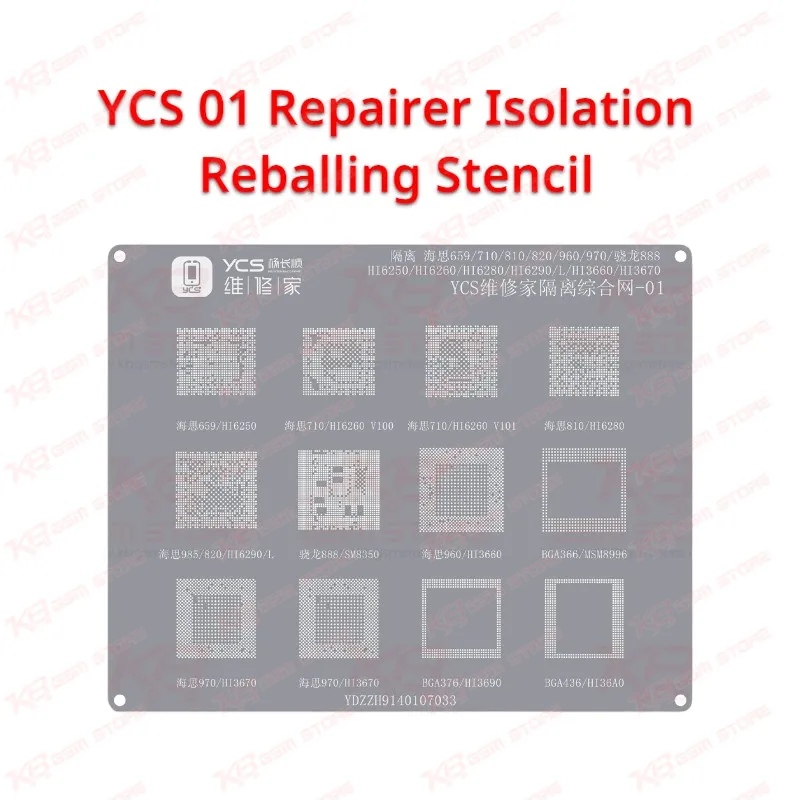
YCS 01 Repairer Isolation Reballing Stencil

YCS 01 Repairer Isolation Reballing Stencil

Regular price Rs.600.00 PKR
Regular price Sale price Rs.600.00 PKR
Sale Sold out
Shipping calculated at checkout.
Quantity

Precision BGA Reballing Stencil for Mobile Chip Repair
The YCS 01 Repairer Isolation Reballing Stencil gives your repair bench a dependable steel template for rebuilding solder balls on mobile phone BGA chips after removal. You line the chip pads up under the precision apertures, spread solder paste across the sheet, and heat it with your hot air station to form even balls ready for remounting. Technicians who handle dead phones, IC replacement jobs, and hardware faults on iPhone and Android boards get cleaner results and fewer bridged joints. Pair it with quality flux, a PCB holder, and a microscope, and the YCS 01 turns a risky chip job into a controlled, repeatable process at a practical price in Pakistan.

SKU:MST-SOLDERING-TOOLS-1032

⚖️ Weight: 0.01 kg

  • Safe & Secure Payment
  • Fast Delivery
  • WhatsApp Support
View full details

Description

Chip-level repair lives or dies at the reballing stage, and the YCS 01 Repairer Isolation Reballing Stencil gives you a steel template built for exactly that moment on the bench. Once you lift a CPU, NAND, power IC, or baseband chip off a mobile phone motherboard, the old solder balls come away uneven, cracked, or bridged, and the chip cannot go back onto the board in that state. You clean the pads, fit the chip under this stencil, and rebuild a fresh, even grid of solder balls that seats correctly when you remount it. YCS sells this sheet under its Repairer line, a name board-level technicians recognise from stencils, reballing platforms, and magnetic work pads made for phone motherboard repair. The workflow stays simple and repeatable. You start by removing the chip with your hot air station, clearing the cured underfill glue, and wicking the old solder off both the chip and the board pads with flux and desoldering braid. You then wipe the pads with isopropyl alcohol so no flux residue blocks the stencil holes. Next, you place the chip under the matching footprint on the YCS 01 sheet and check alignment under your microscope, because even a slight offset produces merged balls along one edge. With the chip locked in position, you spread a thin, even layer of solder paste across the apertures with a spatula and scrape the surface clean so each hole holds the right amount. Finally, you apply gentle, circular hot air until the paste melts into shiny round balls, let the stencil cool, and lift the chip free. A steel stencil earns its place on the bench through flatness and heat stability. Thin, cheap sheets bow under hot air, and when a stencil bows, paste from neighbouring holes flows together and leaves you with shorted balls and a wasted chip. A rigid, accurately cut stencil stays flat against the chip surface, keeps every ball separate, and releases cleanly after cooling, which matters most on fine-pitch processors and storage chips with hundreds of pads. Clean apertures also mean you scrape less and rework less, so your success rate climbs and your time per job drops. You will reach for the YCS 01 on the jobs that bring real money into a Pakistani repair shop. A dead phone that refuses to power on often traces back to a cracked BGA joint under the CPU or power IC, and reballing restores that connection. A phone stuck in a boot loop or hanging on logo after a drop regularly points to the same fault on the storage chip. A network issue with missing baseband commonly comes from a lifted baseband or RF chip, and a properly reballed chip brings the signal back. Customers who bring water-damaged or overheated boards also need chips lifted, cleaned, and reballed before you can diagnose further. In each case, the stencil turns a risky hardware fault into a controlled process you can repeat on the next board. The YCS 01 performs best as part of a complete reballing setup. A stable hot air station gives you controlled, even heat, a good no-clean flux helps the paste wet the pads properly, a PCB holder keeps the motherboard steady while you remount the chip, and a stereo microscope lets you inspect every ball before the chip goes back down. If you reball chips daily, a magnetic reballing platform with locating molds makes a strong upgrade, because it holds the chip and stencil together and cuts your alignment time on every job. Look after the stencil and it will serve you for a long time. Clean the sheet with isopropyl alcohol and a soft brush after each use so dried flux and paste never clog the holes, store it flat in a sleeve away from heavy tools, and never pry at it with a blade while it is still hot. Whether you run a busy shop in Lahore, Karachi, or Islamabad or you are building board-level skills at a training institute, the YCS 01 Repairer Isolation Reballing Stencil gives you a reliable foundation for professional chip repair.

Key Features

  • Steel stencil sheet built for BGA chip reballing on phone motherboards
  • Precision apertures that hold an even amount of solder paste per pad
  • Stays flat under hot air, reducing bridged and merged solder balls
  • Clean release after cooling so the chip lifts free without damage
  • Reusable across many jobs with simple isopropyl alcohol cleaning
  • Works with standard solder paste, flux, and any hot air station
  • Fits naturally into a full reballing kit alongside PCB holders and microscopes
  • Part of the YCS Repairer line made for board-level phone technicians

Specifications

Brand Entity YCS (Repairer series)
Product Entity YCS 01 Repairer Isolation Reballing Stencil
Technology Entity BGA reballing, solder paste stencil printing
Compatible Device Entities Mobile phone motherboard BGA chips (CPU, NAND, power IC, baseband)
Repair Process Entity Chip removal, pad cleaning, reballing, chip remounting
Industry Entity Mobile phone repair, PCB and board-level repair

Compatible Devices

  • Mobile phone BGA chips matching the footprints printed on the YCS 01 sheet
  • Universal — not device-specific; confirm the chip footprint against the stencil before use

Common Repair Uses

  • Reballing a CPU or power IC after removal on a dead phone
  • Rebuilding solder balls on NAND/storage chips for boot loop and hang-on-logo faults
  • Reballing baseband or RF chips to fix network issues
  • Chip lift, clean, and reball on water-damaged or overheated boards
  • Restoring cracked BGA joints after a drop

FAQ

What is the product name?
The product name is YCS 01 Repairer Isolation Reballing Stencil.
What is the brand of this product?
The brand of this product is YCS.
What is the model of this product?
The model of this product is 01.
What is this product used for?
This product is used for rebuilding solder balls on mobile phone BGA chips before remounting them on the motherboard.
Which devices are compatible with this product?
This product is compatible with mobile phone BGA chips that match the footprints on the stencil sheet; check your chip against the sheet before you start.
Who should use this product?
This product is suitable for mobile repair technicians, repair shops, service centers, and professional users.
Should I use solder paste or solder balls with a reballing stencil?
Most phone technicians use solder paste with this type of stencil: you fill the apertures, scrape the surface flat, and heat it so the paste forms balls. Loose balls work too, but paste gives faster and more consistent results on fine-pitch chips.
Why do my solder balls bridge together during reballing?
Bridging usually comes from paste left on the stencil surface, a misaligned chip, or too much heat that lifts the stencil. Scrape the surface clean, confirm alignment under a microscope, and apply gentle circular hot air while holding the stencil flat.

Ask any Query