


Brand:
YCS
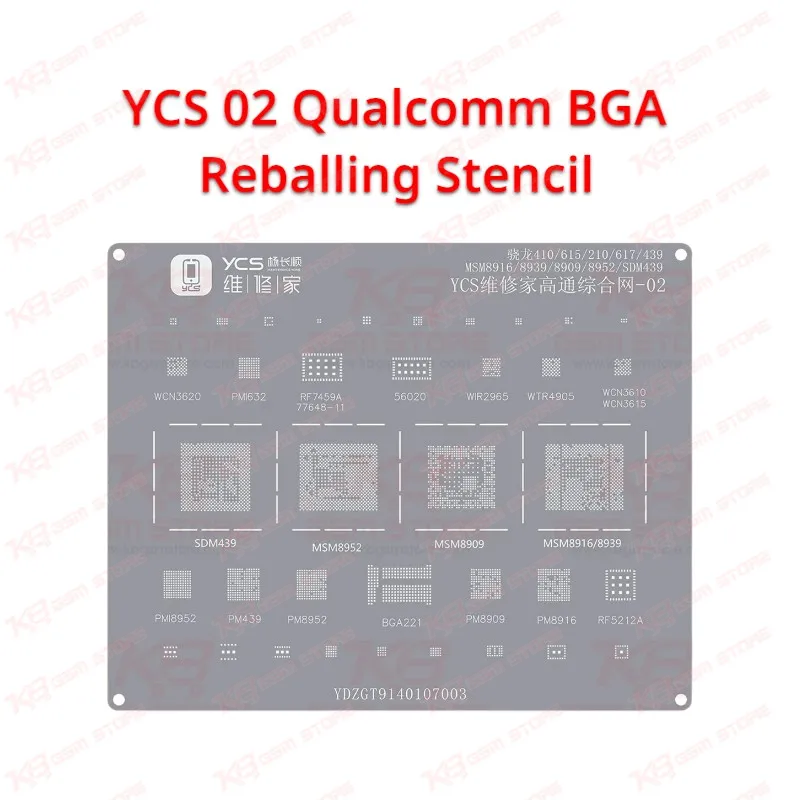
YCS 02 Qualcomm BGA Reballing Stencil
YCS 02 Qualcomm BGA Reballing Stencil
Regular price
Rs.600.00 PKR
Regular price
Sale price
Rs.600.00 PKR
Shipping calculated at checkout.
Quantity
Couldn't load pickup availability
Qualcomm MSM8916 to SDM439 CPU and PMIC Reballing Stencil
The YCS 02 Qualcomm BGA Reballing Stencil gives your bench one sheet that covers the Snapdragon 410, 615, 210, 617 and 439 platforms, including MSM8916, MSM8939, MSM8909, MSM8952 and SDM439 CPUs. You also get matching apertures for the PM8916, PM8909, PM8952, PMI8952, PM439 and PMI632 power ICs, plus the WCN Wi-Fi chips and WTR transceivers from the same boards. When a budget Qualcomm phone lands on your counter dead, stuck on the logo or with a network fault, you lift the chip, reball it with this stencil and seat it back without hunting for separate templates.
SKU:MST-SOLDERING-TOOLS-1018
⚖️ Weight: 0.01 kg
- Safe & Secure Payment
- Fast Delivery
- WhatsApp Support


Description
FAQ
What is the product name?
The product name is YCS 02 Qualcomm BGA Reballing Stencil.
What is the brand of this product?
The brand of this product is YCS.
What is the model of this product?
The model of this product is YCS 02 (Repairman Qualcomm Comprehensive Network-02).
What is this product used for?
This product is used for reballing CPU, power, Wi-Fi and RF chips on Qualcomm Snapdragon 410, 615, 210, 617 and 439 motherboards.
Which devices are compatible with this product?
This product is compatible with boards using MSM8916, MSM8939, MSM8909, MSM8952 and SDM439 CPUs, along with their PM8916, PM8909, PM8952, PMI8952, PM439 and PMI632 power ICs.
Who should use this product?
This product is suitable for mobile repair technicians, repair shops, service centers, and professional users.
Does the YCS 02 stencil cover the PMIC as well as the CPU on Snapdragon 439 phones?
Yes. The sheet carries the SDM439 CPU pattern along with the PM439 and PMI632 power IC patterns, so you can rework both the processor and the power chips on these boards from one stencil.
Which YCS Qualcomm stencil do I need for MSM8953 or SDM632 boards?
Those chips fall outside the 02 sheet. The YCS 05 Qualcomm stencil covers MSM8953, SDM632, MSM8937, MSM8940 and MSM8917, so pick that sheet for Snapdragon 625, 632, 435 and 430 boards.