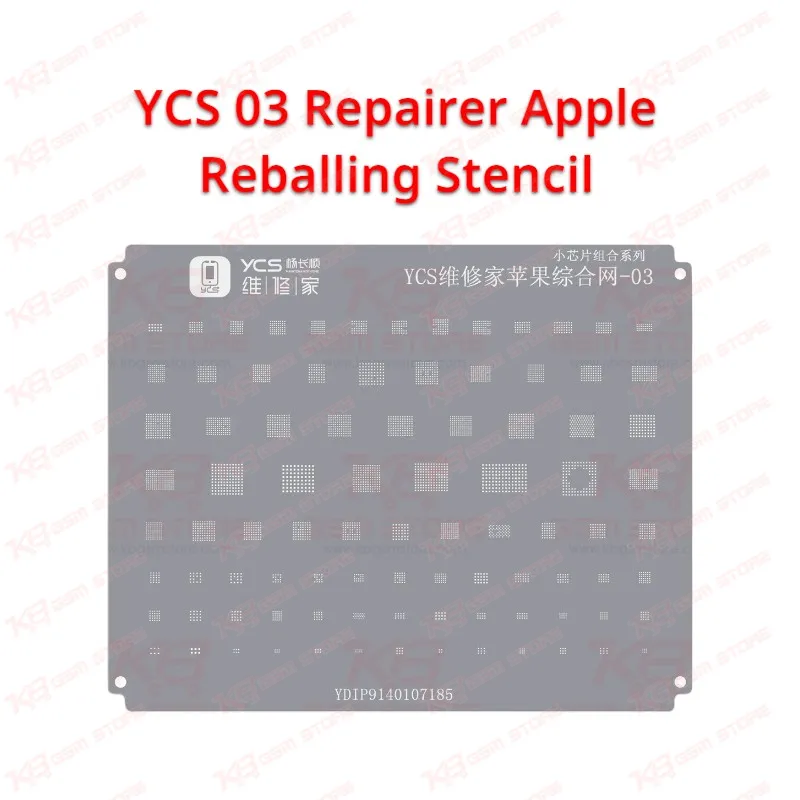
When a dead phone lands on your repair bench with a cracked solder joint under the CPU or a reflow job gone wrong, the YCS 03 Repairer Apple Reballing Stencil gives you the clean, repeatable ball pattern that separates a successful chip job from a second visit from the same customer. This stencil belongs to the YCS Apple Mesh Series, a line that YCS builds for BGA soldering on iPhone motherboards, with CPU and GPU-level chips across the iPhone 6 to 17 Pro Max range as its core focus. YCS cuts each aperture against the original chip drawings, so every opening sits exactly over its pad and every ball lands where the chip expects it. You see the difference the moment you lift the stencil: even rows, full rounded balls, and no bridged pairs waiting to short out the board. The rounded-corner aperture shape plays a big part here, because paste releases cleanly from a curved opening instead of clinging to sharp corners, which gives you uniform ball height across the whole grid. Heat control matters just as much on a reballing stencil, and this is where cheap meshes fail technicians in busy shops. Thin generic steel bows under hot air, lifts off the chip, and lets paste run between pads, and then you spend twenty minutes cleaning and starting over. YCS uses imported alloy steel with a rated working range of -50°C up to 500°C, and the sheet keeps its flexibility, springs back to flat after heating, and resists wear across many jobs, so the precision you get on day one stays with you after months of daily use. In your actual workflow, the YCS 03 Repairer Apple Reballing Stencil sits in the middle of the board-level repair chain. You start with diagnosis using a DC power supply and multimeter to confirm the fault points to a BGA chip rather than a simple charging issue or display problem. Next you lift the chip with your hot air station, clean the old solder off the chip and board with a soldering iron and wick, and then bring in the stencil. You align the chip under the mesh, spread solder paste across the openings with a flat blade, scrape off the excess, and apply controlled hot air until the paste forms solid balls. After the balls cool and you lift the stencil, you inspect the grid under a microscope, refit the chip on the board, and test the phone for boot, hang on logo symptoms, and normal current draw. A stable PCB holder keeps the board steady through the whole job, and a solid reballing kit with quality paste and flux rounds out the bench. If you reball iPhone CPUs regularly and want the chip locked down firmly while you work, the YCS Repairer CPU magnet reballing U platform makes a logical upgrade, because it clamps the chip tightly and holds the stencil stable during heating. Before you start a job, match the chip in your hand against the patterns cut into the 03 sheet, because each numbered stencil in the series carries its own set of chip layouts, and the right match decides whether the balls seat properly. Shop owners in Lahore, Karachi, and Islamabad who run high-volume iPhone board repair need tools that stay accurate under daily heat, and this stencil fits that demand without fuss. You get a reliable mesh for CPU reballing, chip replacement after a failed reflow, and recovery of boards that went dead after a drop or water damage. Keep the sheet clean with isopropyl alcohol after every job, store it flat, and it keeps delivering the same sharp ball pattern for a long time. For any technician who wants fewer comebacks on iPhone chip work, this stencil earns its spot in the drawer next to your hot air station and microscope.