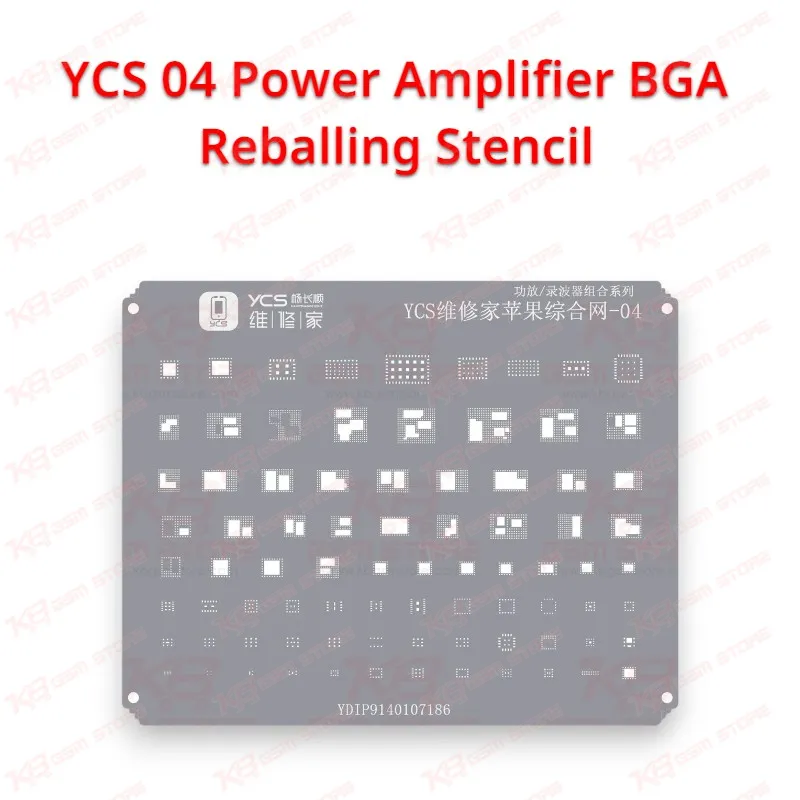
The YCS 04 Power Amplifier BGA Reballing Stencil handles a job every iPhone board technician meets sooner or later: a power amplifier or audio chip that has lost its solder balls and needs to go back onto the logic board with a clean, even ball pattern. YCS sells it as part of its Apple Comprehensive Network-04 range, a combination series that groups power amplifier and recorder (audio) IC footprints on one steel sheet, so the patterns you reach for during network and sound repairs stay in a single place. Power amplifier modules sit in the RF path and push the transmit signal toward the antenna, which makes them a common suspect when a customer walks in with no service, a phone stuck on searching network, or calls that drop the moment signal gets weak. Audio ICs on the same boards fail differently, usually after a drop or liquid exposure, and you see it as a dead microphone, no sound during calls, or a voice recorder that captures silence. In both cases the diagnosis often ends the same way: you remove the chip with hot air, inspect it, and either fit a new part or reball the original. A new chip from the market rarely arrives with perfect balls, and a removed chip never does, so the stencil decides how good your final joint will be. Your workflow starts with lifting the IC on a hot air station at a controlled temperature, then cleaning both the chip and the board pads with solder wick and flux until every pad sits flat and bright. Next, you align the chip under the matching aperture on the YCS 04 sheet, either by hand under the microscope or with a reballing holder that stops the chip from sliding, then spread a thin layer of solder paste across the openings with a flat blade and scrape off the excess. Low airflow hot air across the stencil melts the paste into round balls, and once the stencil cools you lift the chip free, clean the flux residue, and check every ball row under magnification before you place it back on the board. Small details decide the result on PA and audio packages because their pitch is tight and their pads connect to fine RF and audio lines. Even paste thickness gives you equal ball height, and equal ball height lets the chip seat flat instead of rocking on one tall ball and leaving an open joint underneath. Bridged balls under a power amplifier often show up later as a phone that heats near the antenna area or drains its battery while hunting for signal, so the cleaner your reball, the fewer comebacks you face at the counter. Good habits protect the stencil too: let it cool before you separate it from the chip, wipe it with isopropyl alcohol after every job, and store it flat so the apertures keep their shape across hundreds of repairs. Keep a few companion tools close, because this stencil performs best inside a complete rework setup. A stereo microscope helps you align tiny packages and inspect ball rows, a PCB holder keeps the logic board steady while you remove and refit the chip, and a quality low or medium temperature solder paste gives you predictable melting every time. Flux, solder wick, and fine tweezers round out the kit. For shops that handle mixed brands, the YCS Universal stencil covers generic ball sizes and pitches, while the YCS Qualcomm and MTK series serve Android CPU and PMIC work on the same bench. If your iPhone board repair volume keeps growing, a dedicated reballing platform with fixed stencil alignment becomes the natural upgrade from hand alignment. KB GSM Store stocks this stencil for technicians and repair shop owners across Pakistan who want reliable PA and audio IC reballing without paying for a full stencil kit they will never finish using, and you get it at a price that makes sense for daily bench work in Lahore, Karachi, Islamabad, or anywhere your shop runs.