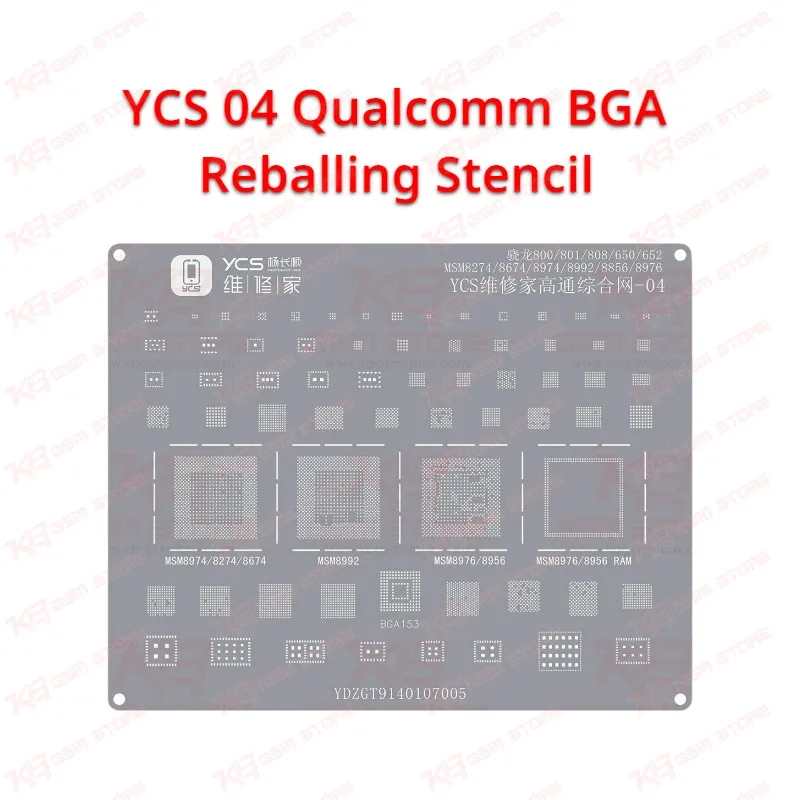
The YCS 04 Qualcomm BGA Reballing Stencil earns its place on any bench that still handles older Snapdragon motherboards, because it gives you a ready-cut ball pattern for the Snapdragon 800, 801, 808, 650 and 652 families instead of forcing you to hunt through a universal sheet for a pitch that almost fits. YCS builds this plate as part of its Repairman Qualcomm Comprehensive series, and the 04 position in that series targets the MSM8274, MSM8674, MSM8974, MSM8992, MSM8956 and MSM8976 processors. When a phone with one of these chips arrives as a dead phone, stuck in a boot loop, or hanging on logo after a drop, and your diagnosis points to a cracked CPU joint rather than a software fault, you have to lift the processor, clean it, and put a fresh ball grid under it before it goes back on the board. The stencil handles the most delicate part of that job. You seat the cleaned chip, align the openings over its pads, spread solder balls across the plate, and every aperture drops a ball exactly where the pad needs it, so the chip leaves the stencil with an even, complete grid. That consistency matters on Snapdragon parts because many of these processors sit in a package-on-package stack with memory above them, and one missing or merged ball is enough to give you no power, random restarts, or a phone that boots once and dies again the next morning. A typical job on your repair bench runs like this: you preheat the board on a PCB holder, lift the CPU with your hot air station at a controlled temperature, wick the old solder off both the chip and the board with flux and braid, wash away the residue, then move to the stencil for reballing. After reflow, you inspect the grid under a microscope before placing the chip back, which saves you from reworking the same board twice. Since the plate carries several Qualcomm patterns on one sheet, one stencil covers a whole group of chips instead of separate pieces for each model, and that keeps your stencil drawer organized when you work on a mix of Samsung, LG, Sony, Xiaomi, OnePlus and Google handsets from this Snapdragon generation. Shops across Lahore, Karachi and Islamabad still receive plenty of these phones for board-level work, especially the Xiaomi Redmi Note 3 Pro with the Snapdragon 650 and the LG G4 with the Snapdragon 808, a model that earned a reputation for boot loop failures that many technicians trace to weak solder joints under the processor. If your shop currently swaps boards whenever a customer brings a hardware fault like this, the YCS 04 lets you offer a proper CPU reball as a paid service, which returns far better margins than a board replacement. For clean results, match your solder ball size to the stencil openings, use a quality no-clean flux, and keep the plate perfectly flat, because a bent stencil lets balls roll and bridge under heat. Wipe the apertures with isopropyl alcohol and a soft brush after each job so old flux does not harden inside the holes and block the next reball. The plate weighs only about 10 grams, so it slips into a drawer or a stencil book without taking up space. Pair it with your Hot Air Station, Soldering Station, Microscope, PCB Holder and a Reballing Kit with balls and flux to complete the CPU rework setup. If your bench also takes on newer Snapdragon chips, the YCS 08 Qualcomm stencil covers the later 4xx, 6xx and 7xx series processors, giving you a natural next step as more modern boards reach your table. Technicians who already own a universal stencil set still benefit from this dedicated plate, because it removes the guesswork about pitch and alignment, and you spend less time fixing bridged balls and more time closing jobs and returning working phones to customers.