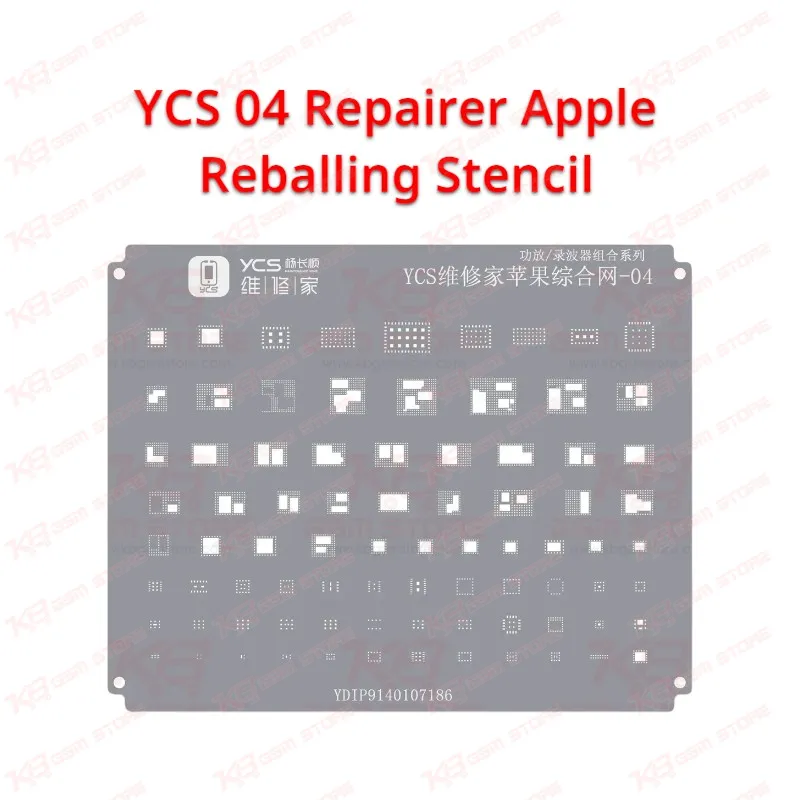
When an iPhone lands on your bench with a dead phone complaint after a drop, a hang on logo fault, or a network issue that traces back to a cracked BGA joint, the YCS 04 Repairer Apple Reballing Stencil gives you the clean ball grid you need to put that chip back on the board properly. YCS builds this sheet as part of its Apple mesh series, a line of chip repair stencils that the brand keeps updating for iPhone boards from the iPhone 6 generation up to the iPhone 17 Pro Max, and the 04 sheet carries its own group of Apple chip footprints on a single plate. YCS cuts every aperture against the original chip drawings, so each hole sits exactly over its pad and you avoid the shifted balls that cause short circuits and repeat jobs. Reballing works best when the stencil stays flat under heat, and that is where the material matters most. YCS uses imported alloy steel for this sheet, and the steel keeps its spring and returns to shape instead of bowing under hot air, which stops solder paste from bleeding between neighbouring holes during the melt. The rated operating range runs from minus 50°C up to 500°C, so the plate handles repeated hot air cycles without losing its precision, and you get the same accurate result on the fiftieth chip as on the first. The rounded corner design of each aperture lets paste release cleanly when you heat and lift, so every ball forms round and full rather than half-filled, and that uniform height matters when you seat a CPU or another fine-pitch BGA chip back onto an iPhone board. In a normal workshop flow, you first remove the chip with your hot air station, then clean the old solder off both the chip and the board with a soldering iron, desoldering wick, and a little flux until the pads look flat and shiny. Next you align the chip under the YCS 04 sheet, ideally on a reballing platform or magnetic holder so nothing shifts, confirm the alignment under your microscope, and spread a thin, even layer of solder paste across the holes with a scraper blade. Apply moderate hot air in a slow circular pattern until the paste turns into bright balls, let the plate cool for a few seconds, and then release the chip. A quick check under the microscope tells you whether any ball came out small or merged, and you can touch it up before you place the chip back on the board. This sheet fits naturally into board-level iPhone work, from CPU reballing during a motherboard swap to reseating any Apple BGA chip on the sheet’s map when a cracked joint leaves the phone with no service, no power, or a charging issue. Pair it with a reliable hot air station, a soldering station with a fine tip, a stereo microscope, a PCB holder, and good flux, and you have the core reballing setup that serious iPhone technicians run every day. For shops that handle a heavy volume of Apple boards, the natural upgrade path leads to a complete YCS Apple mesh set or a dedicated CPU reballing platform, which adds magnetic positioning for faster, repeatable alignment across every job. Keep the plate clean with isopropyl alcohol after each job, wipe off flux residue before it hardens, and store it flat in its sleeve away from heavy tools, because a scratched or bent stencil costs you accuracy on the next chip. Before you start any job, match the chip on your board against the footprint printed on the sheet, since each Apple mesh number carries its own chip map and the right match decides whether your balls land cleanly on the pads. KB GSM Store supplies the YCS 04 Repairer Apple Reballing Stencil at a practical price in Pakistan for repair shops in Lahore, Karachi, Islamabad, and every other city, so you can stock the exact sheet your bench needs and stop wasting time with worn generic stencils that leave you redoing the same chip twice.