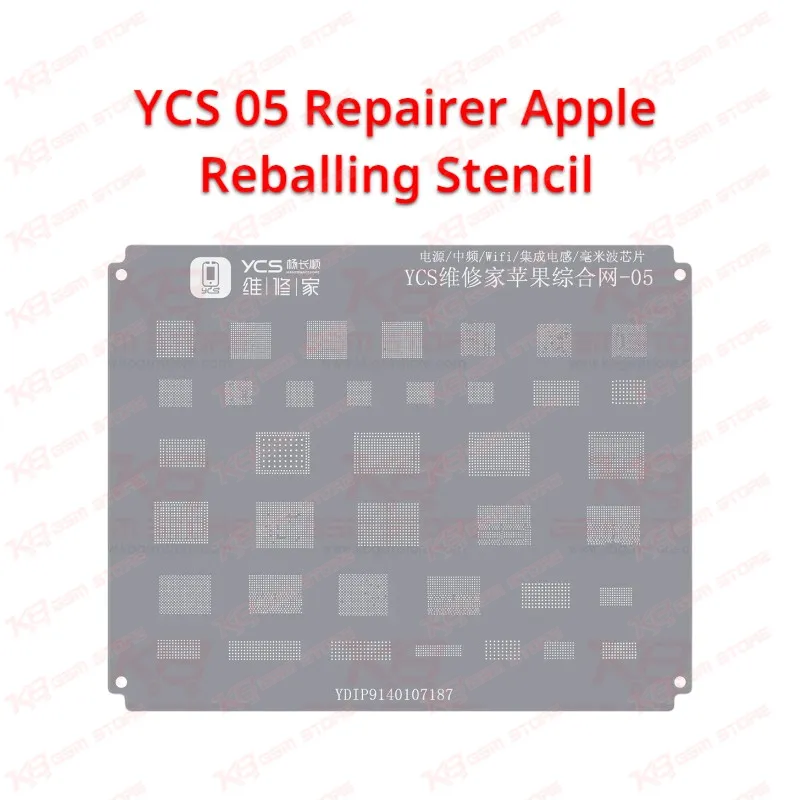
The YCS 05 Repairer Apple Reballing Stencil belongs on every bench that lifts chips off iPhone motherboards, because a chip you remove with hot air never goes back down cleanly until you rebuild its solder balls. Picture a dead phone that reaches your counter after a drop, or an iPhone that sits hang on logo after a liquid spill: once your diagnosis points to a cracked ball joint under a BGA chip, you have to lift that chip, clean it, reball it and seat it again, and the stencil decides whether that last step works the first time or turns into a second rework. YCS builds this sheet from imported alloy steel and calibrates each aperture against the original manufacturer drawings, so the holes sit exactly over the chip pads and every ball forms at the right size. The apertures carry a rounded-corner profile, which lets the paste release cleanly and leaves full, even balls instead of half-formed ones that cause a short or an open joint after reflow. Heat is where cheap meshes fail, and this one holds up: the steel handles an operating range from -50°C to 500°C, flexes under hot air without permanent warping and springs back flat once it cools, so the alignment you get on later jobs matches the first one. The 05 sheet belongs to the YCS Apple Mesh Series, a line that YCS maintains for CPU, GPU and board-level chips across Apple iPhone generations from the iPhone 6 range up to the 17 Pro Max, and the brand keeps adding sheets as Apple releases new boards. Before you start a job, match the model markings on the sheet against the chip on your bench, since every numbered YCS sheet carries its own group of chip footprints. On the bench the workflow runs like this: you clamp the board in a PCB holder, lift the chip with your hot air station at a controlled profile, wick the old solder off the chip and the board pads with flux and a fine soldering tip, then lay the cleaned chip under the YCS stencil and line up the apertures under the microscope. You spread solder paste across the mesh with a scraper, wipe away the excess and reflow with gentle hot air until the balls form and shine. Let the stencil cool before you separate it from the chip, because lifting it hot drags balls out of position, and wipe the mesh with isopropyl alcohol after each use so dried flux never blocks the next set of holes. The reballed chip then goes back on the board with fresh flux, and you check current draw on a DC power supply before you boot the phone to confirm the fix. This stencil sits naturally next to the rest of your reballing setup from the KB GSM Store catalog: a reliable hot air station for lifting and reflow, a soldering station with a fine tip for pad cleaning, a stereo microscope for alignment, a PCB holder to keep the board flat, and quality solder paste and flux from our consumables range. If your shop handles iPhone board work every day, the natural upgrade is a magnetic reballing platform that locks chip and stencil together, which speeds up alignment when you reball several chips in a row. Technicians in Lahore, Karachi and Islamabad who take on no power, charging issue, network issue and boot loop issue repairs on iPhones get a fast payback from a dedicated stencil, because one accurate reball saves a second heat cycle on the board and protects nearby components from extra stress. For shop owners comparing reballing stencil price in Pakistan, the YCS 05 gives you a branded, drawing-matched steel mesh at a cost that suits a daily-use bench tool rather than an occasional spare.