


Brand:
YCS
YCS 06 Qualcomm BGA Reballing Stencil
YCS 06 Qualcomm BGA Reballing Stencil
Regular price
Rs.600.00 PKR
Regular price
Sale price
Rs.600.00 PKR
Shipping calculated at checkout.
Quantity
Couldn't load pickup availability
YCS 06 Qualcomm Stencil Price in Pakistan for SDM660 and SM6125 Reballing
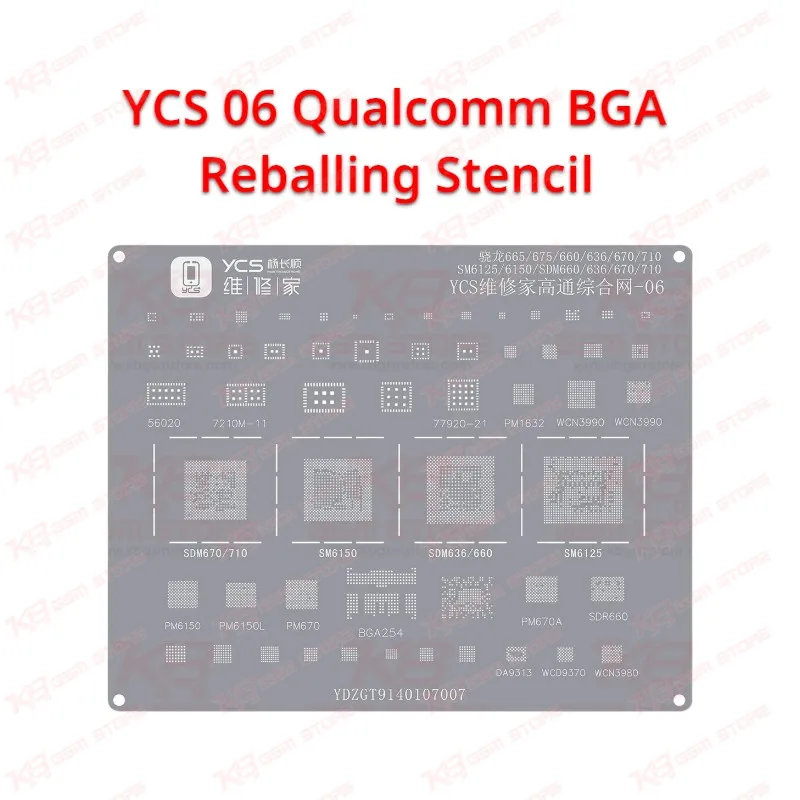
The YCS 06 Qualcomm BGA Reballing Stencil gives you one steel plate with laser-cut ball patterns for the Snapdragon 660, 636, 665, 675, 670 and 710 CPUs, plus the PMIC, RF transceiver and WiFi chips that sit around them on the same boards. When a Redmi Note 7 or Redmi Note 8 lands on your bench as a dead phone or with a hang on logo issue after a drop, you lift the CPU or PMIC, clean the pads and rebuild every ball with this single plate. KB GSM Store keeps it in stock at a shop-friendly price in Pakistan for repair benches in Karachi, Lahore and Islamabad.
SKU:MST-SOLDERING-TOOLS-1026
⚖️ Weight: 0.01 kg
- Safe & Secure Payment
- Fast Delivery
- WhatsApp Support


Description
FAQ
What is the product name?
The product name is YCS 06 Qualcomm BGA Reballing Stencil.
What is the brand of this product?
The brand of this product is YCS.
What is the model of this product?
The model of this product is YCS 06 (Repairman Qualcomm Comprehensive Network-06).
What is this product used for?
This product is used for reballing Qualcomm Snapdragon 660 to 710 series CPUs and their companion PMIC, RF and WiFi chips.
Which devices are compatible with this product?
This product is compatible with SDM660, SDM636, SM6125, SM6150, SDM670 and SDM710 CPUs, plus PM6150, PM6150L, PM670, PM670A, SDR660, WCN3990 and WCN3980 chips.
Who should use this product?
This product is suitable for mobile repair technicians, repair shops, service centers, and professional users.
Does the YCS 06 stencil support Snapdragon 665 SM6125 CPU reballing for Redmi Note 8?
Yes. The plate includes a dedicated SM6125 pattern, which covers the Snapdragon 665 CPU used in the Redmi Note 8.
Can I reball the PM6150 and PM670 power ICs with the YCS 06 stencil?
Yes. The plate carries separate patterns for PM6150, PM6150L, PM670 and PM670A, so you can reball the PMIC alongside the CPU from one sheet.