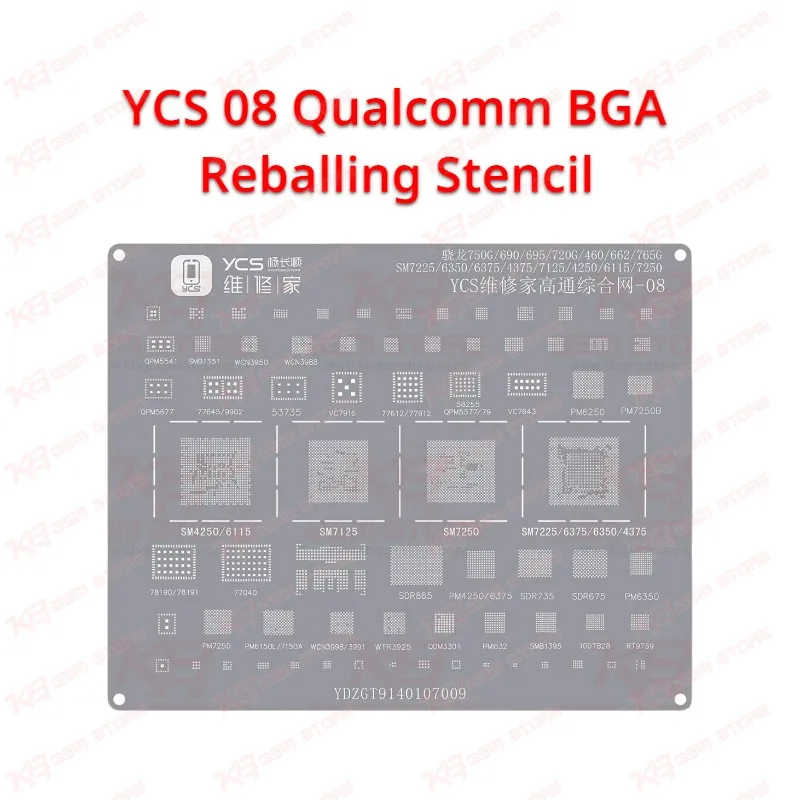
Every technician knows the moment: you lift a Snapdragon CPU off the board, clean the pads, and then realise the stencil in your drawer does not match the ball layout. The YCS 08 Qualcomm BGA Reballing Stencil solves that problem for the mid-range Qualcomm boards that fill Pakistani repair shops every day. YCS builds this plate as its Qualcomm Comprehensive Network-08, and it groups the footprints of the Snapdragon 460, 662, 690, 695, 720G, 750G and 765G platforms onto a single sheet. You get CPU footprints for SM7125, SM7225, SM7250, SM6350, SM6375, SM4375, SM4250 and SM6115, so one stencil handles a large share of the Samsung, Xiaomi, Oppo, Vivo, Realme and Motorola mid-rangers that come in with a hardware fault. The plate does not stop at the processor. It also carries the PM7250B and PM4250/6375 power management footprints, the SDR865, SDR735 and SDR675 RF transceiver footprints, and the 77040 and 78190/78191 RF-section footprints, which means one tool follows you from the CPU area to the power section and into the network section of the same board. That coverage matters when you chase a dead phone that refuses to power on after a drop, because a cracked ball under the CPU or the PMIC often causes the fault, and a clean reball brings the board back. The same logic applies to a phone stuck on hang on logo or caught in a boot loop issue after heat damage, where weak joints under the processor break the boot chain. On the network side, a phone that shows no service or drops signal after water damage often needs the transceiver lifted and reballed, and the SDR footprints on this plate let you do that job without improvising. The workflow stays simple and familiar on the repair bench. You remove the chip with your hot air station, clear the old solder from the chip and the board with wick and flux, and wash the residue away. You then align the YCS 08 plate over the matching footprint, lock the chip in a reballing platform or PCB holder, spread solder paste or drop solder balls into the apertures, and apply controlled heat until fresh, even balls form. Check the result under your microscope before you place the chip back, because a bridged or missing ball sends you straight back to the start. Because each footprint sits in its own labelled position, you spend less time matching ball patterns and more time finishing the job, which counts on a busy day when customers wait at the counter. Shop owners who handle bulk Qualcomm repairs also save money, since one plate replaces several single-chip stencils and keeps your stencil box organised. Pair this stencil with a good hot air station, a fine-tip soldering station, quality flux, a magnetic reballing base and a stereo microscope to build a complete BGA rework setup. If your shop also works on newer Snapdragon 8 series and 7 Gen boards, plan an upgrade path to the higher-numbered Qualcomm network stencils so your coverage keeps pace with the phones arriving at your counter. For MediaTek and Exynos boards, the matching YCS MTK and Exynos network stencils follow the same layout style, so your hands already know the routine. Keep the plate clean with isopropyl alcohol after every job, store it flat, and avoid bending it during removal, because a warped plate lifts away from the chip and spreads solder where you do not want it. Treat it well and it keeps producing tidy reballs job after job. For Pakistani technicians who want reliable Qualcomm CPU, PMIC and RF reballing coverage without spending on a full stencil kit, the YCS 08 Qualcomm BGA Reballing Stencil delivers practical value at a price that suits any repair shop budget, and KB GSM Store keeps it ready for delivery to Lahore, Karachi, Islamabad and cities across Pakistan.