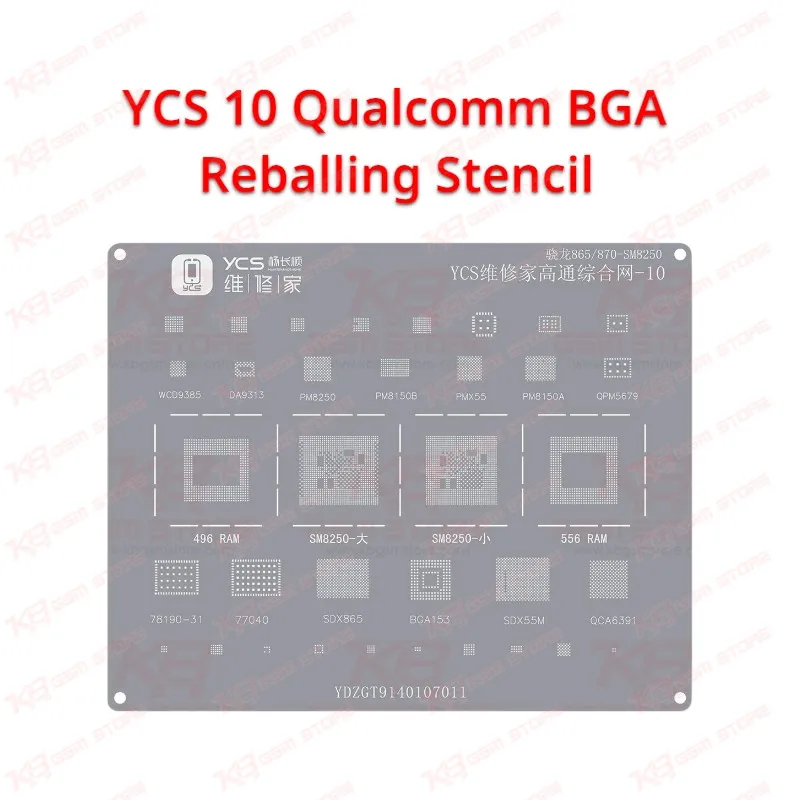
When a Qualcomm phone lands on your counter with a dead board, a boot loop issue that no flash can fix, or a hang on logo after the customer dropped it, the CPU solder joints often turn into the real suspect, and the YCS 10 Qualcomm BGA Reballing Stencil gives you the exact mesh you need to rebuild those joints properly. YCS builds this plate as part of its Android mesh series, where the Qualcomm range runs from Net-01 to Net-11, and the number 10 plate carries its own group of Snapdragon CPU footprints. Before you start, match the chip number printed beside each pattern with the marking on your CPU, because a pattern that looks close but differs by a single row will ruin the whole ball array. YCS calibrates every aperture against the original manufacturer drawings, so the holes sit right over the pads and you skip the frustration of sliding a universal plate around under the microscope for ten minutes. The rounded-corner aperture design earns its place on a busy repair bench, since square holes tend to trap paste in the corners and leave uneven balls, while rounded openings release the paste cleanly and give you full, uniform balls across the entire grid. That uniformity matters most on modern Snapdragon packages, where the ball pitch runs tight and one short ball means an open joint, an intermittent network issue, or a phone that boots once and then goes dead again two days after delivery. The plate uses imported alloy steel rated for an operating range of -50°C to 500°C, which comfortably covers the hot air temperatures you run for CPU reflow, and the steel keeps its flexibility, so it springs back flat after heating instead of bowing up and lifting the balls off the pads. A flat stencil lets you reuse the same plate across dozens of jobs without the accuracy drifting, and that keeps your cost per repair low when Qualcomm boards make up a big share of your daily work. In a normal workflow, you remove the CPU with your hot air station, clear the old solder off the chip with a soldering iron and desoldering wick, wipe the surface with flux cleaner, and then lock the chip under the matching YCS 10 pattern on a reballing platform or a heat-resistant holder. Spread solder paste across the aperture with a scraper, wipe off the excess so every hole stays level with the steel, and heat the plate evenly with hot air until the paste pulls into shiny balls. Let everything cool before you separate the chip, inspect the array under your microscope for missing or bridged balls, and then reflow the CPU back onto a clean, fluxed board. Shops that already keep solder paste, flux, a reliable hot air station, and a stereo microscope on the bench get the most out of this stencil, and pairing it with a magnetic reballing platform such as the YCS U-Platform holds the chip firmly so paste never creeps under the mesh. If you handle Qualcomm, MediaTek, Samsung, and Apple boards side by side, this plate slots naturally into a wider reballing kit, and you can add the other YCS Qualcomm numbers as new CPU generations reach your shop. Technicians who still rely on universal stencils for every CPU job usually spend more time aligning and more time redoing failed reballs, and a chip-specific plate cuts that waste straight out of the process. Keep the plate clean with flux cleaner or IPA after every job, store it flat so the steel never bends, and it will keep delivering accurate balls for a long time. For repair shops across Pakistan that see a steady flow of Qualcomm-based Android phones with a hardware fault at the CPU, this stencil turns a risky, slow job into a routine one you can quote with confidence.