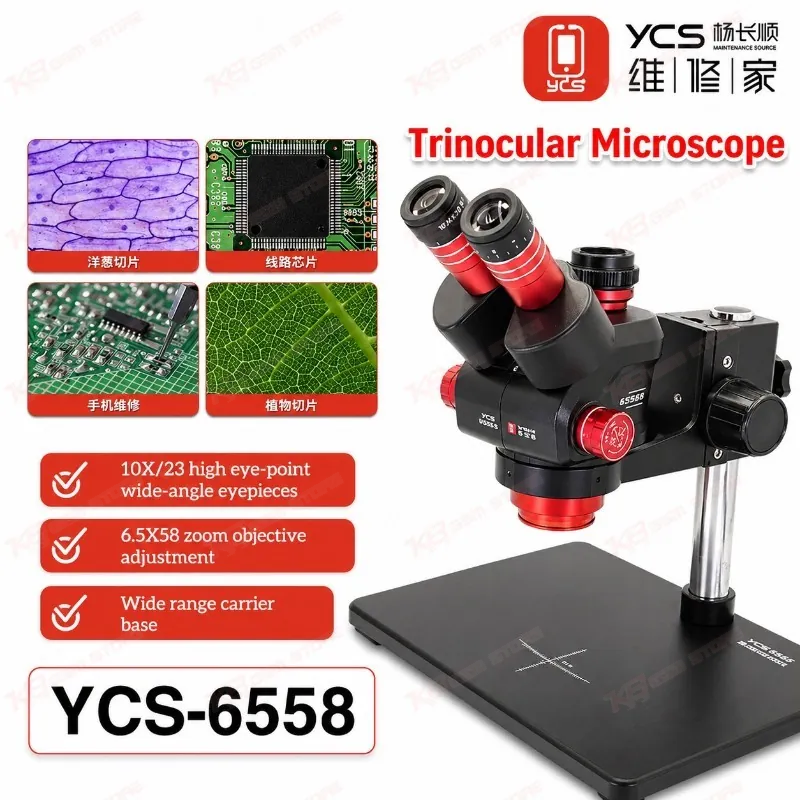
Every board-level technician knows the moment a charging IC refuses to sit flat or a tiny filter capacitor beside the CPU vanishes under a blob of flux, and that is exactly where the YCS-6558X Trinocular Stereo Zoom Microscope with Mechanic iMat Mini Aluminum Base earns its spot on your repair bench. This kit pairs a 6.5X-58X continuous zoom trinocular head from YCS with the Mechanic iMat Mini, a compact aluminum alloy platform topped with a high-temperature silicone pad, so you get proper optics and a heat-safe work surface in one purchase instead of hunting for a separate base later. The zoom starts low enough at 6.5X to show you the whole logic board, the shields, the connectors and the area around the PMIC at a glance, then climbs to 58X when you need to read a faded marking on a power IC, check a cracked joint along a BGA edge, or trace a broken track that leaves a phone dead with zero current draw. Because the objective zooms continuously from 0.65X to 5.8X, you never jump between fixed steps and lose your spot in the middle of a job; you turn the metal zoom knob and the image keeps tracking the area under your tweezers. The head sits at a 45-degree inclined viewing angle and swivels a full 360 degrees, and that matters more than most buyers expect: when you rotate a board to reach a connector from the other side, you turn the head instead of twisting your neck, and long sessions of IC replacement stop leaving you with a stiff back at closing time. The two WF10X/23 wide-field eyepieces use a high eye-point design with adjustable diopters, so technicians who wear glasses still see the full field, and two people sharing one bench can each set the eyepieces to their own eyes in seconds. The trinocular port turns this from a simple viewing microscope into a teaching and documentation tool, because the 0.35X CTV adapter lets you mount a compatible camera and send a live picture to a monitor while the eyepieces and camera zoom together in sync, so a trainee watching the screen sees exactly what you see through the optics. You can use that setup to show a customer the corroded area on a water-damaged board before they approve the repair cost, which builds trust and cuts arguments at the counter, and a training institute can demonstrate reballing and jumper work to a full class without crowding everyone around one bench. Lighting comes from a dustproof LED ring lamp with touch brightness control that snaps onto the objective and spreads light evenly across the board, which removes the dark shadows that hide a lifted pad or a missing resistor next to the network IC; you lower the brightness for shiny shields and raise it for a matte, flux-covered area with a single touch. Now look at the base, because the Mechanic iMat Mini gives this set a real advantage over a plain metal stand. The iMat Mini measures 330 x 245 mm, uses an aluminum alloy body that pulls heat away quickly, and carries a silicone insulation pad that resists temperatures up to 500°C, so you can rest a board on it while your hot air station blows directly on a shielded section without scorching the surface underneath. The pad lifts out for cleaning and replacement, so dried flux, stray solder balls and adhesive residue from screen separation work come off at the sink instead of building up week after week. A precision scale grid along the edge of the work area helps you position small boards and compare component sizes, and a dedicated screw holding area keeps those tiny bottom screws from rolling off the bench when you open a phone for a boot loop issue or a hang on logo complaint. The aluminum body resists corrosion and holds its shape through repeated heat cycles, and its anti-static construction gives you a safer surface for sensitive memory and CPU work. In a real workshop flow, the microscope sits at the center of everything else you own: you locate the short with one of your multimeters, find the hot component, lift it with your hot air station, clean the pads with your soldering station and wick, then place a new part or a freshly reballed chip using your reballing kits, all under the same 6.5X-58X view. When a dead phone needs eMMC or UFS work, technicians often solder test points or wire up ISP pinout tools before connecting eMMC programmers, UFS adapters or test boxes, and those test points on modern boards are small enough that soldering them without magnification risks ripping a pad and turning a simple software job into a hardware fault. The same logic applies when you clamp a board in PCB holders for charging port repair, display connector replacement, or a network issue traced to a damaged RF line; the iMat Mini gives the holder a stable, heat-resistant footing while the swivel head lets you approach the job from whichever angle suits your hands. If you currently work with a basic binocular unit or a USB digital microscope, the YCS-6558X Trinocular Stereo Zoom Microscope with Mechanic iMat Mini Aluminum Base gives you a clear upgrade path: true stereo depth for judging solder height, a camera port for recording or sharing your work, and a base that tolerates hot air instead of warping. For a shop owner comparing microscopes and checking the price in Pakistan before buying, the value of this set comes from combining a proven YCS optical head with a branded Mechanic heat-resistant platform, which removes the extra cost and fitment guesswork of sourcing a separate base. Whether your bench handles daily charging IC replacement on Infinix and Tecno boards, Samsung display problem repairs, iPhone jumper work near the CPU, or FRP lock and pattern unlock jobs that end up needing a test point, you work faster and make fewer mistakes when you can actually see what your tweezers and iron touch. The kit suits a new shop setting up its first proper bench as well as an established service center that wants a camera-ready station for its senior technician, and it fits comfortably on a standard workshop table without eating the space you need for your power supply and tool trays. Order the YCS-6558X set from KB GSM Store and give your workshop a microscope station that handles long days of board-level repair without slowing you down.