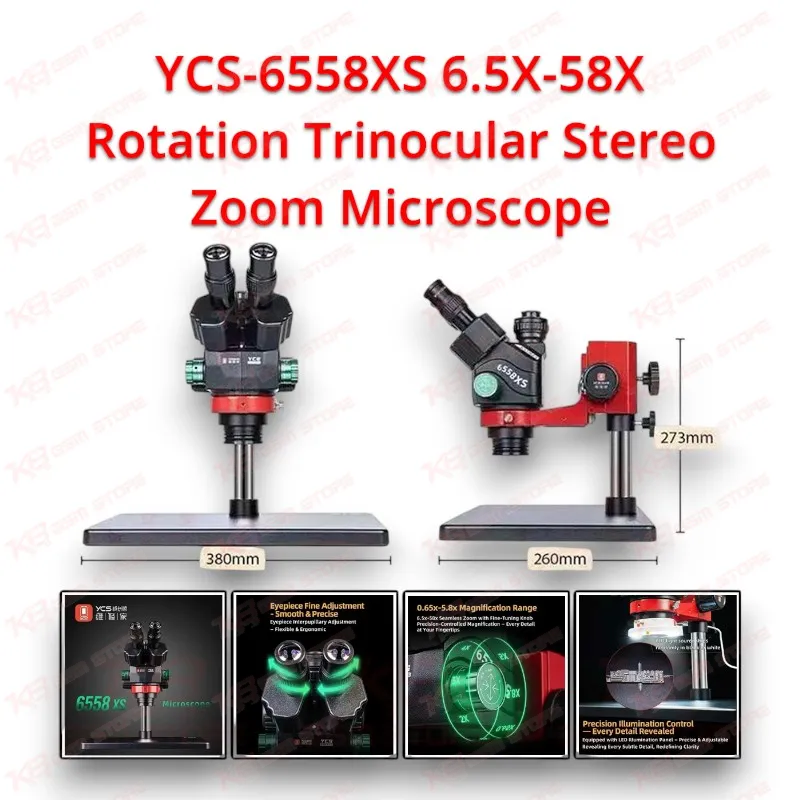
When you lift a tiny filter capacitor beside a CPU or chase a broken trace under a PMIC, your eyes decide the outcome long before your soldering iron touches the board. The YCS-6558XS 6.5X-58X Rotation Trinocular Stereo Zoom Microscope gives your repair bench a continuous zoom range that starts wide enough to scan a full phone motherboard and ends tight enough to check individual BGA solder balls. YCS builds this unit around a stereo optical path, so you see real depth instead of a flat screen image, and that depth matters every time you guide fine tweezers between two components sitting a fraction of a millimeter apart. For Pakistani repair shops that handle dead phone jobs, charging issue boards, and network issue repairs every single day, this microscope turns guesswork into controlled board-level work.
The heart of this microscope is its continuous zoom objective, which runs from 0.65X to 5.8X and pairs with WF10X/23 eyepieces to deliver a total working range of 6.5X to 58X. You turn one metal zoom knob and the image moves smoothly through the whole range without click stops, so you never lose your target while changing magnification. At the low end you get a wide view for locating the fault zone, removing shield covers, and spotting corrosion after water damage. Around the middle of the range you do most of your soldering, jumper wire runs, and component replacement. At the top end you inspect cracked pads, solder bridges, lifted pins, and the edges of underfill around a CPU or memory chip before you power the phone again.
Long shifts at the microscope wear down your eyes and neck faster than any other bench task, and YCS addresses that directly. The WF10X/23 high-eyepoint wide-angle eyepieces give you a broad 23mm field of view, so you see more of the board without constantly shifting it, and the high eyepoint lets technicians who wear glasses work comfortably. High-transmittance optical glass and a large objective lens keep the image bright and sharp across the field, which reduces the strain you feel after eight or ten hours of micro-soldering. In a busy shop where one technician clears board after board from morning to night, that comfort translates straight into faster, cleaner repairs and fewer mistakes late in the day.
The rotation in the product name refers to real mechanical flexibility. The stand assembly adjusts freely, and the lens module turns a full 360 degrees, so you can swing the optics toward a second technician, angle the head to suit a cramped bench, or rotate the view to match how you naturally hold your tools. The wide-range stage gives you room for more than phone boards. You can place a tablet logic board, a laptop motherboard section, or a PCB holder with a mounted board under the lens without fighting for space. That freedom lets you keep your board fixture, preheater, and solder wick within reach while the optics stay locked on the work area.
The trinocular design adds a third optical port with a 0.5X CTV adapter, which lets you attach a microscope camera and send the live image to a monitor. The monitor view and the eyepiece view zoom together, so you never need to refocus the camera separately when you change magnification. Many Pakistani shop owners use this setup to show customers the exact burnt component or corroded connector before quoting a price, which builds trust and closes jobs faster. Training institutes use the same port to display a reballing or IC replacement demonstration to a full class, and repair channels use it to record clean board-level footage. If you start with the microscope alone, the trinocular port gives you a clear upgrade path toward a 4K HDMI microscope camera whenever your budget allows.
Lighting decides whether you see a hairline crack or miss it completely. The YCS-6558XS uses a ring light with a dust-proof lampshade and a touch-adjustable light source, so you dial brightness up for dark epoxy-covered chips and down for shiny lead-free solder that throws glare. The snap-on fitting keeps the light centered around the objective, which spreads even illumination across the board and removes the harsh shadows that hide bridged pins. The light draws little power and runs for a long service life, so you avoid frequent replacements in a shop that keeps the microscope switched on all day.
Think about where this microscope sits in your daily workflow. Diagnosis usually starts with a DC power supply and a multimeter in diode mode, where you trace a short to a specific rail. Once you narrow the fault to a capacitor, a charging IC, or a power line, you move the board under the microscope and confirm the damage visually. From there you work with your hot air station to remove a PMIC or audio IC, then use your soldering station with a fine tip to clean pads and run a jumper wire across a broken trace. For CPU, eMMC, or UFS chips behind a boot loop issue or hang on logo complaint, you pair the microscope with a reballing kit and stencil, then inspect every ball before you seat the chip again. ISP work for FRP lock removal or data recovery on a dead phone also depends on precise wire soldering to tiny test points, and the 58X top magnification gives you the detail you need to land those wires without lifting a pad.
Every stage of board-level repair, from fault finding to final inspection, runs better when you can actually see what your hands are doing. A cheap single-lens magnifier or USB camera gives you a flat image with no depth, which makes tweezers placement awkward and slows down IC removal. A proper stereo zoom microscope gives your brain two slightly different views, and that natural depth perception makes component handling feel controlled rather than risky. Technicians moving from software-only work into hardware fault repair often find the microscope is the single tool that makes micro-soldering click for them.
Shop owners searching for a microscope price in Pakistan usually balance three things: optical clarity, build strength, and room to grow. The YCS-6558XS covers all three with its continuous 6.5X-58X zoom, wide-angle eyepieces, rotating lens module, generous stage, and trinocular camera port. It suits a new technician setting up a first hardware bench, an established repair shop replacing an older binocular unit, a service center running several benches side by side, and a training institute that needs a camera feed for students. Add a PCB holder, a quality hot air station, a fine-tip soldering station, and a reballing kit from KB GSM Store, and you have a complete micro-soldering setup built around a microscope that keeps your work accurate from the first board of the day to the last.