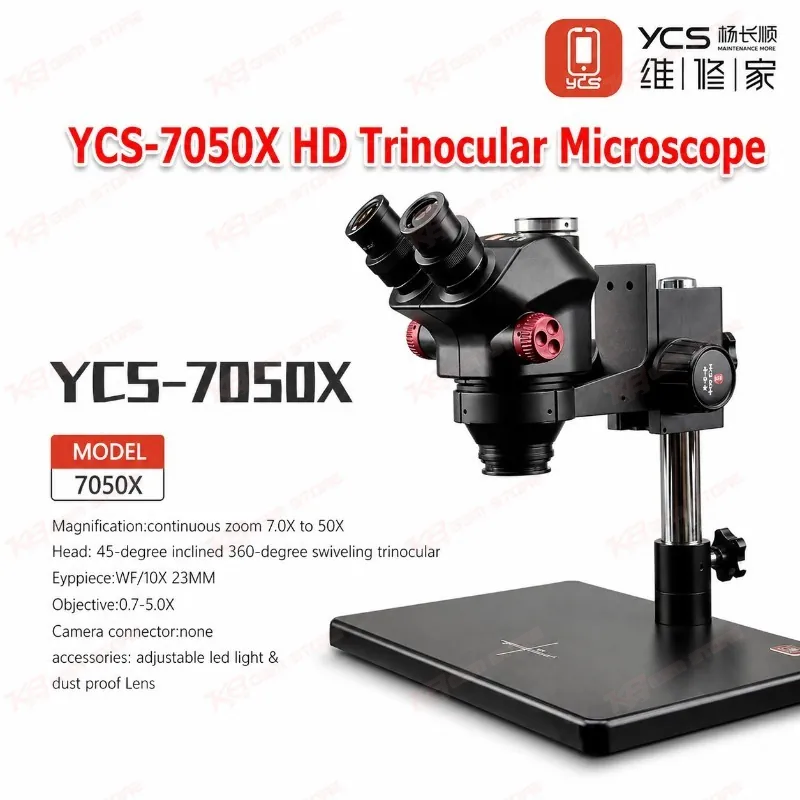
Board-level repair starts with what you can actually see. The YCS-7050X HD Trinocular Microscope gives your repair bench a continuous 7X to 50X stereo zoom, a dedicated camera port, and a 144 LED ring light on a heavy aluminum alloy base. Technicians across Pakistan face the same daily load: dead phone cases, charging issue jobs, network faults, and boards that hang on logo after a bad drop or water damage. Every one of these jobs ends at a tiny component, a cracked solder joint, or a shorted capacitor, and you need clean depth perception to reach it. This microscope keeps that view stable from the first inspection to the last solder joint.
The optical heart of the unit is a synchronous zoom stereo body with a 7X to 50X range. At the low end you see the full logic board, the shield frames, and the general layout, which helps you plan your route before you lift a single part. Turn the metal zoom knob and the view moves smoothly toward 50X, where you can read component markings, trace a burnt line, and judge the shape of individual BGA solder balls. The continuous zoom means you never jump between fixed steps and lose your focus point. Your hands stay on the tweezers and the soldering iron while the image changes under your eyes.
Stereo vision matters more than raw magnification on a repair bench. Two eyepieces give you true depth, so you can tell whether your iron tip touches the pad or floats a hair above it. The YCS-7050X uses WF10X/23mm wide-field eyepieces that give you a broad, comfortable field of view, and you can adjust them to match your own eyesight. The head sits at a 45-degree incline, which keeps your neck in a natural position during long shifts. It also swivels a full 360 degrees, so you can turn the head toward a second technician or reposition it without moving the whole stand.
The third optical path turns this unit into a trinocular microscope rather than a standard binocular one. A CTV lens adapter on top of the head lets you mount a microscope camera, and most microscope cameras, including HDMI 4K models, fit this setup. The camera image zooms in sync with the eyepieces, so whatever you see through the eyepieces also appears on the monitor at the same magnification. Training institutes use this to show students a live IC replacement on a big screen. Repair shop owners use it to record board condition before and after a job, which protects you when a customer questions a repair.
Lighting decides how much detail the optics can actually deliver. The YCS-7050X comes with a 144 LED ring light that surrounds the objective and spreads even illumination across the work area. That even spread cuts the dark shadows that hide hairline cracks, corrosion under shields, and lifted pads around a CPU or PMIC. When you check a water-damaged board, you spot green corrosion and white residue around connectors much faster under uniform light. Reflective solder and shiny shield frames still need careful angling, and the ring design gives you a consistent starting point every time you place a board under the lens.
Stability is the part most technicians underestimate until a cheap stand starts to shake. The YCS-7050X sits on a large aluminum alloy base that gives the stand a solid footprint and room for a PCB holder underneath. A steady base keeps the image still while you press down with tweezers, scrape solder mask, or work with hot air near the lens. The bracket assembly adjusts freely, so you can raise or lower the head to suit tall fixtures, reballing stencils, or a preheater platform. You set your working distance once and the stand holds it through the whole job.
Inside a real repair workflow, this microscope supports almost every hardware stage. During diagnostics you inspect the board after a multimeter or test box points you toward a faulty line. During rework you pair it with a hot air station to lift a charging IC, clean the pads, and confirm that no pad tore away. During reballing you check ball alignment on the stencil before reflow. During jumper work you guide a thin copper wire from a broken trace to the nearest test point with full control. For eMMC and UFS ISP work, it helps you locate tiny ISP pads and solder fine wires without bridging neighbouring points.
The YCS-7050X fits naturally into a complete KB GSM Store bench. Pair it with a Soldering Station and a Hot Air Station for daily rework, add a PCB Holder to keep the board flat under the lens, and keep a Reballing Kit nearby for CPU and memory jobs. Technicians who already run ISP Pinout Tools and eMMC Programmers gain the most, because accurate ISP wiring depends on clear vision at high zoom. When your shop grows into heavy board-level service, you can upgrade the setup with a 4K HDMI microscope camera and a dedicated monitor for full-screen work and customer demonstrations.
For repair shop owners checking the microscope price in Pakistan, the real value shows up in fewer damaged pads, fewer repeat jobs, and faster diagnosis on dead boards. A clear stereo view saves you from guessing, and guessing costs real money on expensive logic boards and flagship CPUs. Whether you run a small shop that handles charging port and display problem jobs, or a service center that takes on CPU reballing and hardware fault cases every day, the YCS-7050X gives your team a dependable optical base. Set it up once, tune the zoom and light to your hands, and it stays on your bench as the tool you reach for first on every board-level job.