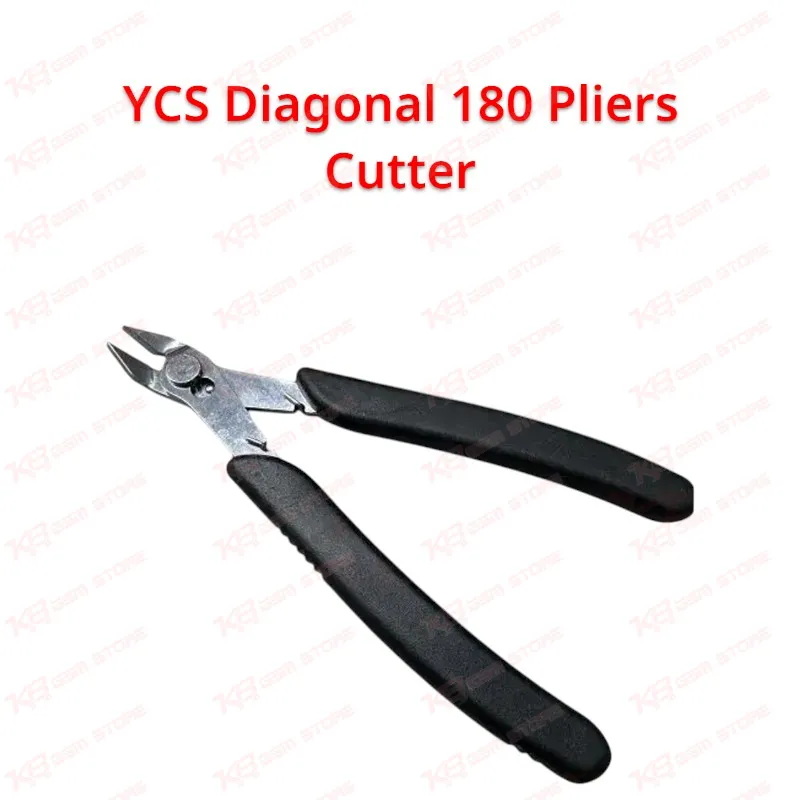
The YCS Diagonal 180 Pliers Cutter earns its place on the repair bench through the small jobs every technician repeats a dozen times a day. You trim a jumper wire after a charging issue repair, cut away a damaged flex section, snip cable ties off a box of incoming phones, or clip the excess leg from a through-hole part on an older board, and a reliable side cutter finishes each of those in one squeeze. YCS built its name in mobile repair hand tools, especially precision screwdrivers, and this diagonal cutter follows the same bench-first thinking: a simple tool that does one job well so you keep your focus on the actual fault. The angled jaw explains why diagonal cutters dominate electronics benches. The cutting edges sit at an offset angle to the handles, so you reach into a tray, a stripped-down frame, or a cluttered corner of the bench and still land the cut exactly where you want it without twisting your wrist. When a dead phone arrives with a broken battery connector and a chewed-up flex, that reach lets you remove the damaged section cleanly instead of tearing it. The 180 size class gives you a longer lever than the mini cutters most shops keep inside the screwdriver kit. Longer handles mean less hand force on thicker copper wire, multi-strand test leads, and the plastic spacers and sprues that ship with replacement housings and back panels. Anyone who builds their own test cables for a DC power supply or battery booster knows how quickly a tiny cutter struggles on thick wire, and this pliers cutter takes that prep work off your hands without the strain. Be clear about where it fits in your workflow. The YCS Diagonal 180 handles preparation and bench-side cutting, not fine-pitch cutting directly on the motherboard. During a hardware fault repair you use it to cut jumper wire to length, take solder wire off the spool, trim tinned leads, and clear zip ties and packaging while the board waits in a PCB holder under the microscope. Once you need to cut a jumper flush against a tiny pad beside a PMIC or charging IC, switch to a precision flush cutter or sharp tweezers, because a general-purpose diagonal cutter carries too much jaw for that space. Keeping both on the bench, each for its own job, protects the board and stretches the edge life of both tools. Edge care decides how long any cutter stays useful. Diagonal cutters hold their sharpness when you feed them the material they suit: copper wire, component leads, cable ties, wire insulation, and soft plastics. Keep them away from hardened steel wire, screws, and springs, since those nick the edges and leave you with a cutter that crushes the wire instead of cutting it. Wipe flux residue off the jaws after a soldering session, keep the tool clear of the hot air station nozzle, and park it in a tool rack rather than loose in a drawer where the edges knock against other steel tools. A typical Pakistani repair shop runs a soldering station, a hot air station, a multimeter, a microscope, and a reballing kit, and those expensive machines get most of the attention. Hand tools like this one decide how smoothly the small steps between them go. When your cutter works the first time, jumper prep for a network issue or display problem repair stays quick, and your hand stays fresh for the delicate soldering that follows. Training institutes also value a solid diagonal cutter as one of the first tools a new student learns to handle properly, because clean cutting habits carry straight into board-level work later. If you are setting up a new bench or replacing a worn-out cutter, pair the YCS Diagonal 180 Pliers Cutter with a precision flush cutter for on-board jumpers, a good set of tweezers, and a PCB holder, and you cover every cutting step from the wire spool to the final jumper. Check the latest YCS Diagonal 180 Pliers Cutter price in Pakistan on KB GSM Store and add it to your next tools order.