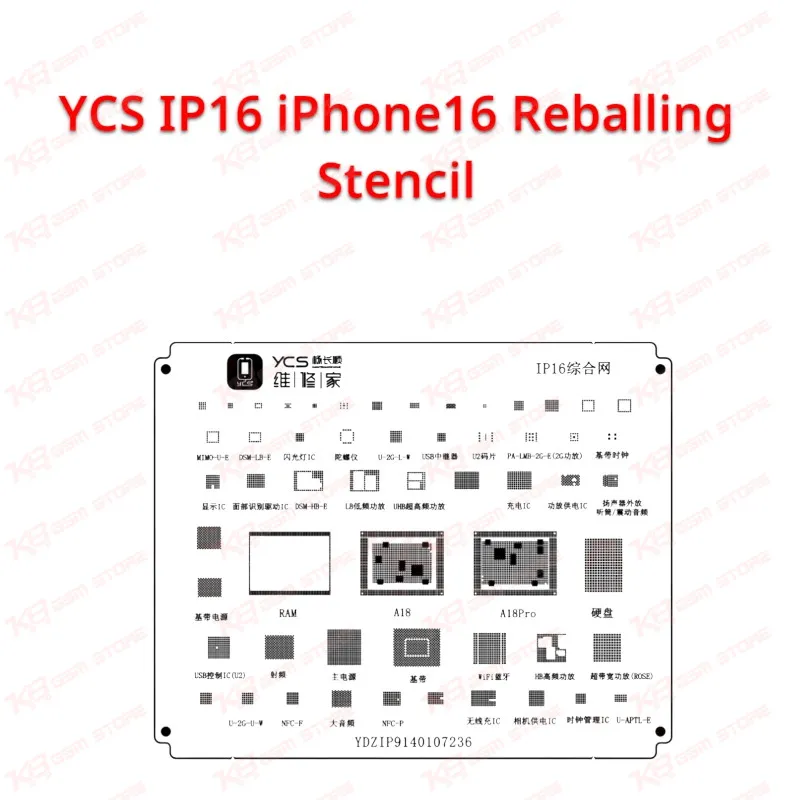
Every iPhone 16 board repair that involves a BGA chip reaches the same step sooner or later: the chip comes off the board, and its solder balls need rebuilding before it goes back on. The YCS IP16 iPhone16 Reballing Stencil handles that step for the complete iPhone 16 family. YCS builds it under its M.Y (Mr. Yang) stencil line as a model-specific steel mesh, so you skip the guesswork of hunting through a universal sheet for a window that only roughly matches. You pick the window for your chip, align it, and get on with the job.
Coverage spans the full iPhone 16 lineup: iPhone 16, iPhone 16 Plus, iPhone 16 Pro, iPhone 16 Pro Max and iPhone 16e. Apple packs these boards tightly, and the BGA chips on them use fine ball pitches that leave little room for error. A generic stencil with slightly mismatched apertures leaves uneven balls, and uneven balls give you a chip that sits crooked, misses pads and sends the phone straight back to your counter with the same fault. A stencil that matches this board generation removes that variable from your repair.
The workflow stays familiar for any technician who already reballs on the bench. Lift the faulty or suspect chip with your hot air station, then clean the old solder off the chip and the board pads with flux and desoldering wick until both surfaces sit flat. Fix the chip in position, lay the matching YCS IP16 window over it and line every hole up with a pad under the microscope. Spread solder paste across the openings with a scraper, wipe away the excess, and heat the mesh evenly until the paste pulls into shiny round balls. Let it cool, release the chip, inspect every ball, and refit the chip to the board.
The steel mesh resists the heat of repeated hot air cycles, so it stays flat through daily shop use instead of warping after a handful of jobs. A flat stencil matters more than many technicians realise, because a bowed mesh lifts away from the chip during heating and lets paste spread between holes. That spread creates the bridges you later fight with flux and a soldering iron. Clean the mesh with a soft brush and isopropyl alcohol after each job, and it stays ready for the next board.
In Pakistani repair shops, iPhone 16 boards reach the bench with the usual mix of faults: a dead phone after a drop, a phone stuck in a boot loop issue or hang on logo, a charging issue that survives a port replacement, or a network issue after water damage. When your diagnosis with a DC power supply and multimeter points to a chip with a cracked joint, reballing with the correct stencil gives that chip a fresh, even joint instead of a quick reflow that fails again within weeks. That difference protects your shop’s name, because a customer who returns with the same hardware fault rarely trusts the shop a second time.
This stencil belongs in your Reballing Kits range and works alongside the tools you already use for board-level work. Pair it with a reliable hot air station for controlled heat, a microscope for alignment, a PCB holder to keep the iPhone 16 board steady, and a soldering station for pad cleanup. If iPhone 16 jobs reach your bench regularly, a magnetic middle layer reballing platform for the iPhone 16 series makes a natural upgrade, since it adds a fixed base for sandwich board work next to chip-level reballing.
Shop owners who stock a dedicated stencil for each new iPhone generation spend less time per job and redo fewer repairs. The YCS IP16 iPhone16 Reballing Stencil keeps your iPhone 16 board work precise and repeatable, and KB GSM Store delivers it across Pakistan so you can add it to your bench without waiting on international orders.