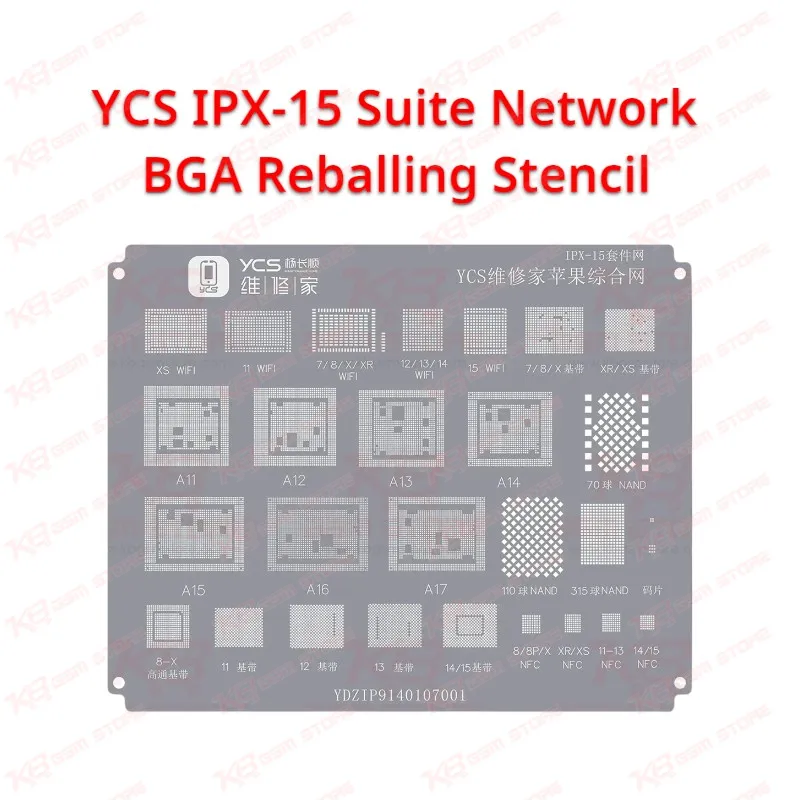
Network faults rank among the most common board-level jobs on a Pakistani repair bench, and most of them end at the same point: the chip in the network section needs to come off, get reballed, and go back on. The YCS IPX-15 Suite Network BGA Reballing Stencil exists for exactly that step. YCS built this suite around the network section of iPhone logic boards from the iPhone X generation through the iPhone 15 series, so you work with patterns cut for those packages instead of forcing a universal grid onto a chip it was never sized for. For a shop that handles iPhone no-service cases every week, a dedicated set saves real time and keeps your results predictable.
A typical job starts with diagnosis. You check for a missing IMEI, no baseband, or a constant searching status, then confirm the hardware fault with your multimeter in diode mode around the network section. Once you lift the IC with your hot air station, you clear the old solder with a soldering iron and desoldering wick, clean the pads with flux remover, and seat the chip under its matching aperture pattern. You then spread solder paste or load solder balls, scrape the surface level, and apply controlled heat until every ball forms. Lift the stencil, inspect the result under your microscope, and the chip is ready for refitting on the board.
Fine-pitch network chips leave very little margin for error. A pattern that sits slightly off center gives you uneven balls, missing joints, or bridges that short neighbouring pads, and that turns a simple network repair into a dead phone. Because the IPX-15 suite groups network-section patterns for several iPhone generations in one set, you match each chip to its correct opening quickly and keep alignment consistent from job to job. That consistency matters most when you rework the same model repeatedly, such as a run of iPhone 11 or iPhone 12 boards arriving with the same no-service complaint after a fall.
Heat control decides whether a stencil survives hundreds of jobs or warps after a few. Keep your hot air temperature moderate, spread the airflow evenly across the surface, and avoid parking the nozzle on one corner. Let the stencil and chip cool before you separate them, because pulling a hot stencil drags balls out of position and forces you to start again. Clean the stencil with IPA after every job so dried flux never blocks the small apertures. With that routine, your stencil stays flat, your ball height stays even, and you get a reliable joint when the chip goes back onto the board.
This stencil set sits inside a complete reballing toolkit rather than replacing one. Pair it with a PCB holder to hold the board steady, a quality flux, solder paste matched to your preferred melting point, fine precision tweezers, and a stereo microscope for inspection. Keep a DC power supply on the bench to check current draw after reassembly, before the phone goes back to the customer. Technicians who move into full board swaps or CPU-level work on iPhone often upgrade to a magnetic middle-frame reballing platform, and our Reballing Kits, PCB Holders, Hot Air Stations, and Microscopes categories carry options for every stage of that workflow.
Repair shops in Lahore, Karachi, Islamabad, and smaller cities all face the same iPhone network complaints, and customers reward the technician who fixes the fault on the first attempt. The YCS IPX-15 Suite Network BGA Reballing Stencil gives your bench a focused, model-matched tool for that work, whether you run a busy service center or a single-counter shop building its iPhone board-repair skills. Check the current YCS IPX-15 price in Pakistan on KB GSM Store and add it alongside your flux, paste, and hot air setup for a complete network repair workflow.