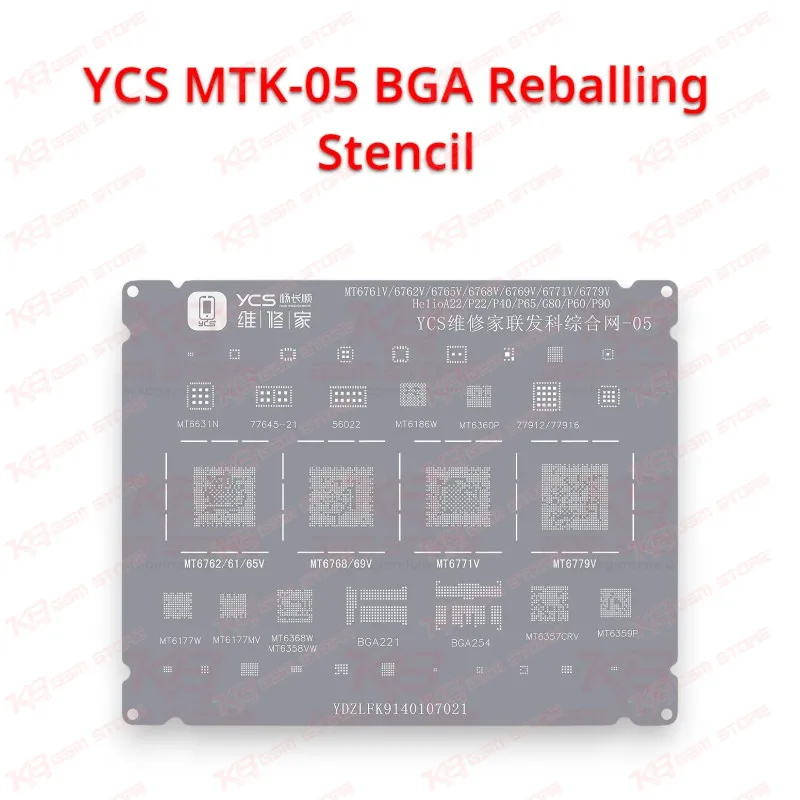
The YCS MTK-05 BGA Reballing Stencil gives your repair bench a dedicated steel mesh for MediaTek processor work, so you stop fighting a universal stencil every time an MTK phone lands on your table with a hardware fault. CPU reballing decides whether a dead phone comes back or goes into the scrap box, and the stencil you choose controls ball size, ball height, and whether the IC sits flat on the board again. YCS builds its chip repair stencils from imported alloy steel and calibrates each mesh against the original chip drawings, so the aperture pattern follows the real ball map of the MediaTek package instead of an approximate grid.
In a Pakistani repair shop, MediaTek handsets make up a large share of the daily Android workload, and many of the toughest jobs trace back to the processor. A phone that shows hang on logo after a drop, a boot loop issue that survives every flash, or a set that died after water damage often points to cracked or corroded CPU solder joints. Once you lift the chip with your hot air station, you clean the pads, apply fresh solder paste through a matching stencil, and rebuild every ball at an even height. The YCS MTK-05 BGA Reballing Stencil handles that rebuild stage, and you get repeatable results because the mesh matches the MTK footprint rather than forcing you to mask off unused holes on a generic sheet.
The steel matters as much as the pattern. Cheap stencils warp the moment hot air hits them, the mesh lifts off the chip, and paste bleeds between neighbouring holes to create bridges. YCS rates this stencil for an operating range of minus 50 to 500 degrees Celsius, and the alloy keeps its spring, so the sheet returns flat after every heating cycle. That flatness keeps each aperture sealed against its pad while the paste melts, and you lift the stencil to find clean, separate balls instead of a smeared mess. The rounded-corner aperture design helps molten solder pull into a full, uniform sphere and release cleanly from the mesh, which cuts the rework passes that eat your time and stress the chip.
For a smooth workflow, set the CPU in a BGA reballing platform or a magnetic stencil holder, align the YCS MTK-05 mesh under your microscope, and spread solder paste with a flat scraper. Heat evenly from your hot air station with a wide nozzle and moderate airflow so the stencil stays put. After the balls form, clean the chip with IPA and inspect every row under magnification before you place it back on the board. Pair this stencil with quality flux, a fine-tip soldering station for pad cleaning, desoldering wick for levelling, and a PCB holder that keeps the board steady. When your shop volume grows and you start taking MTK board work from other technicians, a complete multi-pattern stencil set and a dedicated reballing jig make the natural upgrade.
The stencil earns its place beyond full CPU swaps. You reach for it when you move a working processor from a donor board, when a previous repair left uneven balls, or when a chip shows intermittent contact that causes random restarts after a fall. Each of these jobs depends on accurate ball placement, and a matched stencil turns a risky job into a controlled process you can repeat on the next phone.
KB GSM Store stocks YCS stencils for technicians across Lahore, Karachi, Islamabad, and the rest of Pakistan who want dependable BGA tools without guesswork. Check the chip marking and ball layout on your board against the stencil pattern before you start, and you get a clean, flat reball that lets the CPU seat properly and the phone boot again.