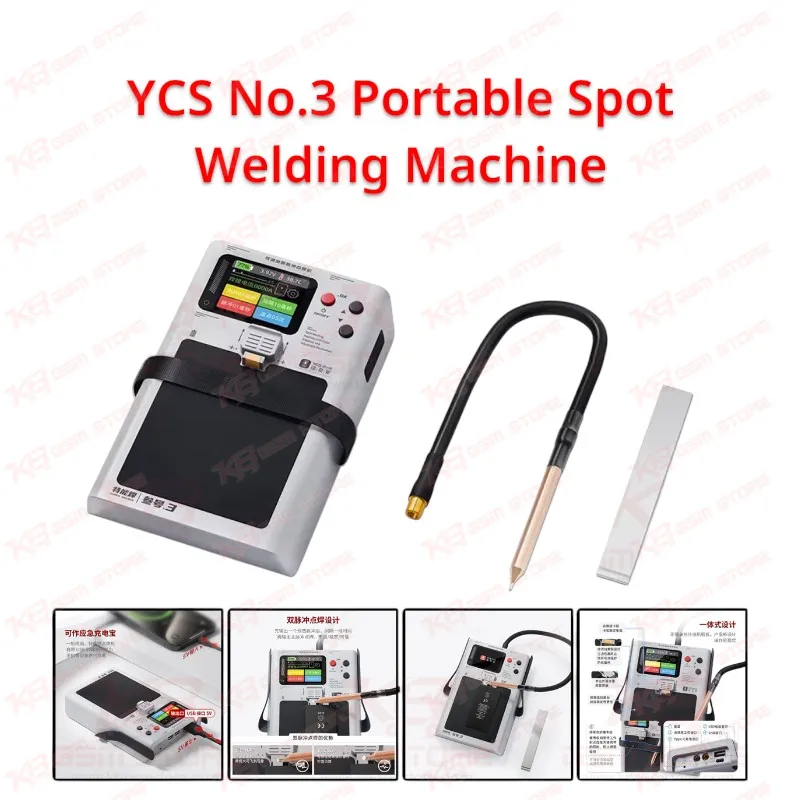
The YCS No.3 Portable Spot Welding Machine gives your repair bench a clean way to fix battery tabs without a soldering iron cooking the cell. Every Pakistani repair shop sees the same battery faults: a dead phone that refuses to charge, a power bank that dies after a week, a lithium pack with a snapped nickel strip. Soldering directly onto a cell holds heat on the casing for too long, and that shortens the cell's life. Spot welding delivers its heat in a split second at one small point, so the cell stays cool and the joint stays strong. The YCS No.3 targets exactly this job. It welds nickel tabs onto 18650 and 21700 cells from a digital, portable body.The double-pulse design is the feature that matters most on the bench. The machine fires a pre-heat pulse first, and that pulse clears the oxidation layer off the metal surface. The main pulse follows and makes the actual weld. Oxidised nickel and dirty cell terminals cause most failed welds with cheap single-pulse tools, so the pre-heat stage gives you a more reliable joint on the first attempt. When you rebuild a pack for a customer, a weld that holds on the first try saves you from rework and from a returned job.You control the process from the digital display. The YCS No.3 lets you adjust the welding speed, and it lets you tune the pre-heat pulse and main pulse to suit the task. A thin tab on a small cell needs less energy than a thicker strip on a larger one, and the adjustable settings let you match the output to the job instead of guessing. Start low, test on a scrap piece of nickel, and raise the setting only until the weld holds. You avoid burn-through, and you protect the cell underneath.
The machine supports 18650 lithium batteries, and its tab welding covers both 18650 and 21700 cell formats. That scope fits the daily work in a mobile repair shop. You pick up a worn-out power bank, a laptop battery module, or a hardware fault caused by a loose battery tab, and you handle the repair at your own bench. Many technicians send this kind of job out or turn it away. With a spot welder on your table, you keep the job and the margin.
Size and handling make the YCS No.3 practical in a busy workshop. The compact, lightweight body takes little space beside your hot air station and soldering station, and you can carry it to a customer's location or another shop when you need to. The clear display keeps your settings visible while you work, so you do not interrupt your rhythm to check a dial.Place the YCS No.3 where it belongs in your repair workflow. You diagnose first. A multimeter tells you whether a pack holds voltage or sits dead, and a microscope helps you inspect the tabs, the protection board, and the solder joints on the board. Once you confirm that the fault sits in the tab or the pack structure, you remove the failed strip, clean the terminal, and weld the new nickel tab with the spot welder. A PCB holder keeps the protection board steady when you reconnect it, and your soldering station handles the board-side connections. The spot welder covers the cell side, and the soldering tools cover the circuit side. Together they let you finish the whole battery job at one bench.Safety deserves a clear word, because lithium cells punish carelessness. Inspect every cell before you weld. Skip any cell that looks swollen, leaks, or shows physical damage, and never weld on a damaged cell. Keep a fire-safe surface under your work area, wear eye protection, and keep metal tools away from exposed terminals so you avoid shorting the pack. Welding a healthy cell with sensible settings carries far less risk than holding a hot iron on it for ten seconds.If you search for a spot welding machine price in Pakistan, you will see a range of options from entry-level handheld units to heavier industrial machines. The YCS No.3 sits in the portable, battery-pack category. It suits technicians who rebuild battery packs and fix tab faults on 18650 and 21700 cells. If your shop later moves into heavier pack building or thicker material, you can step up to a higher-capacity spot welder, and the habits you build on this machine carry over directly.Choose the YCS No.3 if you want a digital, adjustable, double-pulse tool that handles daily battery tab repair on your bench. It pays for itself the first few times you keep a battery job in-house instead of sending your customer elsewhere.