


Mega Idea Universal Multi functional Stencil
Mega Idea Universal Multi functional Stencil
Regular price
Rs.800.00 PKR
Regular price
Rs.999.00 PKR
Sale price
Rs.800.00 PKR
Shipping calculated at checkout.
Quantity
Couldn't load pickup availability
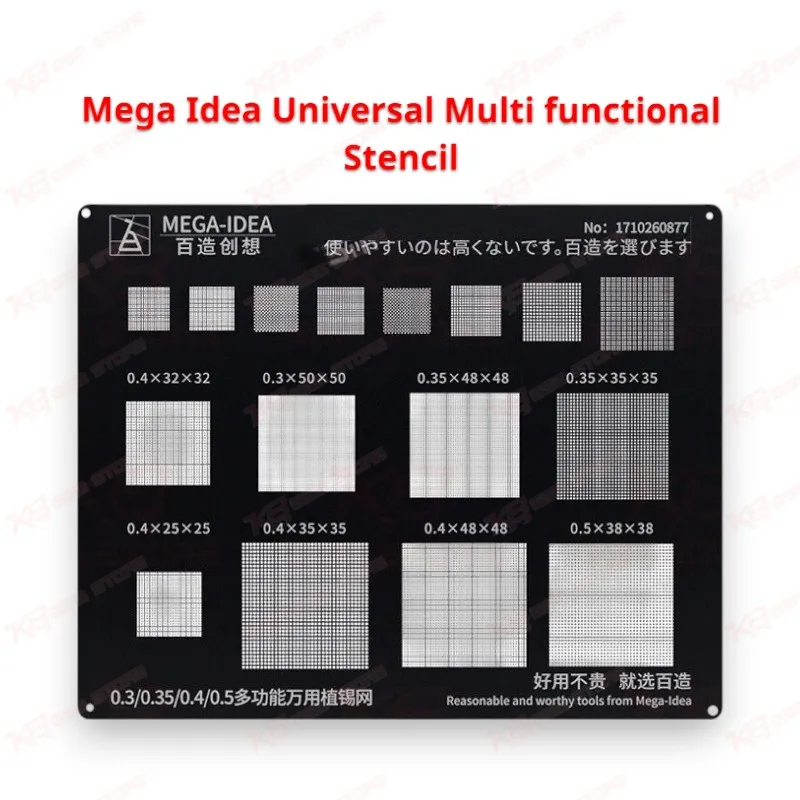
Mega Idea Universal Multi functional Stencil helps you reball mobile phone BGA chips with one black template instead of a separate plate for every chip. You get 0.3mm, 0.35mm, 0.4mm, and 0.5mm hole sizes in parallel, 45-degree, and dislocation layouts, so you match the ball pitch you see under your microscope and rebuild a clean solder ball array after chip removal. The 0.12mm plate suits CPU, eMMC, UFS, and power IC rework on dead phone, boot loop, and hang on logo boards. Pair it with a hot air station, reballing kit, and PCB holder on your repair bench, and order it from KB GSM Store in Pakistan.
SKU:MST-SOLDERING-ACCESSORIES-1101
⚖️ Weight: 0.5 kg
- Safe & Secure Payment
- Fast Delivery
- WhatsApp Support


Description
FAQ
What is the product name?
The product name is Mega Idea Universal Multi functional Stencil.
What is the brand of this product?
The brand of this product is Qianli Mega-Idea.
What is the model of this product?
The model of this product is BZ-26.
What is this product used for?
This product is used for reballing mobile phone BGA chips by rebuilding a solder ball array on the pads.
Which devices are compatible with this product?
This product is universal and not device-specific. It works with BGA chips whose ball size and layout match the 0.3mm, 0.35mm, 0.4mm, or 0.5mm arrays on the plate.
Who should use this product?
This product is suitable for mobile repair technicians, repair shops, service centers, and professional users.
Which ball sizes does this stencil cover?
The stencil covers 0.3mm, 0.35mm, 0.4mm, and 0.5mm hole sizes.
Which hole layouts does this stencil include?
The stencil includes parallel holes, 45-degree holes, and dislocation holes.