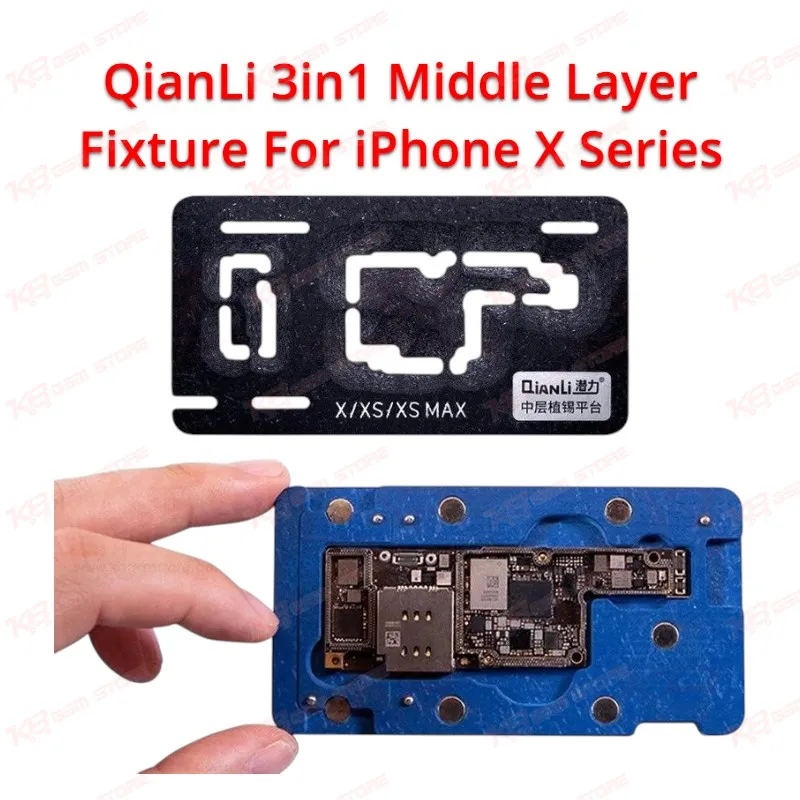
On an iPhone X, XS, or XS Max motherboard, the CPU and several other ICs sit on a section of the board called the middle layer — a thin strip sandwiched between the upper and lower board halves. When you separate the board for a CPU repair, backlight fix, or NAND replacement, that middle layer has to come off cleanly and go back on without shifting a single solder ball. Do this by hand on a flat mat and you risk chip virtual welding, tin bridging, or a burnt board, problems that turn a straightforward repair into a dead phone. The QianLi 3in1 middle frame reballing fixture solves that by giving the layer a fixed, heat-safe home during the entire rework.The base platform seats the motherboard so the middle layer sits flush and doesn't move once you apply the hot air gun. Because the body is built from heat resistant synthetic stone rather than plastic or thin metal, it absorbs and disperses heat slowly instead of transferring it straight into your worktop or your hands. That matters when you're running a hot air station at reballing temperatures for several minutes at a stretch. A fixture that heats up too fast becomes a hazard, and one that warps throws off your positioning halfway through the job.This set covers three models with three separate stencil platforms rather than one generic template. iPhone X gets its own stencil, and XS/XS Max get a matched pair, one for the main section and one for the left part of the XS Max board, since the pad layout shifts slightly between the two. Drop the correct stencil onto the base, line up the board, and the pad pattern matches the middle layer exactly. That precision positioning is what separates a clean reball from a repair that comes back with a hang on logo issue or intermittent boot loop two weeks later.Workflow on the bench looks like this: place the disassembled logic board into the lower section of the platform, fit the stencil that matches the model you're working on, apply reballing solder paste through the stencil openings, lift the stencil away, then run your hot air gun over the exposed pads to reflow and bond the middle layer back onto the board. The fixture holds everything steady through each stage, so you're not fighting the board while you're also managing heat and paste application.For a repair shop running iPhone X-series boards regularly, this fixture earns its place for a simple reason: layer separation and reassembly is one of the most repeat-heavy steps in chip-level work. Every time you need to get back into the board, whether that's a second attempt at a CPU reball, an IC change karna job that didn't take the first time, or a diagnosis that turns out to need another look, you're separating and rejoining that middle layer again. Doing it freehand each time multiplies the chance of pad damage. A dedicated platform keeps that risk low across dozens of repeat jobs instead of just the first one.The synthetic stone build also means the platform doesn't degrade the way rubber mats or printed jigs do under repeated heat cycles. It stays flat, keeps its shape, and doesn't scorch the way lower-grade materials do when you're running hot air close to the surface. For a technician doing this kind of rework daily, that durability translates into consistent results job after job rather than a fixture that needs replacing every few months.Pairing this fixture with a hot air rework station gives you full control over the reballing temperature profile, and a stereo microscope afterward lets you confirm solder ball formation before you close the board back up. Skipping that inspection step is how repeat faults slip through, since a joint that looks fine to the naked eye can still be a cold joint under magnification.At 102mm x 60mm x 18mm and roughly 140 grams, the whole three-piece stencil set and base tuck into a small tray or drawer on the bench without taking up dedicated space, and the black finish makes solder residue and flux easy to spot and clean off between jobs. If your bench regularly sees iPhone X, XS, and XS Max boards for CPU issues, charging problems, or any repair that requires layer separation, this fixture removes the guesswork from a step that has zero margin for error. It's built for one specific job and does it precisely, which is exactly what middle-layer reballing calls for.