Skip to product information
1 of 5

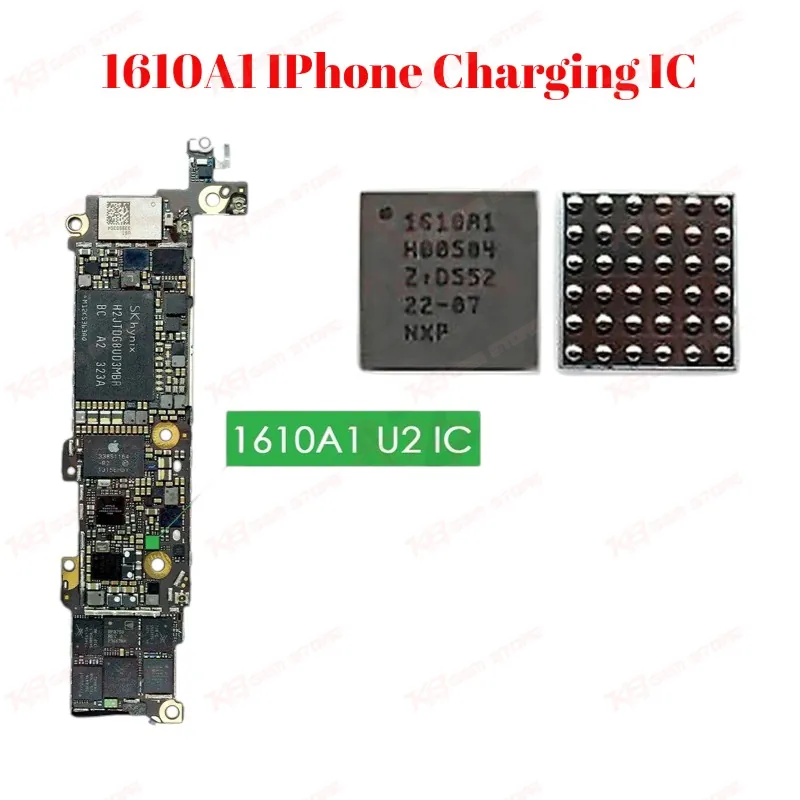
1610A1 IPhone Charging IC

1610A1 IPhone Charging IC

Regular price Rs.200.00 PKR
Regular price Sale price Rs.200.00 PKR
Sale Sold out
Shipping calculated at checkout.
Quantity

A customer walks in with a phone that won't charge, the port tests clean, the battery holds voltage, and the real fault is sitting under the tristar. The 1610A1 is that chip — NXP's original tristar, marked U2, U1300, or U6000 depending on the board, and it manages every handshake between the Lightning connector and the charging circuit. This part fits iPhone 5S, iPhone 5C, iPad Air, iPad Mini 2, and iPad Mini 3 boards. Reach for it when a board shows no current draw, won't show up on iTunes or Finder, or went dead right after a flash with no charging response at all.

⚖️ Weight: 0.01 kg

SKU:MST-IC-223

  • Safe & Secure Payment
  • Fast Delivery
  • WhatsApp Support
View full details

Description

A repair bench sees the same pattern over and over: phone won't charge, port looks fine, battery reads good voltage, and the technician ends up staring at the tristar spot on the board. That's the 1610A1 — NXP built it as the first-generation Tristar IC, and Apple used it across the iPhone 5S, iPhone 5C, iPad Air, iPad Mini 2, and iPad Mini 3. On the board it goes by U2, U1300, or U6000 depending on which device you're working on, but it's the same chip doing the same job everywhere it appears.The workflow starts the moment a charger gets plugged into the Lightning port. The tristar reads what got connected, negotiates how much power the device should draw, and routes the USB data and audio lines to wherever they need to go next. None of that happens quietly in the background if the chip has failed — the phone stops drawing current, refuses to register on a computer, or shows nothing on screen even with a charger connected for an hour.Dead-after-flash cases are where this chip earns its reputation. A board that powered up fine before a restore, then went completely unresponsive afterward with zero charging behavior, points straight at the tristar more often than the battery or the flex cable. Confirm it the way any board-level tech would: check the pads under the chip for a short to ground or an open line, since a failed 1610A1 tends to do one or the other rather than degrading gracefully.Fitting this chip correctly matters as much as diagnosing the fault. The 1610A1 is the original spec for 5S, 5C, and iPad Air boards specifically — later boards moved on to the 1610A2 for the iPhone 6/6 Plus, then the 1610A3 for the SE and 6S generation. Some of these later revisions get used as cross-replacements on older boards, but that swap needs the pinout and firmware behavior confirmed first, because a mismatched tristar can leave a phone charging but failing every restore attempt afterward.This is a fine-pitch BGA part, and the removal step decides whether the repair goes smoothly or turns into a bigger job. Splitting the balls evenly during a clean pull keeps the pads intact for the replacement chip — rush that step with a hot air gun and no scope, and a bridged pad under the tristar turns a fifteen-minute IC swap into a full pad-repair session. Anyone doing this work regularly keeps a microscope on the bench specifically for this reason.Liquid damage brings this chip up just as often as flash failures do. Moisture that gets into the Lightning port travels straight along the charging traces, and the tristar sits right in that path. A board that shows corrosion near the charging connector, along with charging issue symptoms that won't clear up after cleaning, usually needs the 1610A1 checked and replaced rather than just the port itself.For a shop handling a steady flow of 5S, 5C, and iPad Air units, stocking this alongside the 1610A2 and 1610A3 covers the full tristar lineup in one drawer. Paired with a proper BGA rework station, this becomes a repair that technicians can quote and complete with real confidence, rather than a swap-and-hope job on the charging port.

Key Features

First-generation NXP tristar matching original factory spec for 5S, 5C, and iPad Air boards

Manages charger detection and USB data negotiation at the Lightning connector

Correct part for dead-after-flash and no-charging diagnostics on this board generation

Fine-pitch BGA package built for microscope-assisted rework

Cross-references with 1610A2 and 1610A3 for shops running mixed-device diagnostics

Fixes the actual charging-line fault instead of replacing the whole port assembly

Handles liquid-damage recovery jobs where the charging line shows a short or corrosion

Works with the same hot air and BGA rework setup already used for Apple board repair

Specifications

Brand Entity NXP
Product Entity 1610A1 Tristar IC (U2/U1300/U6000)
Technology Entity USB Protocol Negotiation and Charger Detection
Compatible Device Entities iPhone 5S, iPhone 5C, iPad Air, iPad Mini 2, iPad Mini 3
Repair Process Entity BGA Reballing and Board-Level IC Replacement
Industry Entity Mobile Phone PCB Repair and Component-Level Servicing

Compatible Devices

iPhone 5S, iPhone 5C, iPad Air, iPad Mini 2, iPad Mini 3 — board designation U2 / U1300 / U6000 depending on device

Common Repair Uses

No-charging and no-current-draw board repair, dead-after-flash diagnostics, USB/computer detection failure fixes, liquid-damage recovery on the charging line, and BGA reballing practice on genuine Apple charging hardware

FAQ

What is the product name?
The product name is the 1610A1 tristar IC, commonly called the U2 chip.
What is the brand of this product?
The brand of this product is NXP.
What is the model of this product?
The model of this product is 1610A1.
What is this product used for?
This product replaces a failed tristar IC that manages charger detection and USB data negotiation on the board.
Which devices are compatible with this product?
This product is compatible with the iPhone 5S, iPhone 5C, iPad Air, iPad Mini 2, and iPad Mini 3.
Who should use this product?
This product is suitable for mobile repair technicians, repair shops, service centers, and professional board-level repair businesses.
How do I confirm the 1610A1 is the actual fault instead of the charging port?
Check the pads under the chip for a short to ground or an open line while the port and battery test normally, since that pattern points to the tristar rather than the port.
Is the 1610A1 safe to reball with a standard hot air station?
Yes, but a clean pull under a microscope is strongly recommended, since the fine-pitch pads under this chip are easy to bridge or lift with hot air alone.

Ask any Query