


2UUL
2UUL BH17 CPU REBALL BASE Magnetic Dual-Sided Reballing Platform Set
2UUL BH17 CPU REBALL BASE Magnetic Dual-Sided Reballing Platform Set
Brand:
2UUL
Regular price
Rs.14,999.00 PKR
Regular price
Rs.16,500.00 PKR
Sale price
Rs.14,999.00 PKR
Shipping calculated at checkout.
Quantity
Couldn't load pickup availability
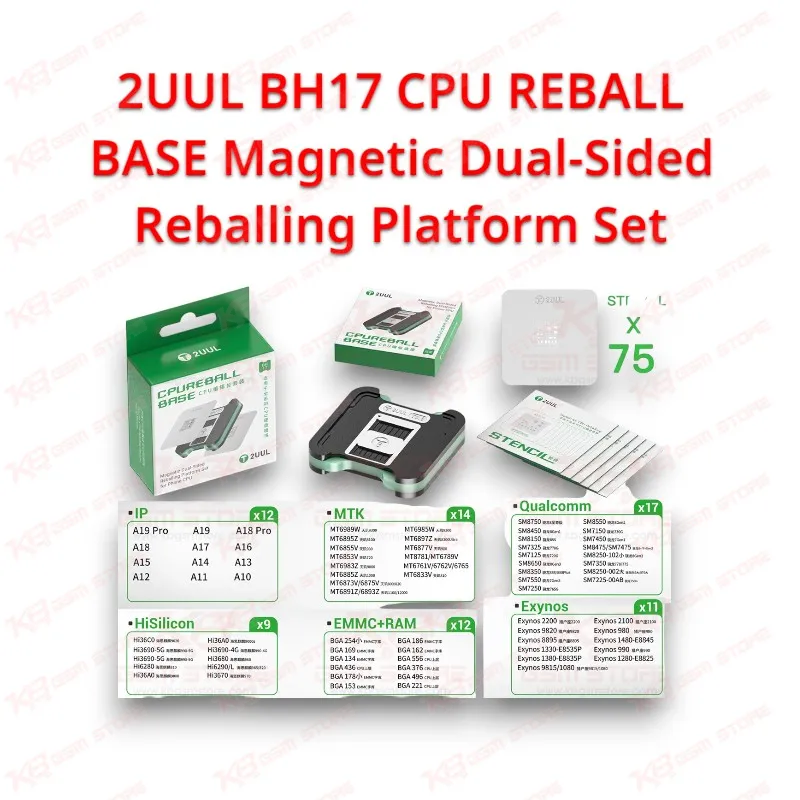
The 2UUL BH17 CPU REBALL BASE Magnetic Dual-Sided Reballing Platform Set gives you a compact aluminum fixture with two working sides and 75 stencils for CPU and memory reballing. One side carries T0.6 thickness for Apple CPUs and the other carries T0.35 for Android CPUs, so you switch jobs without swapping tools. Built-in magnets hold the chip still while you place balls and run hot air. The stencil library covers iPhone A10 to A19 Pro, Qualcomm, Exynos, HiSilicon, MediaTek, and eMMC plus RAM footprints. If dead phone and boot loop issue boards reach your repair bench every day, this platform keeps every reball fast, aligned, and repeatable.


Description
FAQ
What is the product name?
The product name is 2UUL BH17 CPU REBALL BASE Magnetic Dual-Sided Reballing Platform Set.
What is the brand of this product?
The brand of this product is 2UUL.
What is the model of this product?
The model of this product is BH17.
What is this product used for?
This product is used for holding mobile CPUs and memory chips in position while you reball them with stencils.
Which devices are compatible with this product?
This product supports iPhone A10 to A19 Pro CPUs and Qualcomm, HiSilicon, Exynos, MediaTek, and eMMC plus RAM chips through its 75 included stencils.
Who should use this product?
This product is suitable for mobile repair technicians, repair shops, service centers, and professional users.
Does the BH17 handle both Apple and Android CPUs?
Yes. The T0.6 side suits Apple CPUs and the T0.35 side suits Android CPUs, so you flip the base between jobs.
Which stencil families come with the BH17 reball base?
The set includes 12 iPhone, 17 Qualcomm, 9 HiSilicon, 11 Exynos, 14 MediaTek, and 12 eMMC plus RAM stencils, 75 in total.