


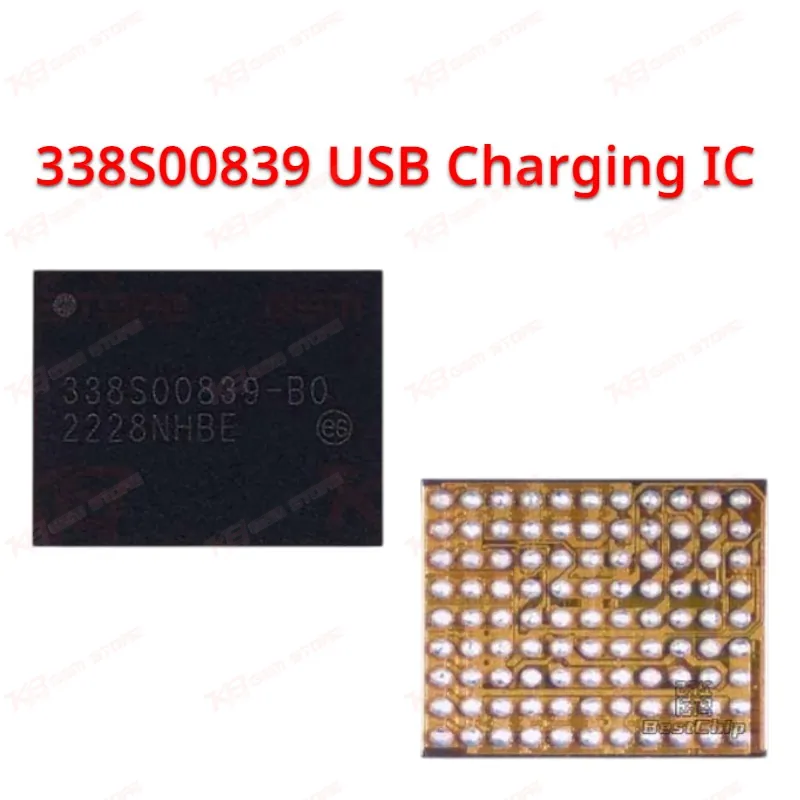
338S00839 USB Charging IC
338S00839 USB Charging IC
Regular price
Rs.650.00 PKR
Regular price
Sale price
Rs.650.00 PKR
Shipping calculated at checkout.
Quantity
Couldn't load pickup availability
The 338S00839, known in the repair trade as the Tigris charging IC, handles USB power delivery and charge management on iPhone 14, 14 Plus, 14 Pro, and 14 Pro Max logic boards. Technicians reach for this chip when a phone shows no charging, intermittent charging, or gets stuck at "Accessory not supported" after liquid damage or a board short. Board-level techs commonly reference it as U4001 on the schematic. This BGA component requires proper reballing and hot air rework skills for a clean reflow. Stock it for your iPhone 14 series charging port and power bench jobs.
⚖️ Weight: 0.01 kg
SKU:MST-IC-289
- Safe & Secure Payment
- Fast Delivery
- WhatsApp Support


Description
FAQ
What is the product name?
The product name is the 338S00839 USB Charging IC, also known as the Tigris charging IC.
What is the brand of this product?
This is an Apple-designed component used across genuine iPhone 14 series logic boards.
What is the model of this product?
The model is 338S00839, commonly referenced as U4001 on the schematic.
What is this product used for?
It manages USB charging power delivery on the board and is replaced to fix no-charging or intermittent-charging faults.
Which devices are compatible with this product?
It is compatible with iPhone 14, iPhone 14 Plus, iPhone 14 Pro, and iPhone 14 Pro Max only.
Who should use this product?
This product is suitable for mobile repair technicians, repair shops, service centers, and professional board-level repair users.
Can I use the 338S00839 on an iPhone 13 or iPhone 15 board?
No — iPhone 13 series boards use the 338S00770 chip and iPhone 15 series boards use the 338S00946; installing the wrong generation won't fix charging and can create a new fault.
Does replacing this IC require a hot air rework station?
Yes — the chip is a BGA package, so you need a hot air station with a suitable stencil and a proper reballing process for a clean reflow.