


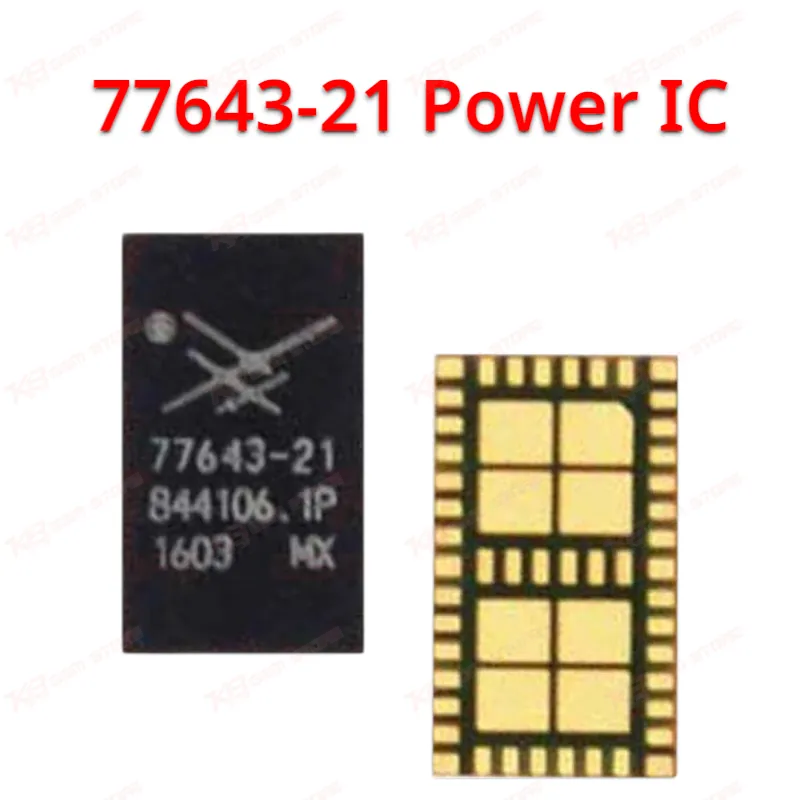
77643-21 Power IC
77643-21 Power IC
Regular price
Rs.450.00 PKR
Regular price
Sale price
Rs.450.00 PKR
Shipping calculated at checkout.
Quantity
Couldn't load pickup availability
The 77643-21 (Skyworks SKY77643-21) is a multimode multiband power amplifier IC built for the RF transmit chain in 3G and 4G/LTE mobile devices. This surface-mount PA module handles WCDMA, TD-SCDMA, HSDPA, HSUPA, and HSPA+ signal amplification across a 700 MHz to 2.6 GHz frequency range, making it a common network/signal IC replacement on Android motherboards. Technicians reach for this chip when a board shows no network, weak signal, or a dead-after-flash fault traced back to the RF front-end. Genuine, tested stock at KB GSM Store gives your repair bench a reliable part for board-level network faults.
⚖️ Weight: 0.02 kg
SKU:MST-IC-269
- Safe & Secure Payment
- Fast Delivery
- WhatsApp Support


Description
FAQ
What is the product name?
The product name is the 77643-21 Power Amplifier IC (Skyworks SKY77643-21).
What is the brand of this product?
The brand of this product is Skyworks Solutions.
What is the model of this product?
The model of this product is SKY77643-21, commonly listed in the aftermarket as 77643-21.
What is this product used for?
This product is used to amplify the RF transmit signal in 3G and 4G/LTE mobile phones as part of the network front-end.
Which devices are compatible with this product?
This is a universal, non-device-specific RF power amplifier used across various Android smartphone motherboards with 3G/4G-LTE RF front-end designs.
Who should use this product?
This product is suitable for mobile repair technicians, repair shops, service centers, and professional users handling network and signal faults.
Which network bands does the SKY77643-21 support?
It covers a 700 MHz to 2.6 GHz frequency range and supports WCDMA, TD-SCDMA, HSDPA, HSUPA, and HSPA+ standards on 3G, plus 4G/LTE.
Is a hot air station required to replace this IC?
Yes, replacing this 42-pad MCM package requires a hot air station with controlled temperature and a PCB holder to keep the board stable during reflow and reballing.