


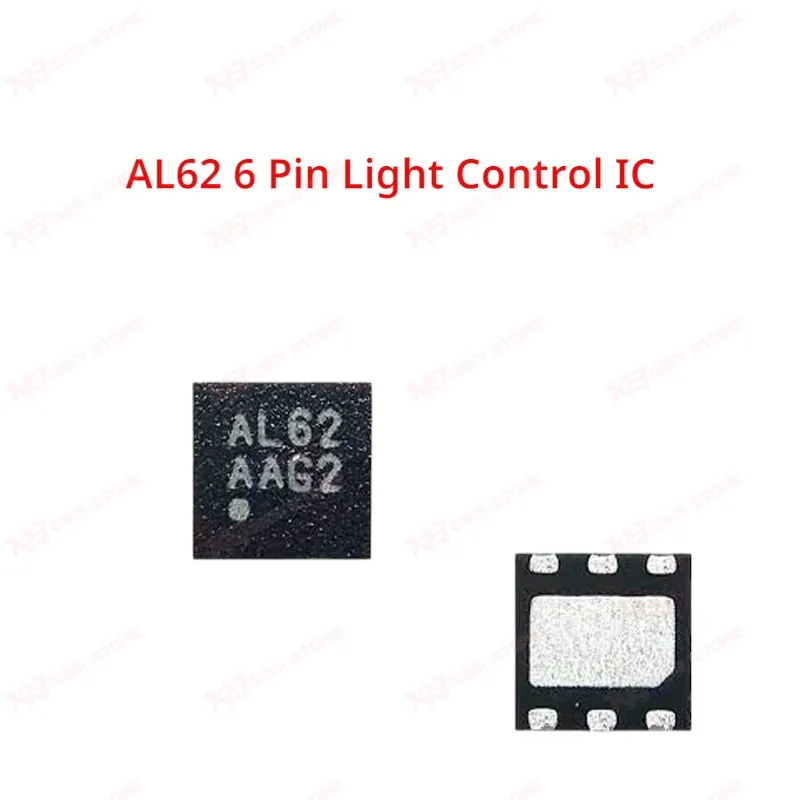
AL62 6 Pin Light Control IC
AL62 6 Pin Light Control IC
Regular price
Rs.250.00 PKR
Regular price
Sale price
Rs.250.00 PKR
Shipping calculated at checkout.
Quantity
Couldn't load pickup availability
The AL62 6 Pin Light Control IC (AW9962DNR) is a PWM white LED driver used to control display backlight brightness on smartphone motherboards. Housed in a compact TDFN2x2-6L package, it regulates the LED string that lights up the screen and supports CABC-based brightness adaptation. Technicians reach for this IC when a board shows a dead backlight, dim display light, or flickering screen light while the panel itself still works. Genuine, tested stock, ready for board-level micro soldering at your repair bench.
⚖️ Weight: 0.01 kg
SKU:MST-IC-186
- Safe & Secure Payment
- Fast Delivery
- WhatsApp Support


Description
FAQ
What is the product name?
The product name is AL62 6 Pin Light Control IC.
What is the brand of this product?
The brand of this product is Awinic, marked AL62 on the package (part number AW9962DNR).
What is the model of this product?
The model is AL62, corresponding to the AW9962DNR PWM white LED driver.
What is this product used for?
You use this IC to restore or replace the backlight driver circuit on a mobile phone board, fixing dead, dim, or flickering display backlight faults.
Which devices are compatible with this product?
It fits boards from the Huawei Enjoy 8E series, Oppo A5 and A71, and Vivo Y93 and 8e/4e/7a series that use the AL61/AL62/AL65 backlight driver footprint.
Who should use this product?
This product is suitable for mobile repair technicians, repair shops, service centers, and professional users.
Does the AL62 IC support CABC brightness control?
Yes, the AL62 (AW9962DNR) includes a PWM control input built for CABC operation, so it works with panels that use adaptive backlight switching.
How many LEDs can the AL62 backlight IC drive safely?
The AL62 carries 38V over-voltage protection and is rated to drive up to 10 LEDs in series, matching typical smartphone backlight strings.