Skip to product information
1 of 4

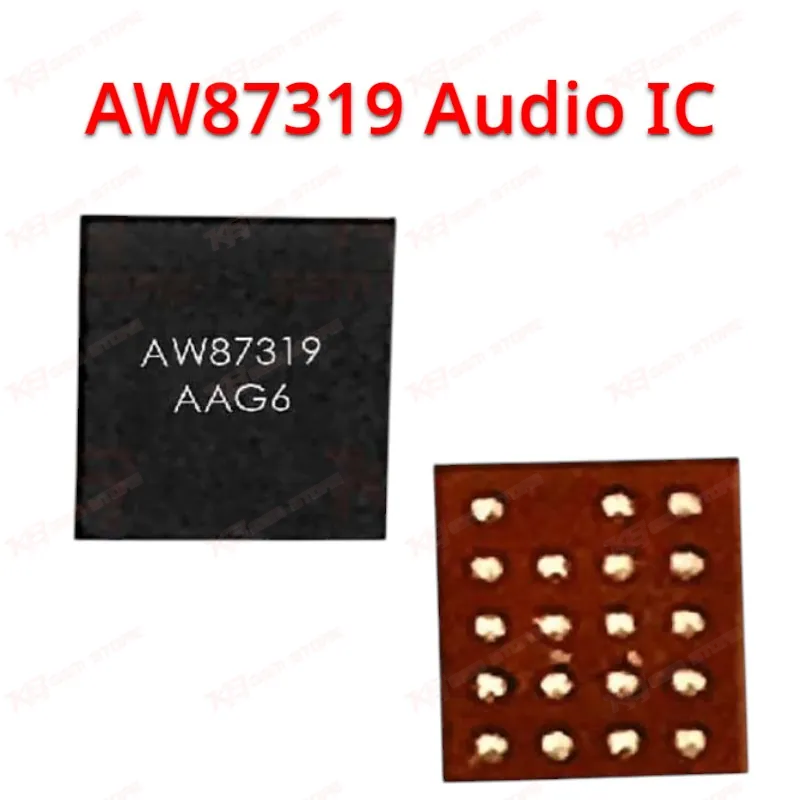
AW87319 Audio IC

AW87319 Audio IC

Regular price Rs.220.00 PKR
Regular price Sale price Rs.220.00 PKR
Sale Sold out
Shipping calculated at checkout.
Quantity

The AW87319 audio IC works as the Class D K-amplifier chip fitted on Xiaomi Redmi 4A, Redmi Note 4, and Redmi Note 4X motherboards. Awinic builds this CSP-19 chip around a synchronous boost stage that pushes output power to 4.1W at 8Ω, so the phone keeps loud, clear audio even when battery voltage drops during use. You reach for this IC when a customer's device shows no sound, low volume, distorted speaker, or a dead speaker after a fall or water damage. Stock genuine AW87319 units on your repair bench and close audio-related jobs without swapping guesswork parts.

⚖️ Weight: 0.01 kg

SKU:MST-IC-273

  • Safe & Secure Payment
  • Fast Delivery
  • WhatsApp Support
View full details

Description

Every GSM technician runs into the "no sound" or "low volume" complaint on Xiaomi boards, and most of the time the AW87319 audio IC sits at the root of it. Awinic designed this chip as a K-class Class D power amplifier, meaning it drives the speaker with a high-voltage synchronous boost stage instead of pulling straight from the battery rail. That boost stage runs at up to 84% efficiency, which keeps the output steady at 4.1W into an 8Ω speaker and 4.6W into 6Ω, even as the lithium battery voltage sags between 3.3V and 4.35V during a call or a game session.The chip carries Awinic's Triple-Level Triple-Rate AGC algorithm, a feature that boosts bass response and expands dynamic range while it protects the speaker coil from over-excursion at high volume. On the technician side, this shows up as fewer "buzzing speaker" complaints coming back after a repair, because the AGC clamps output before the coil gets stressed. Noise floor sits at 47μV with a 102dB signal-to-noise ratio and 0.015% THD+N, so the audio stays clean instead of muddy or crackly once you swap the chip in.AW87319 ships in a CSP-19 package measuring 2.76mm × 2.36mm, small enough that reballing needs a steady hand, flux, and the right stencil size. The chip talks to the main audio codec over I2C, and the board firmware controls boost output voltage, Class D gain, and AGC parameters through internal registers, so a straight IC swap without a matching firmware or EEPROM mismatch restores function on a working donor board. On Redmi 4A, Redmi Note 4, and Redmi Note 4X boards, this chip sits close to the speaker connector, and a short trace run helps keep GSM 217Hz interference out of the audio path — worth checking if the replaced chip still picks up noise during a call.Dead phone boards after liquid contact often show a shorted AW87319 pulling the whole audio rail low, and a jumper lagana fix without replacing the burnt IC rarely holds. Common bench scenarios include: complete dead speaker with the display and touch still working, one-sided audio where receiver works but loud speaker stays silent (or the reverse), speaker output that plays at a fixed low volume regardless of the volume rocker, and a hang on logo or bootloop board where diagnostics later trace back to a shorted amplifier pulling down PMIC output. Before you order a replacement, check chipset markings against the board — counterfeit stock circulating in the market carries the same top marking without matching internal specs, and that mismatch shows up as a repeat comeback within days.Handle this IC with standard BGA reballing practice: preheat the board, control hot air temperature to avoid lifting neighboring components, and confirm ball alignment under a microscope before reflow. A software marna step alone will not fix a physically shorted or cracked chip — this component needs a hardware swap. Once reballed and reflowed, test speaker output at low, medium, and full volume before you close the board back up, since a cold joint on a 19-ball CSP package can pass a quick beep test and still fail under load later.KB GSM Store stocks genuine AW87319 units sourced for accuracy against the original chip markings, so your repair shop gets consistent results job after job instead of chasing comeback repairs from mismatched stock.

Key Features

Class D synchronous boost stage rated up to 84% efficiency

Constant output power across the full lithium battery voltage range

Triple-Level Triple-Rate AGC protects the speaker coil at high volume

4.1W output at 8Ω and 4.6W at 6Ω speaker load

102dB SNR with 0.015% THD+N for clean audio output

Compact CSP-19 package fits factory footprint without board mods

I2C register control for boost voltage, gain, and AGC settings

Built-in over-current, over-temperature, and short-circuit protection

Specifications

Brand Entity Awinic (Shanghai Awinic Technology Co., Ltd.)
Product Entity AW87319 Audio Amplifier IC
Technology Entity Class D Synchronous Boost, I2C, Triple-Level Triple-Rate AGC
Compatible Device Entities Xiaomi Redmi 4A, Redmi Note 4, Redmi Note 4X
Repair Process Entity BGA Reballing, Audio IC Replacement, Board-Level Diagnostics
Industry Entity Mobile Phone Repair, GSM Technician Tools, PCB Repair

Compatible Devices

Xiaomi Redmi 4A, Redmi Note 4, Redmi Note 4X

Common Repair Uses

Dead speaker or no-sound repair, low-volume or distorted audio fix, one-sided speaker/receiver fault, audio IC change after liquid damage, BGA reballing of the amplifier chip, board-level diagnostics for audio-rail shorts

FAQ

What is the product name?
The product name is AW87319 Audio IC.
What is the brand of this product?
The brand of this product is Awinic.
What is the model of this product?
The model of this product is AW87319 (AW87319CSR).
What is this product used for?
This product is used for replacing a faulty or shorted audio amplifier chip that causes no-sound, low-volume, or distorted speaker faults on Xiaomi Redmi boards.
Which devices are compatible with this product?
This product is compatible with Xiaomi Redmi 4A, Redmi Note 4, and Redmi Note 4X.
Who should use this product?
This product is suitable for mobile repair technicians, repair shops, service centers, and professional users.
Does the AW87319 support both speaker and receiver output on the same board?
Yes, the chip supports a 2-in-1 speaker and receiver configuration without extra hardware changes, switched through its internal register settings.
What causes an AW87319 to short out after water damage, and can a jumper fix it?
Liquid contact commonly shorts the boost stage or pulls the I2C line low, and a jumper alone will not restore function — the board needs a full chip reball or replacement to fix the fault.

Ask any Query