


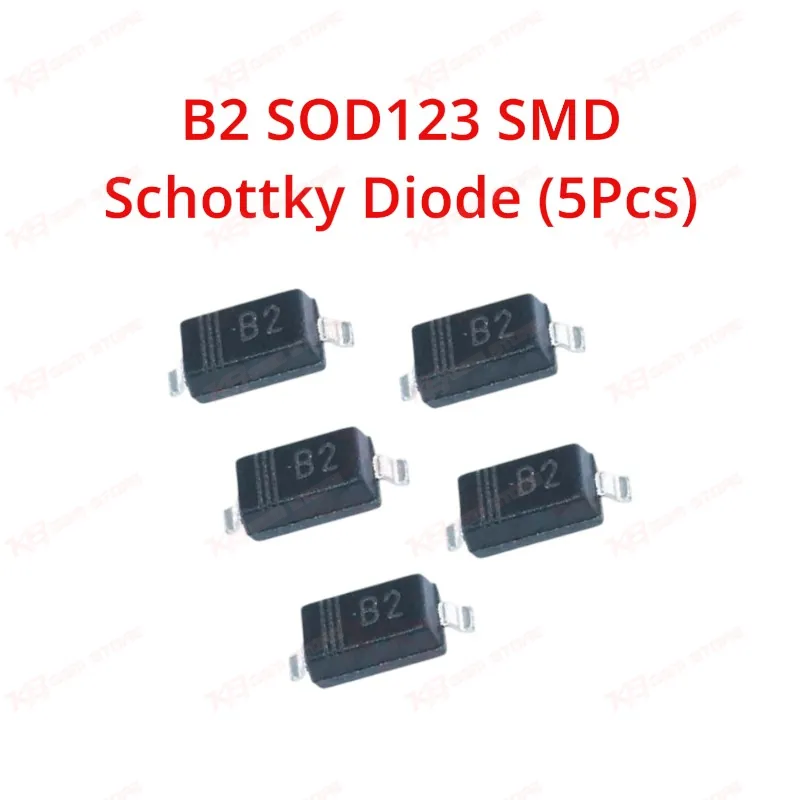
B2 SOD123 SMD Schottky Diode (5Pcs)
B2 SOD123 SMD Schottky Diode (5Pcs)
Regular price
Rs.150.00 PKR
Regular price
Sale price
Rs.150.00 PKR
Shipping calculated at checkout.
Quantity
Couldn't load pickup availability
The B2 SOD123 is a surface mount Schottky power rectifier diode built on the onsemi MBR0520LT1G die, identified on PCBs by its "B2" marking code. Rated for 20V reverse voltage and 500mA average forward current with a low 385mV forward voltage drop, it switches fast and runs cool on charging lines, protection circuits, and power management sections. Housed in a compact 2-pin SOD-123 package, it suits board-level mobile repair work where space on the PCB is tight. This pack gives you 5 pieces of the diode, ready for your repair bench when you find a shorted or open B2 diode during dead phone or charging issue diagnosis.
⚖️ Weight: 0.01 kg
SKU:MST-IC-263
- Safe & Secure Payment
- Fast Delivery
- WhatsApp Support


Description
FAQ
What is the product name?
The product name is B2 SOD123 SMD Schottky Diode (5Pcs).
What is the brand of this product?
The brand of this product is onsemi (ON Semiconductor).
What is the model of this product?
The model is MBR0520LT1G, also marketed as MBR0520T1G.
What is this product used for?
This diode is used for board-level repair on charging lines, battery protection circuits, and power management rails in mobile phones.
Which devices are compatible with this product?
This diode is universal and not device-specific — it fits any mobile board carrying a B2-marked SOD-123 Schottky diode, found across brands including Samsung, Oppo, Vivo, Infinix, and Tecno.
Who should use this product?
This product is suitable for mobile repair technicians, repair shops, service centers, and professional users.
How do I identify a B2 diode on a mobile PCB before replacing it?
Look for a two-pin SOD-123 component marked "B2" near the charging port, USB line, or battery protection area, then confirm with a multimeter in diode mode — a shorted or open reading confirms it needs replacement.
Can this diode handle the current on a fast charging line?
Yes, its 500mA average forward current and 5.5A surge rating cover typical fast charging and protection line loads found on modern mobile boards.