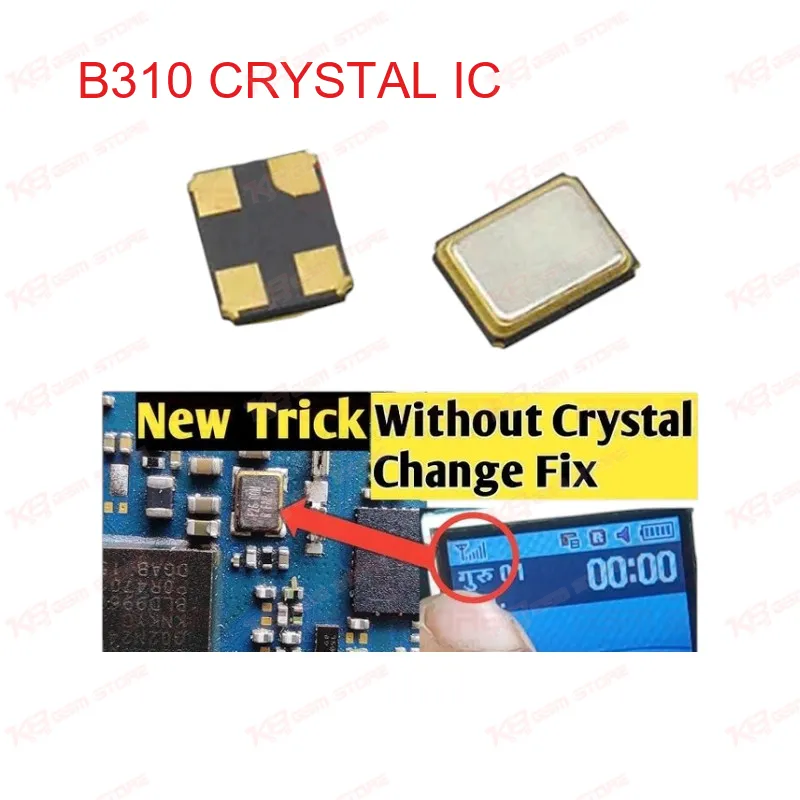
Network dropouts on Samsung keypad phones almost always trace back to a handful of components sitting near the antenna matching network on the motherboard, and the crystal IC marketed in the repair trade as the B310 Crystal IC is one of the most frequent culprits. When a customer walks in with "no service," "SIM not detected," or a phone that keeps searching for network without locking on, your first diagnostic step after ruling out the SIM tray and antenna connector is checking this crystal. A cracked solder joint, moisture damage, or a dead crystal here breaks the reference clock the baseband section needs to lock onto the carrier signal, and no software flash or IMEI repair fixes that — only a physical swap does. This component is sold under several closely related part markings across suppliers — D267, D267K, D267F, D267H, and sometimes D261C or D261A — all functioning as the same network crystal IC and all carrying the trade name "B310 Crystal IC" because of how commonly technicians associate the part with Samsung B310 network repairs. You will find it in both black and silver package finishes depending on the production batch; both variants perform the same job on the board, so match the footprint and pad layout on your target device rather than the color alone when sourcing a replacement. On your repair bench, this crystal fits into a straightforward diagnostic-and-swap workflow. After confirming the SIM reads properly on another handset and the antenna flex or connector tests good, isolate the network fault to the board's RF front end. Use hot air at a controlled temperature to lift the faulty crystal without disturbing neighboring passives, clean the pads with flux and braid, then reflow this replacement using a fine-tip iron or a hot air nozzle sized for small SMD packages. A microscope or a strong loupe helps confirm alignment before reflow, since a misaligned crystal will either fail to make contact or bridge to an adjacent pad and cause a fresh short. This crystal IC is compatible with the Samsung keypad and feature phone lineup where B310-family components are documented, including the B310, B310E, B110, E1200, E1200Y, T1200, B100, and B313 models. Confirm the exact board layout on your target unit before soldering, since Samsung reused similar RF sections across several keypad generations, and always test SIM registration on a live network after the swap rather than relying on a bench-side continuity check alone. Keeping a small stock of this crystal on your bench pays off quickly given how often "dead network" complaints show up on secondhand Samsung keypad phones still circulating in local markets. Instead of turning away a customer or scavenging a donor board for a single component, you can complete the repair in one sitting with a tested, ready-to-solder part. Pair it with a decent flux, a fine desoldering wick, and a hot air station capable of low, controlled airflow, and this becomes one of the fastest, most predictable fixes in your keypad-phone repair queue.