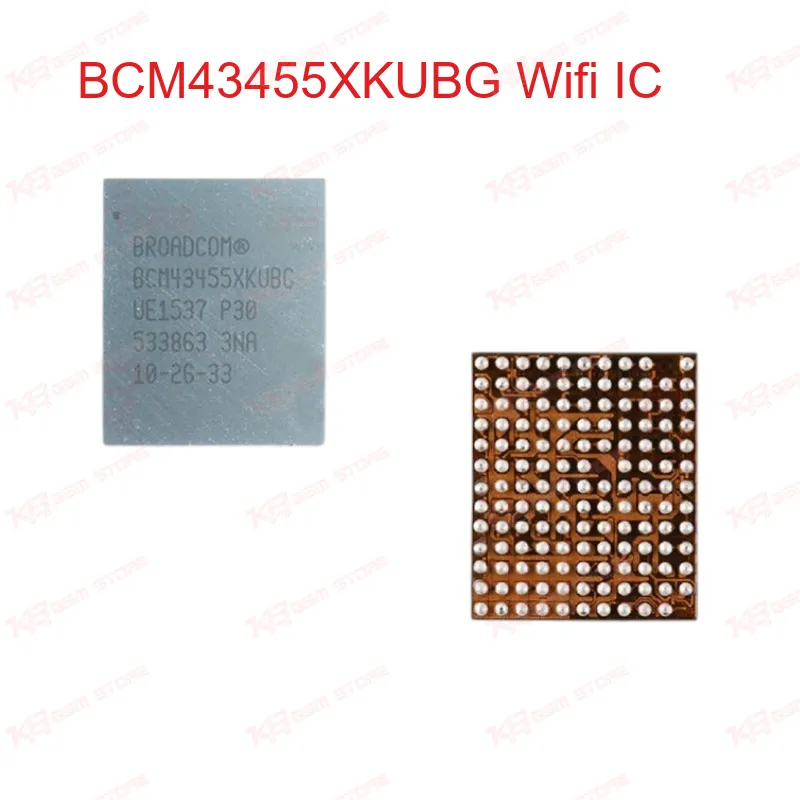
The BCM43455XKUBG is a combo wireless IC from Broadcom's 43455 series, designed to handle WiFi and Bluetooth radio functions on a single die for smartphones, tablets, and other handheld devices. On your repair bench, this chip is one of the most frequently swapped ICs when a phone shows no WiFi networks, WiFi that connects but drops constantly, or a complete wireless module failure after a board-level fault. Architecturally, the chip integrates a single-stream IEEE 802.11ac MAC, baseband processor, and RF radio in one package. It supports 802.11n and 802.11ac operation, running MCS0 through MCS9 rate sets with up to 256-QAM modulation across 20 MHz, 40 MHz, and 80 MHz channel widths. This gives it a maximum PHY data rate of 433.3 Mbps, along with full backward compatibility for 802.11a/b/g/n rates, so it negotiates cleanly with older and newer routers alike. Bluetooth functionality is combined on the same silicon, meaning a single IC failure often takes down both WiFi and Bluetooth on the affected device simultaneously — a useful diagnostic clue when a customer reports both radios missing at once. For Pakistani repair shops, this IC shows up most often on Sony Xperia Z5 Compact / Z5 mini boards and several Huawei models including the Mate 8, Mate 9, P9, Honor 8, and V8. Since Broadcom uses the same part number across compatible board designs, a verified-genuine BCM43455XKUBG pulled from a donor board or purchased new can be used as a direct swap on any board footprint that calls for this exact part number — always confirm against the schematic or board silkscreen before reflow. Typical fault symptoms that lead technicians to this IC include: WiFi option missing from the settings menu entirely, WiFi turning on but never finding networks, WiFi connecting to a network but immediately dropping the connection, or WiFi and Bluetooth failing together after the phone has been dropped, exposed to moisture, or shows signs of a shorted power rail near the wireless module. Before condemning the IC itself, check the RF trace continuity, inspect for corrosion or cracked solder joints under the chip using a microscope, and verify that supply voltages reaching the IC are within spec — a starved or shorted power rail can mimic IC failure without the chip itself being faulty. Replacement requires hot air rework equipment capable of controlled, even heating, a stencil matched to the BGA footprint, and either fresh solder balls or a reballing setup if you're reusing a donor chip. Preheat the board evenly, use flux generously around the pads, and avoid overheating adjacent components since WiFi ICs typically sit close to other RF-sensitive parts on the board. After reflow, always test WiFi scanning and Bluetooth pairing before closing up the device, since a cold joint or misaligned ball can produce an intermittent fault that only shows up under load. KB GSM Store supplies genuine, verified BCM43455XKUBG units suited for board-level mobile repair work across Lahore, Karachi, and Islamabad workshops. Stock is checked before dispatch to reduce the chance of a bad chip going onto your bench and wasting rework time.