


BN35 Charging iC
BN35 Charging iC
Regular price
Rs.300.00 PKR
Regular price
Sale price
Rs.300.00 PKR
Shipping calculated at checkout.
Quantity
Couldn't load pickup availability
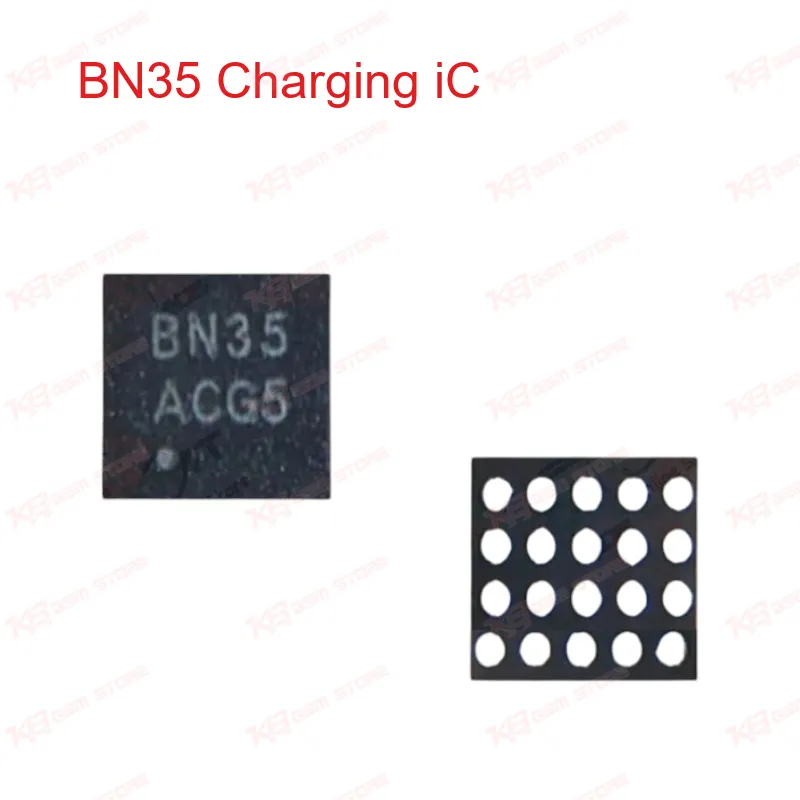
The BN35 Charging IC, marked AW32257FCR on the chip, handles USB charging and power distribution in budget Android phones from Tecno and Infinix. When a phone won't detect the charger, charges slowly, or refuses to turn on after a short circuit, this IC is usually the first component you check on the charging line. Housed in a compact QFN-20L package, it fits directly onto the original pads with no board modification needed. Techs stock this one because charging IC failure is one of the most common faults walking through the shop door — especially on Infinix Smart and Tecno Spark series boards.
⚖️ Weight: 0.01 kg
SKU:MST-IC-382
- Safe & Secure Payment
- Fast Delivery
- WhatsApp Support


Description
FAQ
What is the product name?
The product name is BN35 Charging IC.
What is the brand of this product?
This IC is marked BN35 on top and built on the AW32257FCR die.
What is the model of this product?
The model is BN35, part number AW32257FCR.
What is this product used for?
It manages USB charging, power regulation, and overvoltage protection on the phone's charging circuit.
Which devices are compatible with this product?
It fits Tecno Spark Go 2024 and other Spark series models, plus Infinix Smart 6 (X6511/X6511B/X6511E), Smart 7, and Smart 8.
Who should use this product?
This product is suitable for mobile repair technicians, repair shops, service centers, and professional users.
Does this IC fix a phone that won't detect the charger?
Yes, charger-not-detected is one of the most common faults traced back to a faulty BN35 IC on these boards.
What package type is the BN35 IC, and what tools do I need to install it?
It comes in a QFN-20L package, so a hot air station with a fine nozzle and a matching stencil gives more reliable results than a straight iron.