


BQ24157A Charging IC
BQ24157A Charging IC
Regular price
Rs.180.00 PKR
Regular price
Sale price
Rs.180.00 PKR
Shipping calculated at checkout.
Quantity
Couldn't load pickup availability
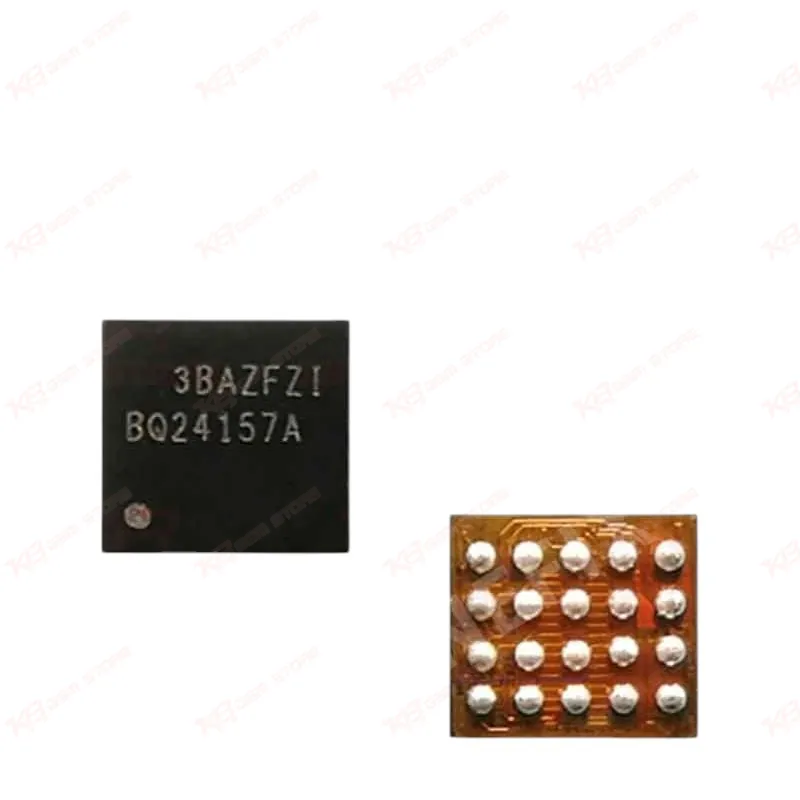
The BQ24157A is a Texas Instruments single-cell Li-Ion/Li-Polymer switch-mode charging IC built for smartphone charging circuits. It handles input current sensing, charge voltage regulation, and charge termination through an I2C interface, supporting charge currents up to 1.55A. Technicians use this IC to fix dead phone and charging issue faults where the board shows no charging, battery not detected, or random shutdown after a charging attempt. It comes in a compact 20-pin WCSP package, making it a direct-fit replacement part for board-level charging IC repair work on your repair bench.
⚖️ Weight: 0.01 kg
SKU:MST-IC-66
- Safe & Secure Payment
- Fast Delivery
- WhatsApp Support


Description
FAQ
What is the product name?
The product name is BQ24157A Charging IC. What is the brand of this product?
What is the model of this product?
The model of this product is BQ24157A.
What is this product used for?
This product manages single-cell Li-Ion/Li-Polymer battery charging on smartphone boards, controlling charge current, charge voltage, and charge termination through an I2C interface.
Which devices are compatible with this product?
This IC belongs to the BQ2415x charger family used on Samsung Galaxy series boards such as GT-i9050 and GT-i8250; confirm exact IC placement against your specific board schematic before replacement.
Who should use this product?
This product is suitable for mobile repair technicians, repair shops, service centers, and professional users.
Does the BQ24157A support USB OTG output?
Yes, it supports boost mode operation for USB OTG, generating a 5.05V VBUS output by boosting the battery voltage.
What charge current does the BQ24157A support?
It supports charge current regulation up to 1.55A with ±5% current regulation accuracy.