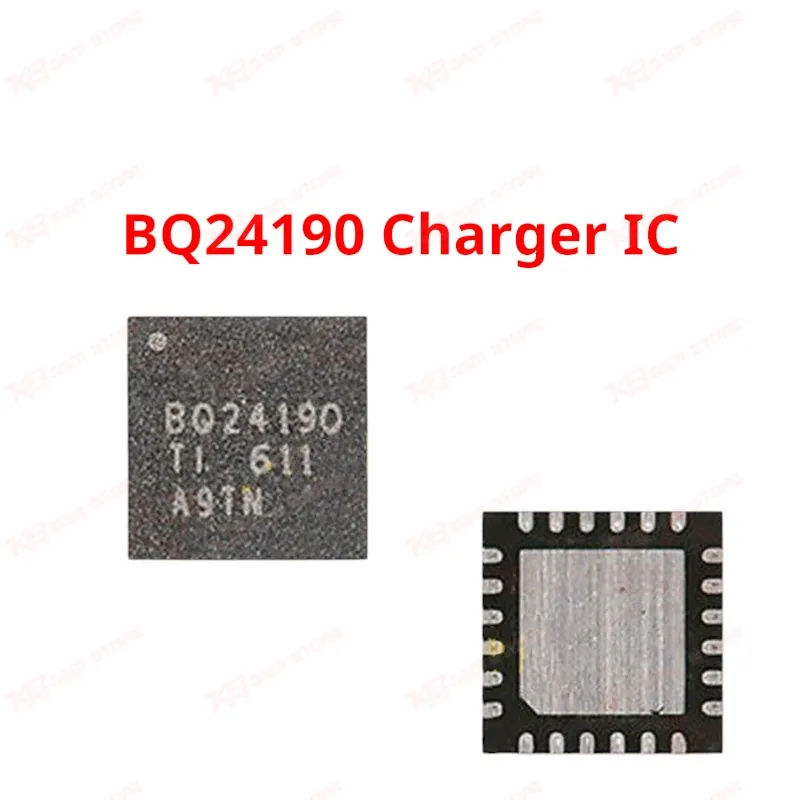
When a tablet or phone comes into your shop with a charging issue that survives a battery swap and a port change, the fault usually sits on the charger IC itself. The BQ24190 is exactly that component — a highly integrated switch-mode battery charge management and system power path device from Texas Instruments, built for single cell Li-Ion and Li-polymer batteries in tablets, smartphones, and similar portable devices.You get a 4.5A switch mode charger with up to 92% charge efficiency at 2A and 90% at 4A, so heat stays manageable even on a board running full charge current. The IC accepts input voltage from 3.9V to 17V, which means it handles everything from a basic USB port to a full-power DC adapter without extra circuitry. Input current limit steps run from 100mA up to 3A, giving the host device room to negotiate power depending on whether it detects a USB host or a dedicated charging port.The BQ24190 uses D+/D– detection to identify the charging source automatically, following USB Battery Charging Spec 1.2. This is the same detection logic responsible for a phone recognizing whether it's plugged into a laptop USB port or a wall adapter — when this detection breaks down, you see slow charging or charging that won't start at all, even with a good cable and good port. Narrow VDC (NVDC) power path management is the other core function on this IC. It regulates system voltage above the minimum threshold even with a fully depleted or completely removed battery, which is why devices with this IC can power on and boot with no battery installed, as long as the charger itself is functional. If your bench test shows the board dead even on direct DC input with no battery connected, the BQ24190 is one of the first parts to check.On the safety side, the IC integrates battery temperature sensing through dual TS pins, a charging safety timer, thermal regulation that kicks in above 120°C, and input overvoltage protection rated up to 18V. It also runs USB OTG boost mode, outputting 5V at up to 1.3A so the host device can power peripherals over the same USB line. All of this runs through a 6BH I2C address for register-level charging control, though the chip also runs autonomously in default mode without host involvement — useful during isolation testing when you want to power a board without full firmware communication.Physically, the BQ24190 ships in a 24-pin VQFN package measuring 4.00mm x 4.00mm with a max height of 1mm and an exposed thermal pad underneath. That thermal pad needs to sit flush against the board ground plane for proper heat dissipation, so when you're doing IC change on this part, make sure your hot air profile and paste application account for that pad — poor thermal pad contact is one of the most common causes of a reflash that looks fine on the meter but fails under real charging load.For diagnosis, check VBUS voltage at the IC input first, confirm continuity on PMID and SW nodes, and test the REGN LDO output before condemning the chip outright. A board that pulls current but never ramps up SYS voltage, or one that gets warm at the IC location during a charging attempt, points straight back to this part. Once you've confirmed the fault sits on the charger IC and not the connector or battery, swapping in a verified BQ24190 restores normal charging behavior, power path switching, and OTG output on the affected board.