


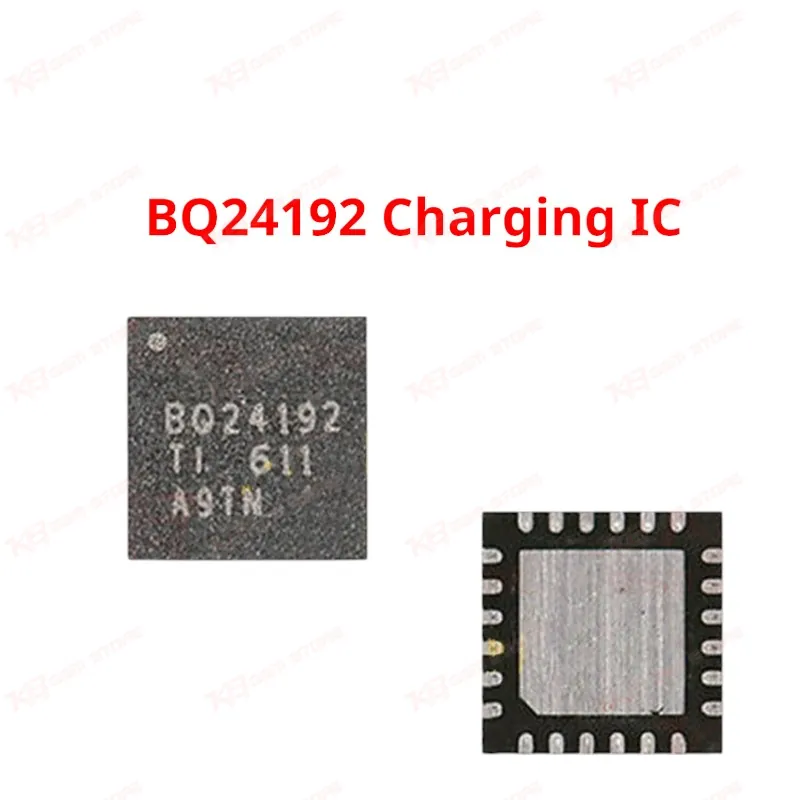
BQ24192 Charging IC
BQ24192 Charging IC
Regular price
Rs.280.00 PKR
Regular price
Sale price
Rs.280.00 PKR
Shipping calculated at checkout.
Quantity
Couldn't load pickup availability
The BQ24192 is a Texas Instruments I2C-controlled charging IC built for single-cell Li-Ion and Li-Polymer battery management in smartphones and tablets. It handles up to 4.5A switch-mode charging with narrow VDC power path management, so your bench gets a stable, hardware-verified replacement for dead charging, no charging, or slow charging faults. Genuine spec, tested for board-level GSM repair work across Lahore, Karachi, and Islamabad service centers.
⚖️ Weight: 0.01 kg
SKU:MST-IC-111
- Safe & Secure Payment
- Fast Delivery
- WhatsApp Support


Description
FAQ
What is the product name?
The product name is BQ24192 Charging IC.
What is the brand of this product?
The brand of this product is Texas Instruments.
What is the model of this product?
The model of this product is BQ24192.
What is this product used for?
This product is used for single-cell Li-Ion and Li-Polymer battery charge management and power path control on mobile phone and tablet boards.
Which devices are compatible with this product?
This IC has verified use in Huawei P6, Huawei P7, Lenovo K900, Infinix X551, and Google Nexus 5, alongside general compatibility with other boards built on the BQ2419x charging architecture.
Who should use this product?
This product is suitable for mobile repair technicians, repair shops, service centers, and professional users.
Does this IC support USB OTG mode?
Yes, the BQ24192 supports USB OTG with a 5V VBUS output at up to 1.3A current.
What is the maximum charging current this IC can deliver?
The BQ24192 delivers up to 4.5A in switch-mode charging, with a default charge current setting of 2A.