Skip to product information
1 of 4

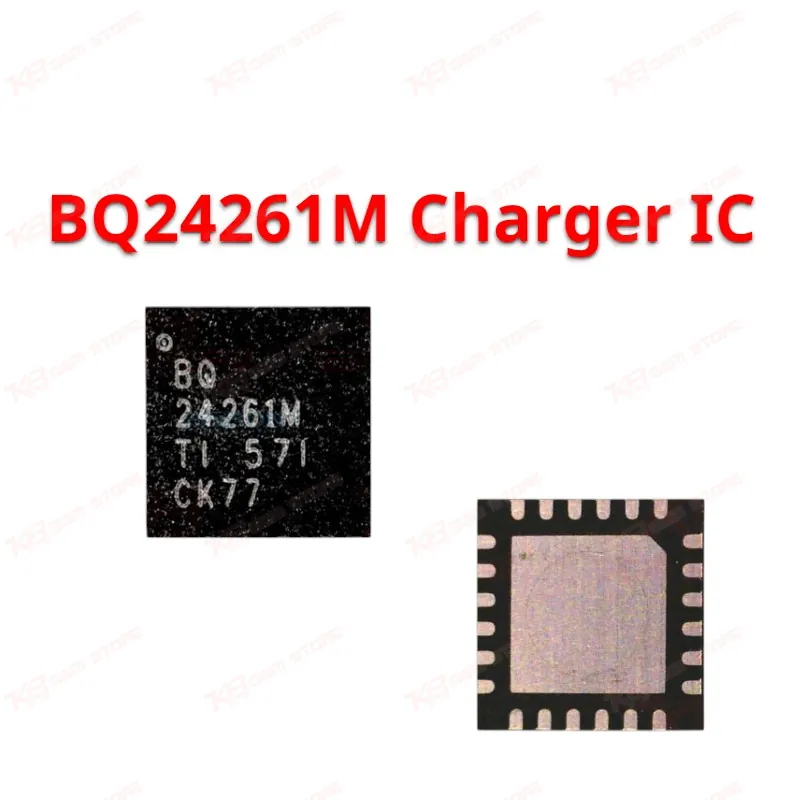
BQ24261M Charger IC

BQ24261M Charger IC

Regular price Rs.250.00 PKR
Regular price Sale price Rs.250.00 PKR
Sale Sold out
Shipping calculated at checkout.
Quantity

The BQ24261M is a Texas Instruments switch-mode Li-Ion battery charger IC built for single-cell power-path management. It delivers up to 3A charge current at 93% peak efficiency, handles a 30V input rating with overvoltage protection, and supports USB-OTG boost output at 5V/1A. Technicians use this IC for charging circuit repair, dead-after-flash charging faults, and no-charging board issues on Li-Ion powered devices. The chip ships in a 24-pin VQFN or 36-pin DSBGA package, giving repair shops a compact, board-level replacement option for failed charging management ICs.

⚖️ Weight: 0.01 kg

SKU:MST-IC-127

  • Safe & Secure Payment
  • Fast Delivery
  • WhatsApp Support
View full details

Description

The BQ24261M comes from Texas Instruments' bq2426x family, and it handles single-cell Li-Ion charging along with system power-path management in one chip. You'll find this IC doing the charging management work on the PCB — deciding how power flows between the input source, the battery, and the system rail — rather than sitting as a standalone charging block.On your repair bench, this chip becomes relevant the moment a device shows a charging issue that isn't a battery fault or a port fault. The BQ24261M runs its Charge Time Optimizer feature, which adjusts the CC/CV transition point to shave down total charge time compared to older fixed-transition chargers. It pushes up to 3A of charge current through integrated FETs, holding 5% current accuracy and reaching 93% peak efficiency — numbers that matter when you're diagnosing a slow-charge complaint versus an actual IC failure.Power-path management is the core of what makes this chip different from a basic linear charger. It carries an integrated 17-mΩ power-path MOSFET with optional BGATE control, so the connected device can power up instantly from a deeply discharged battery, or even run with no battery installed at all. That's a useful detail when you're bringing back a phone that's been dead for weeks with a battery reading near 0V — a board with this IC can still boot from the adapter while the battery recovers separately.The BQ24261M carries a 30V input rating with overvoltage protection built in, so it tolerates rough adapters and voltage spikes better than lower-rated charging ICs. It supports 5V USB 2.0/3.0 input along with 12V USB Power Delivery input — a spec that separates the "M" variant from the base bq24261. On the output side, it also runs USB-OTG boost mode, supplying 5V at 1A out through the IN pin when the device needs to power an external USB accessory instead of pulling power in.For technicians handling dead phone or dead-after-flash cases, this IC sits right in the charging fault chain. When a board shows no charging response, hangs on the charging logo, or drops into a charging/discharging loop, the BQ24261M is one of the first ICs to check — especially on boards where the charging port and battery both test fine on the multimeter. Jumper work around this IC is common when a pad lifts during reballing, so having a verified replacement on the bench saves a repeat visit.This chip is available in two package options: a 24-pin VQFN (RGE) at roughly 4mm × 4mm, and a 36-pin DSBGA (YFF) at roughly 2.4mm × 2.4mm — the smaller WCSP option built for space-constrained smartphone and tablet boards. Match the package footprint to the original chip before ordering a reballing stencil, since VQFN and DSBGA pads are not interchangeable.
Stock this IC alongside your ISP pinout tools and eMMC programmers if you're running a full-service GSM repair bench — charging faults, boot loops, and dead-after-flash cases often overlap on the same board, and having the right power-path IC on hand keeps your turnaround time down instead of waiting on a supplier order mid-repair.

Key Features

Charge Time Optimizer for faster CC/CV transition charging

Up to 3A charge current with 5% accuracy

93% peak charging efficiency

Integrated 17-mΩ power-path MOSFET with optional BGATE control

Instant startup from a deeply discharged battery or no battery at all

30V input rating with built-in overvoltage protection

USB-OTG boost output at 5V/1A

Supports both 5V USB 2.0/3.0 and 12V USB Power Delivery input

Specifications

Brand Entity Texas Instruments
Product Entity BQ24261M Charger IC
Technology Entity Switch-Mode Power-Path Li-Ion Battery Charging
Compatible Device Entities Smartphones, Tablets, Power Banks (Li-Ion single-cell boards)
Repair Process Entity IC Replacement, Reballing, Charging Circuit Diagnosis
Industry Entity Mobile Repair, PCB Repair, GSM Technician Workflow

Compatible Devices

ingle-cell Li-Ion powered smartphones, tablets, and power banks using this chipset on their charging circuit — board-level compatibility depends on the original device's charging IC placement, not a fixed device list

Common Repair Uses

Charging IC replacement, no-charging fault repair, dead-after-flash charging circuit recovery, IC reballing on lifted or damaged charging pads, power-path fault diagnosis

FAQ

What is the product name?
The product name is BQ24261M Charger IC.
What is the brand of this product?
The brand of this product is Texas Instruments.
What is the model of this product?
The model of this product is BQ24261M.
What is this product used for?
This product manages single-cell Li-Ion battery charging and power-path switching on a device's charging circuit.
Which devices are compatible with this product?
This IC is compatible with single-cell Li-Ion powered smartphones, tablets, and power banks that use this chip on their charging board.
Who should use this product?
This product is suitable for mobile repair technicians, repair shops, service centers, and professional users.
Which package options does the BQ24261M come in?
It's available in a 24-pin VQFN package and a 36-pin DSBGA (WCSP) package, so match your reballing stencil to the original chip footprint.
Can the BQ24261M charge a phone with a fully dead battery?
Yes, its power-path design lets the connected device boot and run from the adapter even with a deeply discharged or disconnected battery.

Ask any Query