Skip to product information
1 of 4

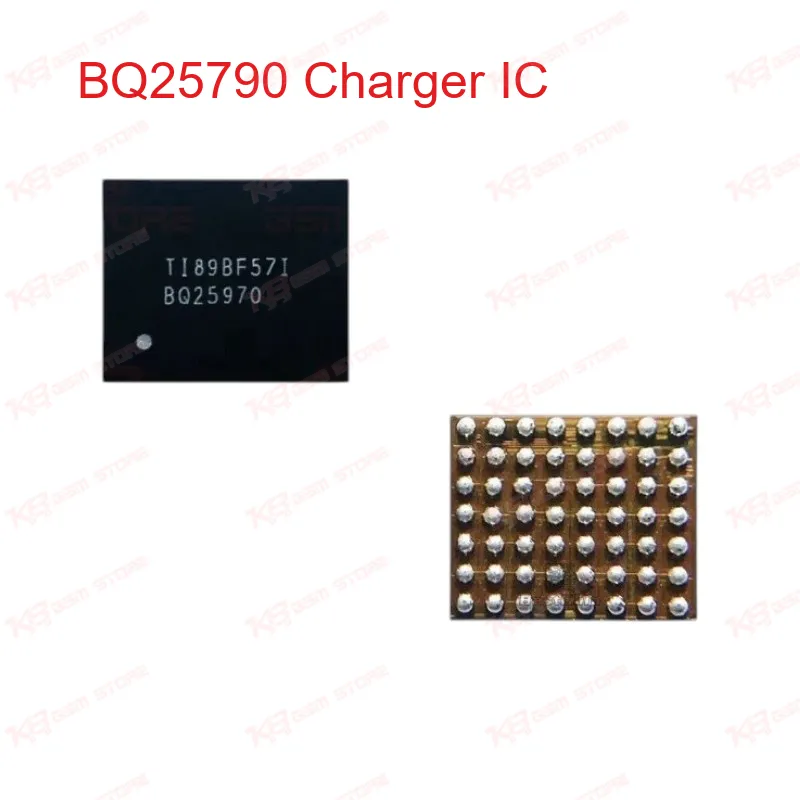
BQ25790 Charger IC

BQ25790 Charger IC

Regular price Rs.550.00 PKR
Regular price Sale price Rs.550.00 PKR
Sale Sold out
Shipping calculated at checkout.
Quantity

The BQ25790 is a 5A I2C-controlled buck-boost battery charger IC from Texas Instruments, built for 1-4 cell Li-ion and Li-Polymer battery systems. It manages the full input voltage range for USB Type-C and USB PD 3.0 applications, covering smartphones, tablets, and other portable devices. The chip packs four switching MOSFETs, a dual-input selector, and MPPT support for solar-input designs into a single 56-pin DSBGA package, giving you one component instead of a scattered charging circuit to troubleshoot. On the repair bench, the BQ25790 shows up in charging port jobs, dead-battery diagnostics, and no-charging faults where the charging controller IC itself needs replacing. Its integrated ADC and JEITA thermal profile support make fault isolation on a live board far more direct than older analog charger designs.

⚖️ Weight: 0.01 kg

SKU:MST-IC-390

  • Safe & Secure Payment
  • Fast Delivery
  • WhatsApp Support
View full details

Description

Charging complaints are one of the most common tickets that land on a technician's bench, and a growing share of them trace back to the buck-boost charger IC rather than the battery or the port. The BQ25790 sits at the center of that circuit in a wide range of USB-C powered devices, and understanding its role helps you separate a genuine IC fault from a connector, cable, or battery problem before you start desoldering anything. Texas Instruments designed the BQ25790 as a fully integrated switch-mode buck-boost charger for 1-4 cell Li-ion and Li-Polymer batteries. Unlike a simple linear charger, it uses four internal switching MOSFETs (Q1 through Q4) along with input and charging current sensing circuits, so it can step voltage up or down depending on what the input supply is delivering versus what the battery pack needs. That buck-boost behavior is what lets a single device charge cleanly whether you plug in a 5V phone charger or a higher-voltage PD adapter — the IC handles the conversion internally instead of relying on external regulation stages. I2C control is central to how this chip works on a real board. The BQ25790 exposes charge current, charge voltage, input current limits, and protection thresholds through I2C registers rather than fixed resistor-set values, which is why boards using this IC often show charging behavior that changes with firmware or software state, not just hardware condition. When you're chasing a charging issue on a board built around this IC, checking whether the fault clears after a software reset or full flash is worth doing before you commit to an IC change karna decision. The dual-input selector and integrated USB OTG output extend what this chip handles beyond plain charging. It can switch between two input sources, supports USB PD 3.0 negotiation directly, and includes MPPT (Maximum Power Point Tracking) logic for designs that pull power from solar or other variable-voltage sources. For rework purposes, the practical takeaway is that a failing BQ25790 can present as several different symptoms depending on which internal block is damaged — a device might still power on and boot but fail to accept charge, or it might reject fast charging and fall back to slow trickle charging over USB. Thermal regulation is built in through JEITA-profile battery temperature monitoring and IC-level thermal protection, along with input overvoltage protection (Input OVP) and input current optimization (ICO). On the bench, this matters because a board that briefly charges and then cuts out under load often points to the IC hitting a thermal or OVP threshold rather than a dead cell — a distinction that changes whether you're looking at rework or a battery swap. The BQ25790 ships in a compact 56-pin DSBGA package (2.9mm x 3.32mm), which puts it firmly in fine-pitch BGA territory. Reballing or replacing this IC calls for a hot air station with tight temperature control, a matching stencil, and a microscope for placement — standard equipment for board-level charging port repair, but not a job for a straight iron-and-flux approach given the ball pitch involved. For technicians stocking charging-circuit ICs alongside programmers, UFS tools, and hot air stations, the BQ25790 is a practical addition for any workshop handling USB-C PD devices where charging faults are a recurring hardware fault category rather than a one-off issue.

Key Features

  • 5A maximum charge current for fast charging support
  • Buck-boost topology handles wide input voltage swings automatically
  • I2C register control for programmable current, voltage, and protection settings
  • Integrated dual-input selector for two-source charging designs
  • Built-in USB PD 3.0 negotiation and USB OTG output
  • JEITA battery temperature profile monitoring for safer charging
  • Input OVP and ICO protection against unstable power sources
  • Compact 56-pin DSBGA package suited for space-constrained boards

Specifications

Brand Entity Texas Instruments
Product Entity BQ25790 Buck-Boost Battery Charger IC
Technology Entity USB PD 3.0, I2C Control, MPPT, Buck-Boost Charging
Compatible Device Entities USB Type-C PD Smartphones and Tablets, 1-4 Cell Li-ion/Li-Polymer Battery Systems
Repair Process Entity Charging Circuit Repair, IC Reballing, Board-Level Rework
Industry Entity Mobile Repair Industry, PCB Repair, Power Management IC Repair

Compatible Devices


Not tied to a specific phone brand or model — this is a circuit-level charging controller IC used in smartphones, tablets, and other portable devices built around 1-4 cell Li-ion/Li-Polymer batteries with USB Type-C PD input. Compatibility scope is chipset/circuit-family level (USB-C PD fast-charging designs), not device-specific.

Common Repair Uses


Charging IC replacement for no-charging and slow-charging faults, board-level charging port repair, dead-battery charging circuit diagnostics, reballing or reflow when the charger IC develops a dry joint or heat damage, and restoring USB PD fast-charging support after IC failure.

FAQ

What is the product name?
The product name is the BQ25790 Buck-Boost Battery Charger IC.
What is the brand of this product?
The brand of this product is Texas Instruments.
What is the model of this product?
The model of this product is BQ25790.
What is this product used for?
This product is used as the main charging controller IC in USB-C PD powered devices, managing buck-boost charging for 1-4 cell Li-ion and Li-Polymer batteries.
Which devices are compatible with this product?
This IC is compatible at the circuit-family level with smartphones, tablets, and portable devices using USB Type-C PD charging with 1-4 cell Li-ion/Li-Polymer batteries, rather than any single phone brand.
Who should use this product?
This product is suitable for mobile repair technicians, repair shops, service centers, and professional board-level repair businesses.
Does the BQ25790 support USB PD fast charging directly?
Yes, the BQ25790 has integrated USB PD 3.0 negotiation along with USB Type-C support, so it manages fast-charging handshakes on-chip without needing a separate PD controller.
What package does the BQ25790 use, and does that affect rework difficulty?
The BQ25790 comes in a 56-pin DSBGA package measuring 2.9mm x 3.32mm, which requires a hot air rework station with precise temperature control and a matching stencil for reballing due to its fine ball pitch.

Ask any Query