


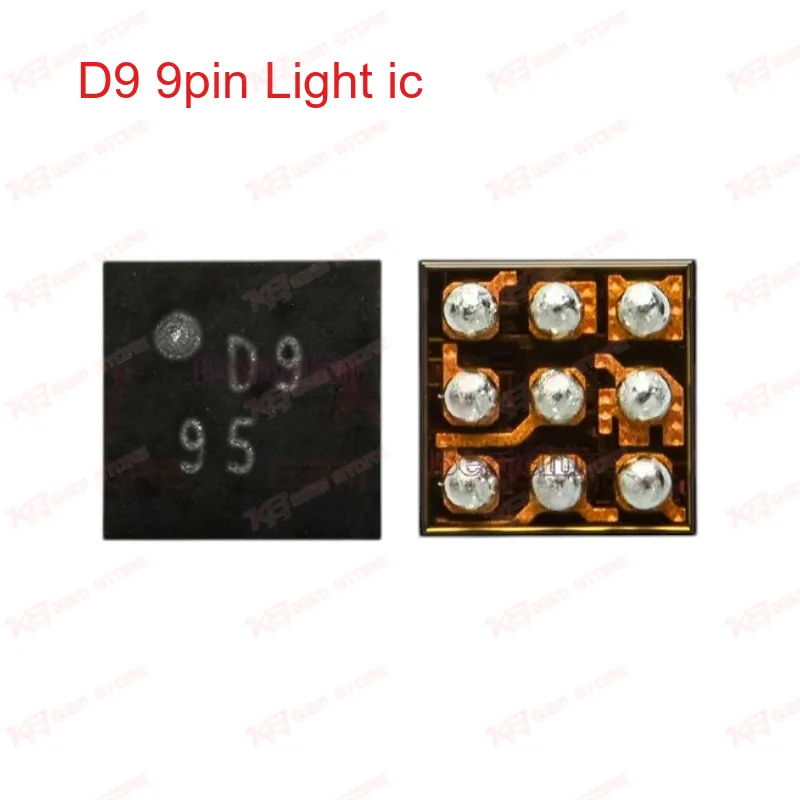
D9 9pin Light ic
D9 9pin Light ic
Regular price
Rs.450.00 PKR
Regular price
Sale price
Rs.450.00 PKR
Shipping calculated at checkout.
Quantity
Couldn't load pickup availability
The D9 9-Pin Light IC is a BGA-packaged backlight control chip used on the iPhone 6 and iPhone 6 Plus logic board at the U1503 position. This IC regulates the boost voltage that drives the LCD backlight LEDs, and it is one of the most commonly replaced components on these boards when a technician sees a display with no backlight, a dim screen, or a display that shows image but stays dark. GSM technicians identify this chip on the board by its "D9" laser marking. It is a direct replacement part for board-level repair work and pairs with standard hot air rework and BGA reballing procedures on your repair bench.
⚖️ Weight: 0.01 kg
SKU:MST-IC-395
- Safe & Secure Payment
- Fast Delivery
- WhatsApp Support


Description
FAQ
What is the product name?
The product name is D9 9-Pin Light IC.
What is the brand of this product?
This is an aftermarket-compatible replacement IC, not an OEM-branded component.
What is the model of this product?
The model is D9 9-Pin Light IC, referenced on the board as U1503.
What is this product used for?
It controls the backlight boost circuit that powers the LCD backlight on iPhone 6-series boards.
Which devices are compatible with this product?
This IC is compatible with iPhone 6 and iPhone 6 Plus logic boards at the U1503 position.
Who should use this product?
This product is suitable for mobile repair technicians, repair shops, service centers, and professional board-repair users.
Does this IC fix a phone with no backlight but a working display image?
Yes, a faulty U1503 backlight IC typically causes exactly this symptom, since the display panel still receives image data but the backlight LEDs are not getting the boosted voltage they need.
Can this IC be reflowed instead of fully replaced?
In some cases a cracked solder joint responds to a reflow, but if the internal die has failed, full replacement with a new D9 chip is required to permanently resolve the fault.